
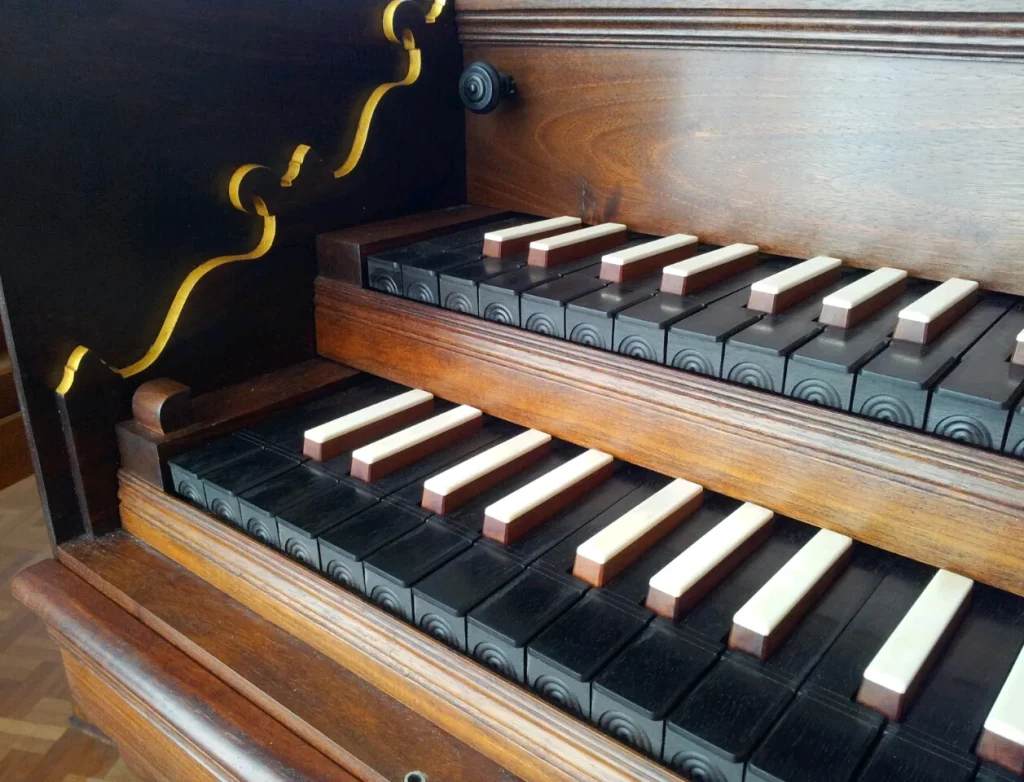
The 1707 French-style harpsichord, made by Jean-Paul Rouaud after Nicolas Dumont, illustrates the richness of Europe’s musical heritage. This article explores the mechanism that creates its distinctive sound.
We will describe every component: plucked strings, the register mechanism and the materials used for the case. You will see how construction and playing techniques shape the timbre.
This guide is intended for musicians and curious readers alike. It explains the construction and the action required to produce the voice of this instrument in simple terms.
By the end, you will have a clear understanding of the mechanism, components and makers’ choices that defined the harpsichord’s sonic identity.
Understanding the basics: how does a harpsichord work?
First appearing in the sixteenth century, the harpsichord reached its height in the seventeenth and eighteenth centuries. This plucked-string instrument produces sound when a plectrum plucks each string as a key on the keyboard is pressed.
Unlike a piano, its mechanism does not strike the string but plucks it. These mechanical differences explain the harpsichord’s quick response and bright timbre. Many composers of the period made use of these qualities in their works.
“The harpsichord remains a model of mechanical refinement and expression, ideally suited to Baroque forms.”
Construction varied by region: France, Italy and the Netherlands produced instruments with different sounds. Understanding the instrument requires studying these developments to appreciate why a particular model suits a specific repertoire.
- Plucked strings versus piano hammers
- An emphasis on clarity and articulation
- Adaptation to the needs of Baroque musicians
| Characteristic | Harpsichord | Piano |
|---|---|---|
| Mechanism | The plectrum plucks the string | The hammer strikes the string |
| Response | Fast, with crisp articulation | Variable, with a wide dynamic range |
| Historical use | Seventeenth–eighteenth centuries, Baroque repertoire | Classical and Romantic periods |
To explore its construction and techniques in greater depth, consult a method devoted to the harpsichord as an instrument. It provides practical guidance for identifying period-specific features.
The instrument’s external structure
Looking at the case reveals the material and ergonomic choices dictated by performance.
Construction materials
The outer structure is made primarily of wood. Oak, maple or walnut provides the rigidity needed to withstand the tension of the strings. The wood also contributes to the tone color.
Internal braces reinforce the case. They prevent deformation over the years and preserve the stability of historical instruments.
Shape and dimensions
The length often ranges from 2 to 2.5 meters, making these instruments centerpieces in drawing rooms and halls. The shape resembles a horizontal harp and reflects centuries of variations in construction.
The placement of the keyboards along the short side, at right angles to the instrument, defines its ergonomics. This arrangement affects the musician’s movements and access to the choirs and registers.
- Woods selected for resonance and strength
- Substantial dimensions suited to the halls of earlier centuries
- A shape designed for projection and playing comfort
The essential role of the resonating case
The resonating case transforms every vibration into a tone color that defines the harpsichord’s identity. It acts as a natural amplifier for the strings and directs the sound into the room.
As a continuo instrument, the harpsichord must produce a precise sound to support the orchestra. The case enables the bass to remain clear, even alongside other instruments.
The shape, crafted in wood, was refined over the centuries to enrich the harmonics. Different construction techniques alter the production and richness of the timbre.
The harpsichordist can vary tone color through touch and the choice of registers, despite being unable to change the volume by striking the keys more forcefully. Sometimes richly decorated, the case also served as a prestigious piece of furniture reflecting social status in the eighteenth century.

To learn more about its history and construction details, consult these instrument histories, which document the diversity of harpsichords and their place in court music.
The plucked-string mechanism
Each string acquires a voice through a mechanism housed beneath the keyboard. This system connects the musician’s gesture to the vibration that produces the timbre.
String tension is adjusted with tuning pins. They stabilize the pitch according to the chosen historical period and temperament.
- The brass or iron strings form choirs that alter pitch and tone color.
- Each string is plucked by a plectrum attached to a jack.
- The entire assembly is installed in the wood of the case to ensure projection and responsiveness.
“The precision of the jack ensures a crisp attack and immediate repetition.”
Unlike the piano, the force applied to the key does not alter the volume. The mechanism favors articulation and clarity.
How the jack works
The jack is the mechanical heart that turns pressure on a key into a precise vibration.
This small piece of hard wood carries the plectrum and the small damper.
Its movement controls the attack and then stops the string.

The role of the plectrum
The plectrum plucks the string as the jack rises.
Traditionally made from quill, it directly influences the resulting timbre.
Today, synthetic or leather plectra often replace quill.
The shape and hardness of the plectrum alter the tone color and projection.
The damper mechanism
The damper is a piece of woolen cloth attached to the jack.
When the key returns to its lowered position, the damper rests on the string and stops its vibration.
The key’s return
Thanks to an ingenious hinge, the jack descends without plucking the string again.
This allows notes to be repeated smoothly and enables great precision at the keyboard.
- Jack: wooden lever that raises the plectrum.
- Plectrum: attacks the string; the choice of material changes the timbre.
- Damper: stops the vibration when the key returns.
| Component | Material | Function | Effect on sound |
|---|---|---|---|
| Jack | Hardwood | Lever and plectrum support | Precision of the attack |
| Plectrum | Quill / synthetic material | Plucks the string | Color and brilliance of the timbre |
| Damper | Woolen cloth | Stops the vibration | Ensures a clean end to the note |
“The jack connects the musician’s gesture to the instrument’s voice through a simple, precise mechanism.”
The soundboard and sound projection
The thin sheet of wood forming the soundboard carries energy from the strings into the case. It transforms each vibration into a wave capable of radiating through the room.
Flemish makers such as the Ruckers perfected this component to improve the projection of their instruments in the eighteenth century. Their expertise remains a benchmark for harpsichord sound production.
The bridge transmits string tension to the vibrating surface. The shape and thickness of the soundboard control the harmonics and the clarity of the playing.
Often decorated with floral motifs, the soundboard combines beauty and acoustics. These decorations recall the harpsichord’s status as both a prestigious instrument and a piece of furniture.

| Parameter | Material | Typical value | Effect on sound production |
|---|---|---|---|
| Thickness | Maple / spruce | 2.5–4 mm | Controls harmonics and sustain |
| Shape | Flat and crowned | Flat or slightly arched | Directional projection |
| Support point (bridge) | Glued hardwood | Variable position | Transmits the tension of the strings |
“The soundboard gives the harpsichord its voice and guides its projection through the room.”
Distinctive features of the keyboard
The keyboard is the direct link between the musician’s gesture and the voice of the instrument. Its design combines ergonomics, appearance and the acoustic requirements of the eighteenth century.
Natural and accidental keys
The keys often have colors reversed from those of the piano. The naturals appear dark, while the accidentals are light. This visual code aids reading and fingering.
The customary range is 4.5 to 5 octaves. Baroque pitch is often set at 415 Hz, suited to historical temperaments and period pieces.
The key fronts sometimes feature carved arcades. These details demonstrate the care devoted to construction and player comfort.
- A fast keyboard response for the complex counterpoint of the eighteenth century.
- Wooden keys, sometimes faced with bone, for a precise touch.
- A design intended for performing major works and supporting the continuo.

“Touch determines the color and subtlety of the interpretation.”
Managing registers and choirs
Choosing a register means choosing a color; the same key can then speak in a different voice.
The registers select string choirs to vary the timbre. At the keyboard, combinations of 8′ or 4′ choirs are activated according to the desired effect.
By combining 8′ and 4′, the harpsichordist obtains a full registration resembling that of an organ. The contrast supports the bass and melodic lines in the music of the period.
The lute stop alters the sound by damping the strings with felt or leather. This small system creates a gentle, almost nasal color useful for varying expression.
- Registers: selection of choirs to obtain varied colors.
- 8′ / 4′ choirs: pitch and density of sound.
- Lute stop: damping and a distinctive timbre.
| Choir | Designation (feet) | Effect on sound |
|---|---|---|
| Principal | 8′ | Full, fundamental sound |
| Octave | 4′ | Clarity and brilliance |
| Lute stop | — | Muted sound, mellow color |
“Flemish harpsichords often incorporate extensive register systems, offering broad expressive possibilities.”
Differences between the harpsichord, spinet and virginal
The internal geometry of the soundboards and strings explains the differences in timbre among these models. All three belong to the same family of plucked-string instruments, but each construction method changes the voice and shape.
String arrangement
Virginal: the strings run parallel to the keyboard. This arrangement creates a rectangular outline and encourages a clear attack.
Spinet: the strings are set at an angle. The frame may be pentagonal or triangular, reducing the effective string length and coloring the sound.
Harpsichord: various arrangements exist, usually longer and designed to promote harmonic richness. Multiple registers and keyboards add further tonal possibilities.
Variations in shape
The shape directly affects string length. The longer the string, the richer and deeper its harmonics.
In the eighteenth century, the harpsichord supplanted the virginal at court and in the orchestra. Its ability to accommodate several keyboards and registers was decisive.
- Parallel strings = rectangular form and direct timbre.
- Angled arrangement = compact format and a more intimate sound.
- Large instrument with long strings = harmonic richness and projection.
“The outline often conceals the most important difference: how the strings are tensioned and oriented.”
To learn more about the technical and historical distinctions among these models, consult the page devoted to the harpsichord, spinet and virginal.
Historical development and celebrated makers
The great instrument-making houses shaped the keyboard’s voice over the centuries. In Antwerp, the Ruckers established technical and aesthetic foundations as early as the seventeenth century.
The oldest surviving instrument dates from 1521. It shows that craftsmanship had already reached a high level in the sixteenth century.
In Paris, the Blanchet family and later Taskin perfected construction during the eighteenth century. Their instruments represent the height of the craft.
The development of the mechanism enabled composers to demand greater nuance and articulation. This progress paved the way for the piano while preserving the charm of early keyboards.
- Renowned makers: Ruckers, Blanchet, Taskin.
- 1521: evidence of an early, accomplished tradition.
- Eighteenth century: the height of harpsichord making and its lasting influence on music.
“The rediscovery of historical instruments in the twentieth century deepened our understanding of early performance.”
The harpsichord in Baroque and Classical music
An instrument of support and color, the harpsichord provided harmonic cohesion in Baroque ensembles.
The basso continuo
Its main role was to provide the basso continuo: the player maintained the bass line and realized the chords for the orchestra and singers.
In operas and concertos, the harpsichord supported melodies and clarified contrapuntal textures.
“The harpsichordist maintained the balance of the works through mastery of the keyboard and registers.”
- Essential for the basso continuo in sonatas and operas.
- François Couperin exploited the sound’s precision and brilliance in his works.
- In the eighteenth century, the piano gradually took its place, but the harpsichord remained central to the Baroque repertoire.
| Function | Context | Musical effect |
|---|---|---|
| Basso continuo | Operas, concertos | Harmonic support, clarity of chords |
| Color | Court pieces and sonatas | Brilliance and articulation |
| Accompaniment | Orchestra, ensembles | Rhythmic and harmonic cohesion |
Harpsichords remain invaluable in Baroque music. Their timbre, based on plucked strings and a responsive mechanism, serves the richness of variation and counterpoint.
For more historical context, consult the reference page about the harpsichord.
The instrument’s twentieth-century revival
Performers and makers revived the instrument in the twentieth century, giving the harpsichord a voice once more. Wanda Landowska played a central role by bringing the early repertoire back to the concert stage.
Modern composers wrote for the instrument and sought new colors. They explored the possibilities of its strings, lute stop and registers to enrich contemporary works.
The mechanism was studied anew to integrate the harpsichord more effectively into orchestras and modern-music ensembles. Adaptations made it easier to combine with the piano and electric keyboards in mixed programs.
Thanks to this renewed interest, harpsichords returned to conservatories and concert halls. Makers revived old woodworking and tuning techniques to restore accurate pitch and string color.
“The twentieth century enabled the harpsichord to bridge the ages and continue speaking to today’s composers.”
Conclusion
Conclusion
Ultimately, this sound-producing mechanism continues to inspire musicians and makers through its refinement and color.
The harpsichord remains a fascinating instrument whose history across the centuries illuminates current practice. This article has shown how its mechanism, registers and command of the basso continuo support Baroque and contemporary music.
Understanding its playing technique and the bass remains essential for performers. Despite the rise of the piano, the harpsichord retains a unique place through its sound and repertoire.
We hope this guide encourages you to explore this instrument’s rich palette further and listen to the music that spans the centuries.