
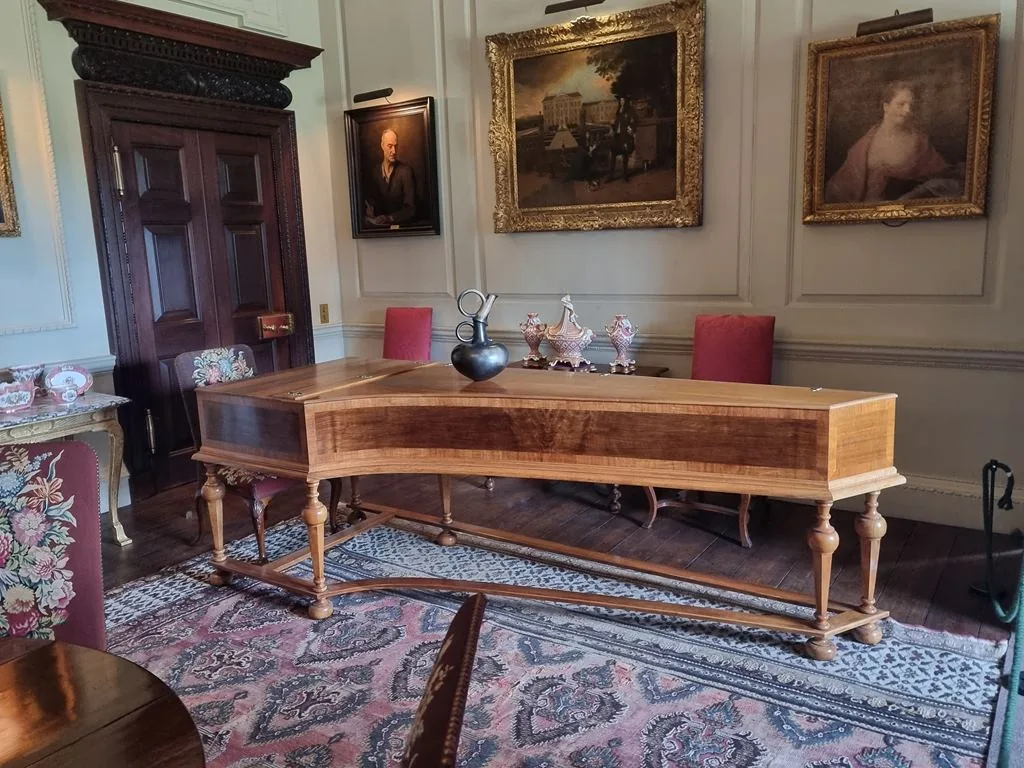
Yes: this instrument is a sonic emblem of the European Baroque period.
Built in the French style by Jean-Paul Rouaud after Nicolas Dumont’s 1707 design, it consists of a wooden case and strings stretched over a soundboard.
The mechanism uses jacks that pluck each string when a key on the keyboard is pressed.
Unlike the piano, the force of the player’s touch does not alter the dynamics; this characteristic gives it a precise, brilliant range of sounds.
Models may have one or more keyboards, making them suitable for complex pieces and harmonic variations.
Rediscovered in the 20th century, the instrument regained its place in conservatories and on stages devoted to early music.
Maintenance: adjusting the plectra and caring for the mechanism ensure accurate tuning and longevity.
Is the harpsichord a plucked-string instrument?
The answer lies in its mechanical action: each note is produced when a plectrum plucks a string.
The jack plays a central role in this mechanism. When a key on the keyboard is pressed, the jack raises a plectrum that plucks the string. The sound is produced immediately and retains a constant dynamic level.
Unlike the piano, in which the strings are struck, instruments such as the spinet and virginal use the same plucked-string principle. This technical difference explains the clarity and rapid attack of their tone.
Each key corresponds to one or more strings, allowing dense polyphony. Mastery requires different techniques because the force used to play does not affect the dynamics.
Conclusion: its mechanism confirms the harpsichord’s place among plucked-string instruments, distinct from struck-string instruments, combining mechanical refinement with keyboard logic.
Origins and definition of the instrument
The harpsichord’s roots lie in the medieval psaltery, which was transformed by the addition of a keyboard. This innovation made polyphonic playing easier and inspired European instrument makers.
Legacy of the psaltery
Originally, the psaltery was a simple string box. Craftspeople introduced keys to organize the notes. The oldest surviving model dates from 1521 and belongs to the Italian school of instrument making.
Historical development
Over several centuries, its form changed, from the spinet to large harpsichords. The wooden structure was reinforced to withstand the tension of the strings.
- 1521: appearance of the earliest Italian models.
- Changes in shape to meet the needs of Baroque composers.
- Improvements in construction to enhance resonance and stability.
Over time, this stringed instrument became central to secular music. Studying old models helps us understand how the keyboard shaped playing technique and sound.
The structure of the resonating case
The case transforms the strings’ vibrations into a recognizable projected sound.
Comparable to a horizontally positioned harp, the case determines the instrument’s shape and volume. Its shape is often straight on the left and curved on the right. This geometry accommodates the length of each string and shapes the tone.
Built of solid wood, the case must withstand the tension. Bottom braces and buttresses reinforce the structure. These construction elements prevent the wood from warping.
With a range of about five octaves, the harpsichord requires a sturdy case. Nevertheless, it remains lighter than a piano case, allowing two people to move it for a concert.
The soundboard is incorporated into the case. It works together with the strings and keyboard to amplify the vibrations produced by the jacks. Every part contributes to the projection and tonal balance of the instrument.
The essential role of the soundboard
The soundboard is a very thin plate of wood that receives the strings’ vibrations. It transforms the mechanical impulse into resonance and determines the color of the sound.
At between 2.2 and 4.2 mm thick, the soundboard demands great precision in its construction. Even a minor adjustment can alter its harmonic richness.
The role of the rose
The rose, which is often elaborately decorated, performs two functions. It adorns the soundboard and modulates the emission of sound, like an organ stop.
Under the soundboard, bracing reinforces the wooden structure. Instrument makers keep these construction methods secret because the bracing affects sustain and tonal color.
- The bridge transmits the sound: it carries the vibration to the soundboard.
- The decoration protects the surface from moisture and extends the material’s lifespan.
- The soundboard balances the frequencies to ensure even projection throughout the case.
In short, without a perfectly designed soundboard, the harpsichord would remain voiceless. Its quality defines the soul of this instrument and the clarity of every note played on the keyboard.
How the jack mechanism works
The secret of its tone lies in the precisely calibrated interaction between the key, jack, and plectrum. This trio turns the action of a finger into an immediate sonic attack.
The role of the plectrum
Formerly made from quill and now often made from plastic or leather, the plectrum plucks the string precisely. Its material influences the warmth and attack of the sound.
The jack in action
The key acts as a lever. It raises the jack, which moves vertically, plucks the string, and then slips past it on the way down.
A small hinged tongue and spring allow it to disengage quickly. The registers make it possible to select different choirs and alternate tone colors to suit each piece.
The damper system
Woolen-cloth dampers rest on the strings when they are not sounding. They stop the vibrations at the desired moment and ensure clarity of articulation.
| Component | Function | Materials |
|---|---|---|
| Plectrum | Plucks the string and defines the attack | Quill (historically), leather, plastic |
| Jack | Transmits movement and releases the string | Hardwood, hinged components |
| Damper | Stops the vibration | Woolen cloth |
| Key | Lever that operates the jack | Wood, sometimes covered |
The strings and their technical arrangement
The arrangement of the strings follows a calculated geometry that compensates for differences in diameter and tension across the soundboard.
The metal wires are made of iron, brass, or copper and run lengthwise. Each string passes over a nut and then a hardwood bridge, which determines its vibrating length and pitch.
Their path across the soundboard often forms an S shape. This arrangement evens out the tension and aligns the harmonics.
Unlike piano strings, harpsichord strings are simply made: they are not wound. This design produces a clean attack and distinctive harmonic richness.
- Metal pins on the nut and bridge provide a precise bearing point.
- Tuning pins adjust the tension and allow the keyboard to be tuned accurately.
- Grouped rows make it possible to vary the choirs and color the registers.
The case must withstand the tension transmitted by the bridge. Without a sturdy structure, the soundboard and projection would lose their balance.

To explore the construction and history of this instrument in greater depth, see this dedicated page.
Managing keyboards and registers
Tuning and combining the keyboards give the player a rich expressive palette, similar to that of an organ but adapted to the harpsichord.
The main keyboard, often supplemented by a second one, activates separate choirs and allows rapid changes of tonal color.
The registers act like switches: rows of jacks can be engaged or disengaged to modify the sound.
Two keyboards can be coupled so that their strings sound together, increasing power and harmonic richness.
The pitch of A3 serves as the reference for tuning all the strings of both keyboards. The range is generally between 4.5 and 5 octaves.
Keys shorter than those of a piano facilitate the rapid playing needed for counterpoint. The lute stop, activated from the upper keyboard, produces a muted, intimate tone.
| Function | Sonic effect | Note |
|---|---|---|
| Keyboard coupling | Doubles the strings for greater power | Used for tuttis and expansive passages |
| Registers | Select rows of jacks | Vary tone and brilliance |
| Lute stop | Muted tone | Ideal for intimate accompaniment |
| Pitch standard | Tuning reference (A3) | 440 Hz in modern practice; 415 or 392 Hz for Baroque music |
To discover remarkable models and examples of craftsmanship, browse this keyboard collection.
Differences between the harpsichord, spinet, and virginal
The geometry of the case and the arrangement of the strings readily explain their sonic differences. Every model in this family uses the same principle but varies in shape and size.
Spinet: usually wing-shaped or pentagonal. Its compact case makes it practical for a sitting room. The strings run diagonally, which changes the attack.
Virginal: a rectangular case with strings parallel to the keyboard. Its voice sounds gentle and direct. It was often the most economical choice.
Harpsichord: larger and sometimes equipped with two keyboards. It offers a wider range and varied choirs. The French tradition developed increasingly complex instruments, whereas Italian construction remained simple.
Over time, the piano ultimately replaced these instruments. Nevertheless, the technical difference between the spinet and harpsichord remains essential to historically informed performance.
“Each form has its own tone and purpose.”
For more about their history and construction, see this specialist resource.
The instrument’s tone and choirs
Its harmonic richness comes from varied choirs that layer pitches and colors. Registers at 8′ and 4′ pitch provide tones resembling those of the harp or organ.
François Couperin used these possibilities to sculpt pieces of great refinement. The soundboard amplifies every impulse and colors the sonic spectrum.
The jack remains central: its leather or plastic plectrum plucks the string precisely. The case and soundboard work together to project a brilliant, articulate sound.
Thanks to its range and two keyboards, choirs and registers can be combined to produce powerful full-registration effects. The key does not change the dynamics through force, but it does permit nuanced phrasing.
Every string, plucked by the mechanism, contributes to the instrument’s acoustic complexity.
| Component | Effect | Note |
|---|---|---|
| Choirs (8′, 4′) | Variation of tone | Similar to organ stops |
| Soundboard | Amplification and color | Major influence on the spectrum |
| Jacks and plectra | Precise attack | Leather or plastic |
| Two keyboards | Combinations and power | Enable full registrations and contrasts |
The harpsichord in Baroque music
Its main function was to provide the basso continuo in the period’s musical landscape. This practice established the harmonic foundation of 17th- and 18th-century sonatas, concertos, and operas.
Domenico Scarlatti fully exploited its potential: more than 500 sonatas showcase the richness of the keyboard and its available registrations.
In ensembles, it often replaced the lute as an accompanying instrument. Its clarity strengthened the bass line and defined the textures within the orchestra.
The forms of pieces—suites, inventions, and sonatas—developed around its capabilities. Makers created models suited to the needs of composers and royal courts.

| Role | Repertoire | Sonic effect |
|---|---|---|
| Basso continuo | Sonatas, operas | Harmonic foundation and clarity |
| Solo | Suites, sonatas | Brilliance and articulation |
| Accompaniment | Concertos, arias | Replaces the lute and provides greater projection |
| Colors | Variations and ornaments | Varied registrations for contrasting tones |
The piano later took its place, but the instrument’s influence on Baroque music remains undiminished. To explore the subject further, read this history of the harpsichord.
Technical comparison with the modern piano
Observing the historical mechanism alongside that of the modern piano shows why their expressive capabilities differ.
Sound production: one plucks the strings, while the other strikes them with hammers. This contrast changes both dynamics and tonal color.
Mechanisms: the former uses jacks and plectra; the latter uses a hammer mechanism and metal frame. The frame allows higher string tension and unmatched power.
From the player’s perspective, the keyboards of both instruments are familiar, but the required techniques differ. The piano responds dynamically to the force of the touch; the harpsichord does not.
| Component | Harpsichord | Modern piano |
|---|---|---|
| Action | Plectrum and jack | Hammer |
| Frame | Lightweight wood | Metal frame |
| Sound | Articulate and rich in harmonics | Rounded and sustained |
Conclusion: comparing these instruments sheds light on the development of instrument making over the centuries and on music’s changing aesthetic choices.
The influence of Italian and Flemish construction
Over the centuries, exchanges among makers combined Italian refinement with Flemish robustness.
The Flemish tradition—represented by names such as Ruckers—strengthened the case and optimized the soundboard to increase power. Choices of wood and bracing construction were intended to improve projection and stability under high tension.
Italian construction was lighter and favored incisive, portable models. These instruments often served as spinets and emphasized a rapid, clear attack.
The position of the jacks, the geometry of the choirs, and the quality of the materials remained hallmarks of each school. Over time, these approaches blended and enriched keyboard design across Europe.
Today, restoration and historical reproductions reveal these traditions. From case to soundboard, every instrument bears witness to a quest for sonic perfection and a balance between power and delicacy.

| School | Characteristic | Sonic impact |
|---|---|---|
| Flemish (Ruckers) | Reinforced case, substantial soundboard | Projection and greater sustain |
| Italian | Light case, lively attack | Clarity and brilliance |
| Mixed (later period) | Combination of practices | Balance between power and delicacy |
The harpsichord’s 20th-century revival
Renewed interest in early music restored the instrument to a central place in conservatories and on concert stages.
In 1889, firms such as Pleyel and Érard attempted to reintroduce models inspired by historical keyboards.
Their approaches combined modern techniques with forms adapted to contemporary tastes.
Wanda Landowska played a decisive role in this revival.
Her advocacy of the early repertoire and public use of faithful reproductions renewed interest in historical sound.
Construction evolved during the 20th century.
Makers incorporated modern materials while respecting the spirit of old models.
Musicians thus regained authentic tones without sacrificing tuning stability.
| Year and figure | Action | Impact |
|---|---|---|
| 1889 — Pleyel, Érard | Reintroduction of historically inspired models | Hybrid approach combining modernity and tradition |
| Early 20th century — Wanda Landowska | Promotion of the repertoire and concert performances | Revival of playing and renewed historical context |
| 20th century | Development of instrument making | Historical reproductions and modern techniques |
Result: audiences and composers rediscovered its range of sounds.
The piano, then dominant, shared the stage with this distinctive and vibrant tone.
For more about the history and stages of this resurgence, read this history of the harpsichord.
The harpsichord’s place in contemporary music
On today’s stages, the instrument’s precise, articulate voice interacts with new textures.
Interest among modern composers: during the century, creators such as Ligeti and Poulenc wrote pieces that exploit its rapid attack and unmistakable color. Their choices demonstrate the continuing creative potential of its tone.
Later, avant-garde works pushed its limits. Contemporary reproductions closely based on historical models encourage bold sonic experimentation.
Some recent uses include:
- contrasting it with the piano to emphasize layers of sound;
- integrating it into mixed ensembles to create timbral effects;
- using solos to explore attacks, silences, and resonances.
In brief: contemporary music proves that the instrument remains alive. Its use in modern ensembles confirms its renewed vitality and opens broad creative possibilities.

To learn more about its history and uses, see this dedicated page.
Conclusion
Its distinctive mechanism continues to inspire musicians and instrument makers, combining Flemish traditions with Italian construction. Its case and soundboard produce a unique tone that is ideal for basso continuo and the works of François Couperin.
Thanks to figures such as Wanda Landowska, the harpsichord regained its place in orchestras and conservatories. Its two keyboards and registrations provide a palette that the modern piano cannot replace.
A living instrument, it interacts with the spinet, lute, and harp and continues to inspire contemporary creation. To continue exploring, read this article about the harpsichord: a forgotten treasure.