
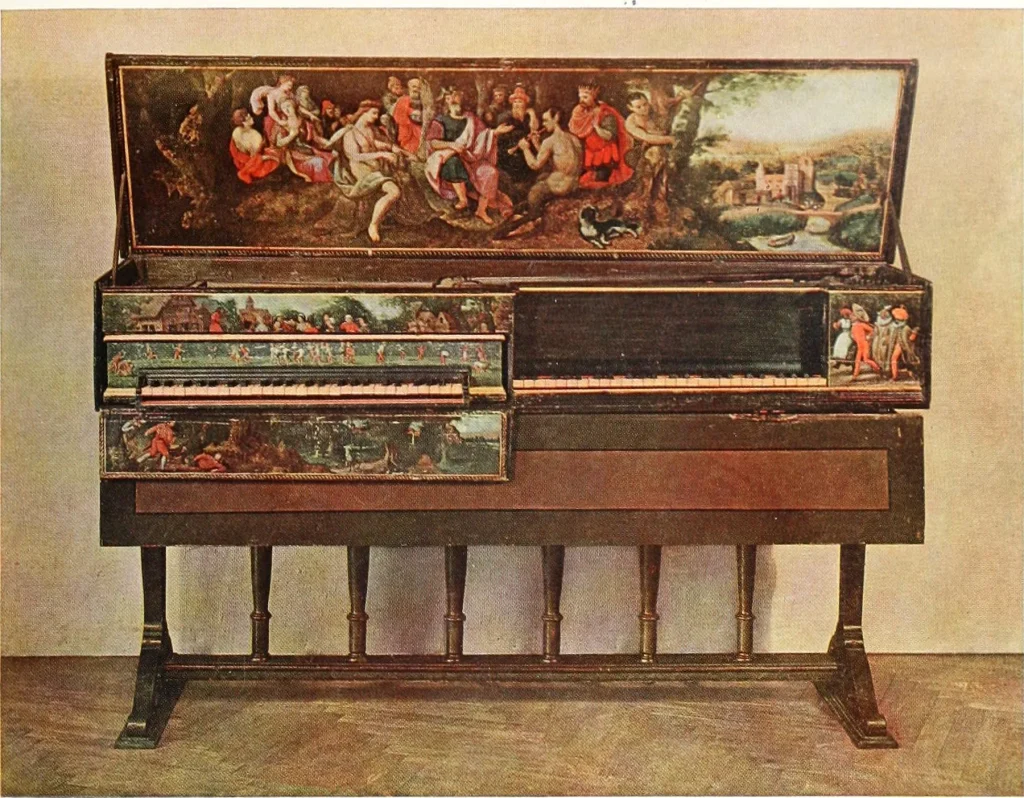
A brief introduction to the origins of the keyboard family. The harpsichord appeared in the 14th century, when a keyboard was added to the psaltery. This mechanical transformation changed both playing technique and sound.
Historical confusion is common. In early texts, the spinet and virginal are sometimes confused with the harpsichord. Yet their layouts and string arrangements differ.
The clavichord does not belong to the same family. Its mechanism strikes the string and produces a more intimate tone. Understanding these distinctions helps us appreciate early music.
This guide explores these historical and technical differences. For a more comprehensive discussion, see a detailed overview of definitions and explanations.
The origins of plucked-string instruments
The transformation of the psaltery into a keyboard instrument marked the birth of a family of plucked-string instruments. From the 14th century onward, Italian craftspeople adapted the small dulcimer by adding a keyboard. The result, known as the clavicymbalum, was the first step toward the harpsichord.
Instrument makers quickly refined the mechanism: plucked strings replaced struck strings, and the keyboard became central to playing. Over the centuries, the instrument became established in chamber music and vocal accompaniment.
- Ancestor: the psaltery, with plucked or struck strings, from which the sound originated.
- Transition: the first clavicymbalums emerged in Italy in the 14th century.
- Golden age: widespread adoption from the late 15th century, followed by its peak in the 17th and 18th centuries.
Unlike the modern piano, the jack mechanism determines the tonal color of each harpsichord. The two instruments share a common lineage that influenced instrument making until the end of the 18th century. For a detailed overview, see this specialist resource.
Small harpsichord: spinet, virginal, or another instrument?
Small plucked-string forms reflect very different instrument-making choices from one region to another.
The Italian spinet uses a 10-degree layout, while the French version has an angle close to 25 degrees. This angle affects the strings’ attack and resonance.
In France, the name spinet was often used for the harpsichord until the 18th century. This usage makes identifying the different models more difficult today.
- Case shape: pentagonal in Italy and wing-shaped in France and England.
- Pointed plectrum: the name derives from it, often causing confusion in early texts.
- String arrangement: specific to each model, it alters the soundboard’s harmonic richness.
| Region | String angle | Shape | Use of the name |
|---|---|---|---|
| 10° | pentagonal | common spinet | |
| France | 25° | wing-shaped | interchangeable name |
| England | variable, flourishing from 1630 onward | bird’s-wing shape | widespread use |
Conclusion: geometry and case shape remain the key features for distinguishing these families. Instrument makers and historians continue to study these variations.
The harpsichord, king of the family
Among early keyboards, this instrument holds a central place thanks to its distinctive mechanism.
The jack mechanism
The jack operates a small plectrum that plucks the string when the key is depressed. The string vibrates freely and is then damped when the key rises. This brief action creates an incisive, rich sound, very different from that of the piano, where the string is struck.
The Ruckers workshop in Antwerp perfected this form of construction in the 17th century. Its harpsichords served as models for centuries and profoundly influenced salon music and composition.
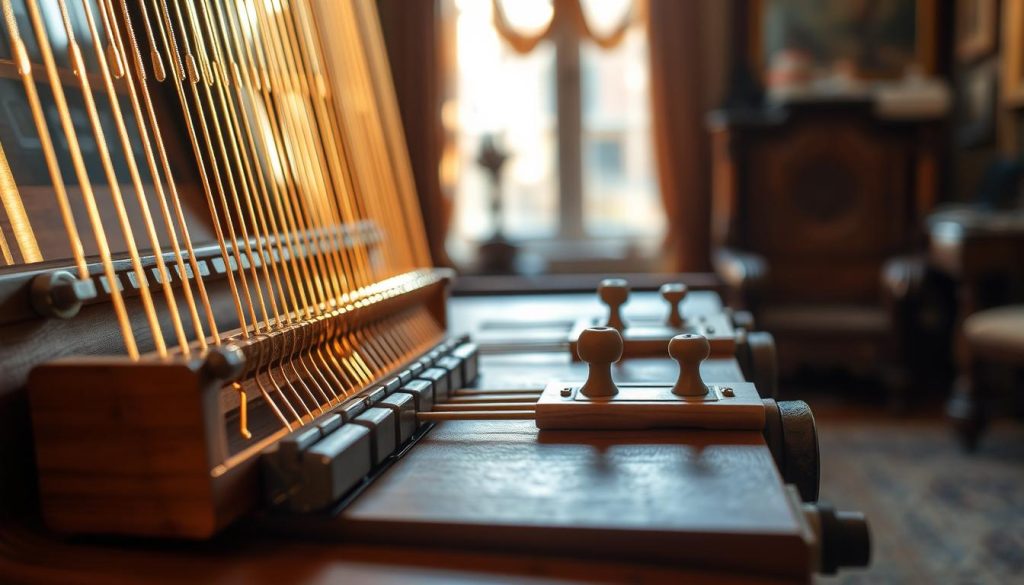
Some models have two or three manuals. This configuration multiplies the available timbres and registrations. There are also stops that imitate the lute or bassoon, expanding the tonal palette compared with the psaltery or organ.
- Jack: plucks the string precisely to produce a clear sound.
- Keys: dynamics do not vary with the force of the player’s touch, requiring a specific technique.
- Multiple manuals: two or three keyboards for varying sounds and registers.
The spinet and its different shapes
The forms of the spinet reveal highly varied instrument-making solutions among European workshops.
The Italian spinet is characterized by an often pentagonal case and two vibrating bridges. This arrangement creates articulate resonance and a clear tone. Its lightweight case makes it easier to transport and use in the home.
The Italian spinet
The use of two bridges alters the transmission of string vibrations to the soundboard. Makers favor spruce for the soundboard. The result: a brighter tone and rich harmonics.
The French spinet
The French version, known as the bird’s-wing spinet, has a more compact layout and a single bridge. Its angle of about 25° makes the string arrangement more similar to that of a traditional harpsichord. Restorers respect these historic techniques to preserve the authenticity of the construction.
“The bridge remains the key component for transmitting the string’s vibration to the case.”
To learn more about historical forms, see the article devoted to the spinet.
The virginal and its mechanical features
The rectangular case known as a virginal houses a mechanism that changes the relationship between the keyboard and the strings. The keyboard is set within the case, and the strings remain parallel to it.
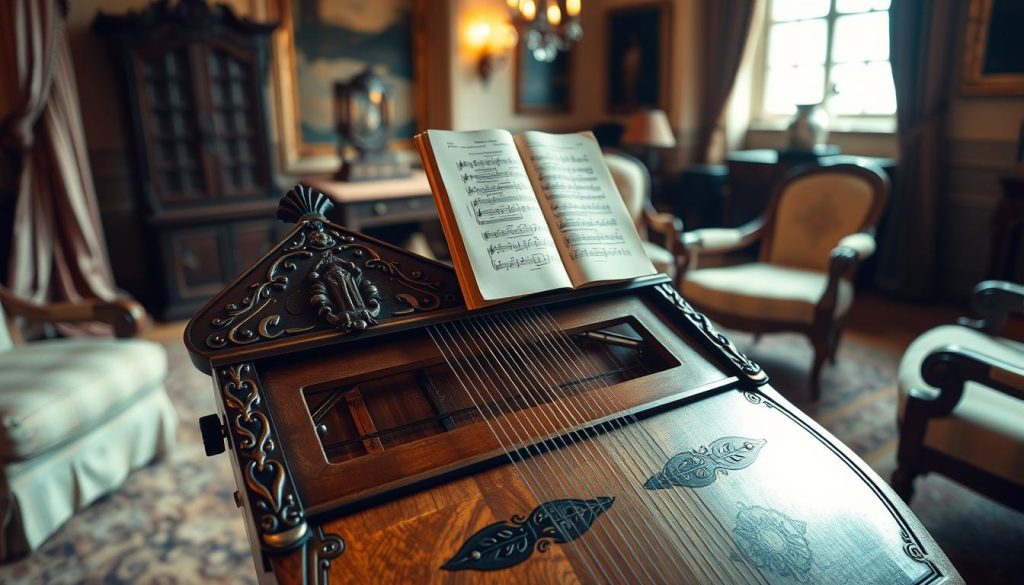
Its construction demands precision: the choice of wood, arrangement of the jacks, and quality of the soundboard determine the clarity of the notes. The keyboard’s limited compass encourages an expressiveness suited to 17th-century domestic music.
Muselaar
The muselaar is a Flemish variant. Its off-center keyboard alters the resonance and produces a more nasal tone, prized in certain repertoires.
Ottavino
The ottavino is a smaller version. It sounds an octave higher and provides unusual brilliance. It was used to create effects and dialogues with other harpsichords.
- Shape: rectangular case, parallel strings.
- Use: furniture and learning, often named after the maker or place.
| Type | Keyboard | Sound characteristic |
|---|---|---|
| Standard | central, internal | clear sound, stable notes |
| Muselaar | off-center | nasal tone, altered resonance |
| Ottavino | reduced | upper octave, brilliance |
Rare forms and hybrid instruments
In the 17th century, workshops conducted numerous experiments to gain tonal richness and save space. Some creations combined two sound sources within a single case.
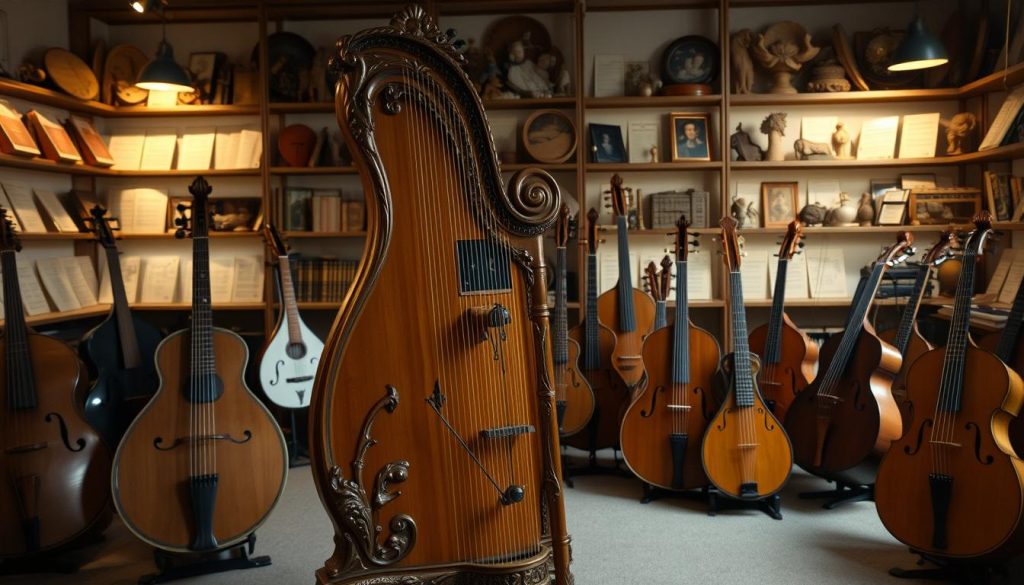
The clavicytherium is a vertical harpsichord. It retains the jack mechanism while freeing up floor space. Its upright shape changes its appearance without altering the principle of plucked strings.
The lute-harpsichord
This rare model uses gut strings to reproduce the warmth of the lute. Here, makers sought to combine the precision of the keyboard with a more poetic tone.
The claviorganum
The claviorganum combines a positive organ with a plucked keyboard. Two systems coexist within a single case, offering a tonal palette suited to continuo playing.
“These hybrids reveal the ingenuity of makers who were pushing the boundaries of instrument building as early as the 17th century.”
- Clavicytherium: saves space while retaining the same string mechanism.
- Lute-harpsichord: gut strings for a warm, lute-like sound.
- Claviorganum: two instruments in one for varying timbres.
For technical and historical details, see the definitions and explanations.
The clavichord, a struck-string relative
Within the keyboard family, the clavichord is distinguished by its mechanism of metal tangents that strike the strings directly. This action gives the instrument remarkable responsiveness and expressiveness.
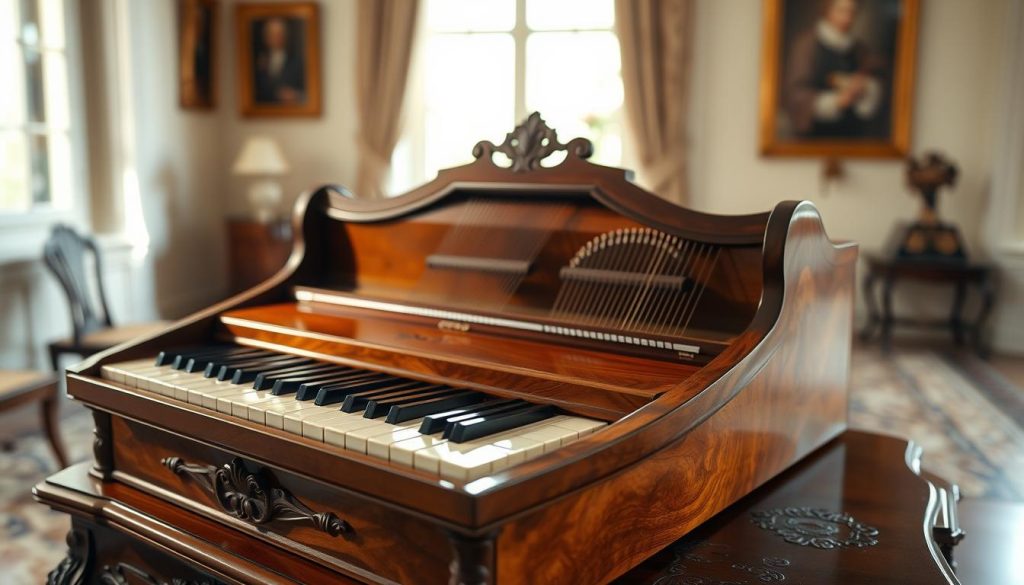
Descended from Pythagoras’s monochord, the clavichord is often presented as a direct ancestor of the piano. The key acts without an intermediate mechanism: the tangent touches the string, then withdraws, producing a quiet but richly nuanced sound.
Unlike the harpsichord, it allows true vibrato. The player rocks the key sideways while the tangent remains in contact. This technique changes the pitch and colors the note.
- Close connection between finger and string: precise control of the attack and sustain.
- Case and wood: the soundboard and bridge shape the resonance.
- Historical role: a bridge between the ancient monochord and the modern piano.
“The clavichord offers a sonic intimacy matched by few other keyboards.”
The subtleties of playing and technique
The thoughtful use of the short octave met a practical need for depth of sound. It provided essential bass notes without increasing the compass of the keyboard.
The technique demands a subtle connection between attack and release. Overlapping articulation becomes essential for making the strings sing, because there is no sustain pedal as on a piano.
Using the short octave
Advantage: composers had access to deep bass notes despite a limited compass. This solution varied among workshops, centuries, and repertoires.
- Articulation: chords are often arpeggiated to soften the sound of the strings.
- Jack: each pluck depends on the key; the duration of the sound is controlled with the finger.
- Spinet: it requires a precise attack to prevent the jacks from jamming during rapid passages.
The soundboard responds to vibrations and colors the sounds. In some cases, the short octave was adapted to regional practices, thereby reflecting their diversity.
For broader context, see the history of the harpsichord.
Conclusion
Ultimately, the tonal palette of early keyboards remains a living source of inspiration.
In summary, the harpsichord, spinet, and virginal form a family rich in shapes and styles. Their history sheds light on 18th-century playing and instrument making.
Although the piano displaced these models for a time, harpsichords and the clavichord are now reclaiming their place in chamber music. Modern makers employ historical methods to restore and reconstruct these rare pieces.
The rediscovery of these instruments by passionate musicians ensures the survival of this heritage. For a historical perspective, see the history of the harpsichord.