
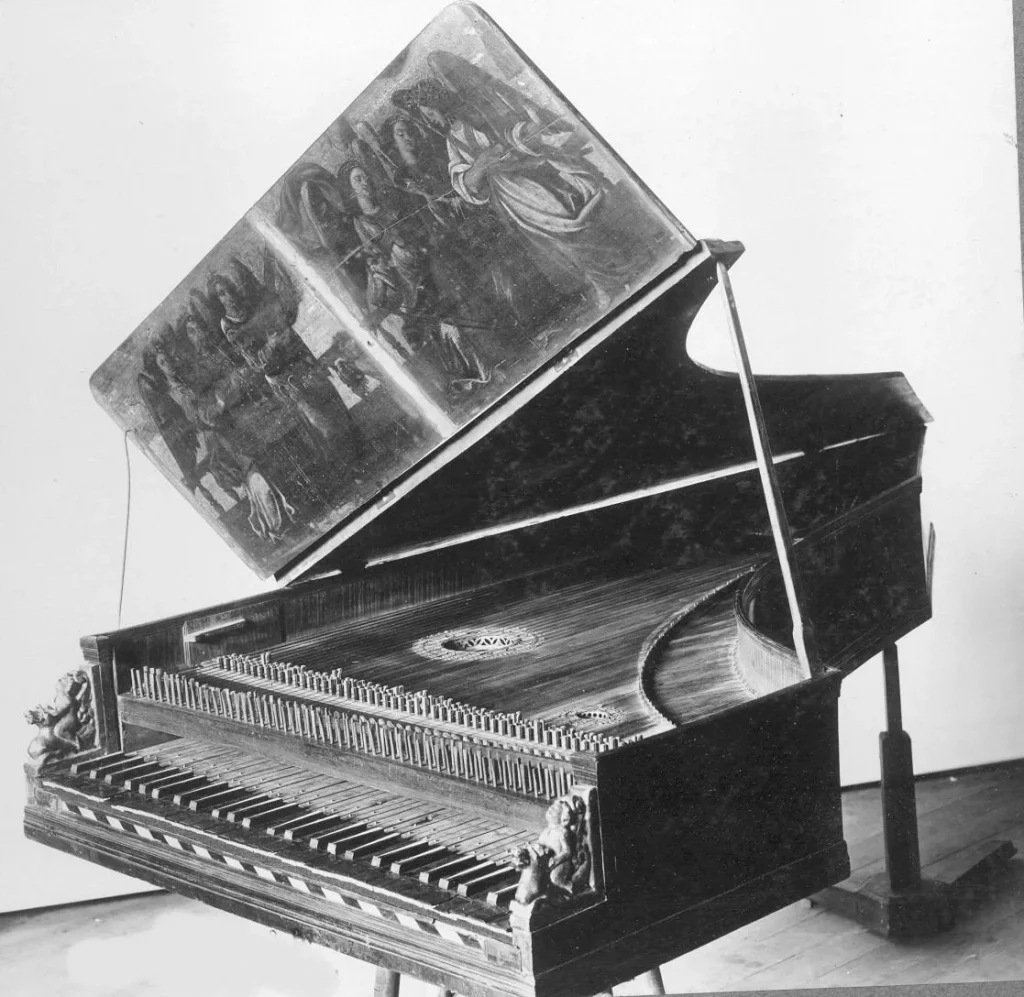
Discover the fascinating journey of this instrument, which shaped the European musical scene for several centuries. This overview highlights its central role in Baroque music and how it influenced performance practices.
As a stringed instrument, the harpsichord offers a distinctive sound. Its keyboard produces rich textures, despite its dynamic limitations before the arrival of the piano in the 18th century.
We will also explain how instruments in this family evolved technically to meet composers’ needs. Each century brought innovations in construction, string resonance and keyboard design.
This introduction prepares the reader for an analysis of the mechanisms, repertoire and traditions that make this heritage unique.
Introduction to the history of the harpsichord: origins and evolution
This overview places the harpsichord within a long line of plucked-string instruments that fostered secular music-making in Europe.
As a central instrument in the keyboard family, it shaped a sonic aesthetic that influenced music for centuries.
Its complex structure enabled a vast repertoire to flourish. This body of work continues to inspire contemporary composers and performers.
We will see how this instrument adapted to changing tastes across the ages while retaining its noble character.
| Element | Role | Musical impact |
|---|---|---|
| Plucked strings | Sound production | Clarity of tone and articulation |
| Keyboard | Melodic control | Development of counterpoint |
| Soundbox | Amplification | Tone color and sustain |
Medieval roots and the birth of the instrument
Exchanges between Europe and the Levant sowed the technical seeds of European keyboard instruments.
The psaltery
The psaltery, introduced in the 11th century, is one of the oldest ancestors. It contributed ideas relating to soundboards, strings and timbres.
Musicians often used a plectrum to pluck the strings. This practice foreshadowed the mechanical action that would later equip the harpsichord.
Middle Eastern influence
At that time, makers sought greater pitch accuracy. These craftspeople established principles of tuning and tension.
The early development of keyboard instruments built on these innovations. This connection marks a key stage in the history of music.
| Element | Role | Impact |
|---|---|---|
| Psaltery | Stringed prototype | Transmission of plucking techniques |
| Plectrum | Playing method | Model for the harpsichord mechanism |
| Makers | Adjustment & tuning | Improved pitch and timbre |
The technical structure and soundbox
The combination of the soundboard, wooden components and shape defines this instrument’s sonic identity. The case amplifies the vibrations of the strings and promotes clear projection, often compared with that of a reclining harp.
Each wooden component is selected for its stability under tension. The internal structure brings together several components that support the string and maintain balance amid changes in humidity.
- The soundboard projects the sound and makes each harpsichord unique.
- The keyboard remains robust enough to withstand intensive playing.
- Unlike the piano, tension is maintained by dedicated components that ensure rich resonance.
These technical choices explain why old instruments, designed over the centuries, retain a stable and expressive sound despite the passage of time.
The complex jack mechanism
The jack controls the mechanical action that transforms pressure on a key into a plucked sound. It is the centerpiece of this instrument. Without it, the string would not be plucked accurately.
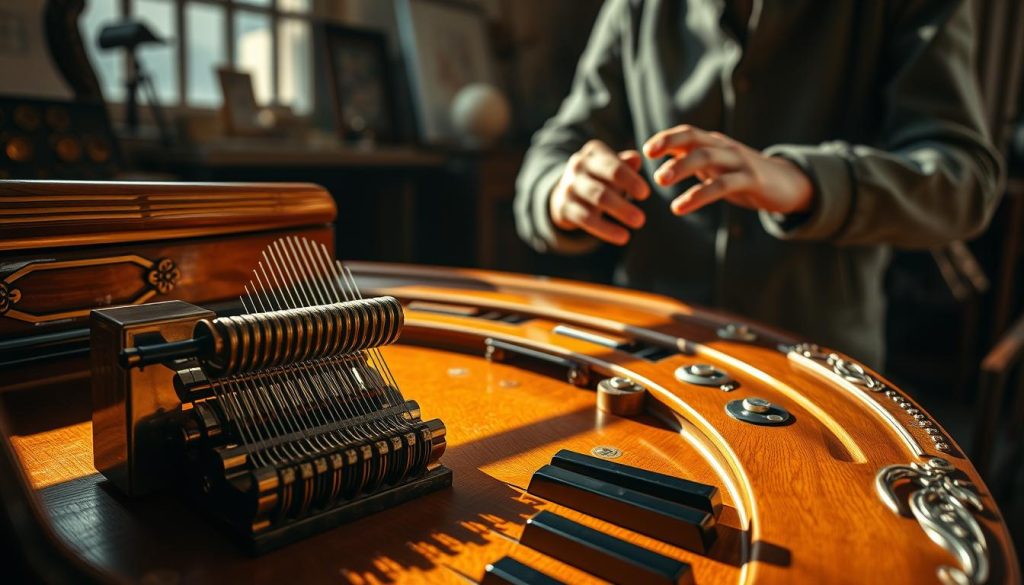
The plectrum plays a central role. Often cut from a quill or made of a rigid material, it produces the plucking effect. The plectrum must return cleanly to avoid unwanted noise.
Each jack is a wooden component adjusted to the millimeter. The assembly ensures that the key remains responsive beneath the musician’s finger. On its return, the mechanism retracts to release the string.
- The jack plucks the string when the key is depressed.
- The plectrum ensures consistent tone and sound.
- The wooden case amplifies the vibration after the string is plucked.
Unlike the piano, this instrument does not vary its volume according to the force applied. Its different registers of strings, however, provide a wider range of colors. This technical feature partly explains why it dominated musical life for a century.
The Italian tradition and its characteristics
The Italian tradition established a school of construction known for its lightness and tonal clarity from the 16th century onward.
Makers such as Dominicus Pisaurensis, active in Venice (1533–1622), laid the foundations for an instrument with a clear sound. Their approach favored a lightweight wooden case and a keyboard designed for agility.
In Bologna, Faby, a clergyman and maker, produced instruments in 1677 whose slender shape encouraged a precise sound. These models accompanied vocal and instrumental music with finesse.
Key characteristics:
- a protective outer case and thin wood;
- a single keyboard, with registers designed for clarity rather than power;
- the occasional inclusion of a spinet to obtain different colors.
| Element | Role | Italian example |
|---|---|---|
| Case | Lightness and projection | Protected Venetian models |
| Keyboard | Precision of playing | Agile Bolognese keyboards |
| Signature | Identification of the sound | Maker’s name on each instrument |
The tradition endured until the end of the 18th century, although the piano was then beginning to change composers’ tastes.
The Flemish school and the Ruckers dynasty
From the beginning of the 17th century, Antwerp workshops established a sonic model that inspired all of Europe. The Ruckers dynasty, centered around the Guild of Saint Luke, set construction standards renowned for their solidity and tone.
The influence of the Guild of Saint Luke
Antwerp makers worked as a network. The guild controlled the transmission of expertise. Each instrument bore the master’s name, guaranteeing consistent quality.
The enlargement of instruments
Ruckers harpsichords often offered two keyboards and 8- and 4-foot registers. These choices provided rich tonal variations. In the 18th century, Pascal Taskin practiced ravalement: he extended the keyboard’s range to meet the new demands of music.
- The wooden case was more robust than that of Italian models.
- The soundboard was often exquisitely decorated.
- The virginal shared the same construction characteristics.
To learn more about Flemish harpsichord making, see this feature on Flemish harpsichord making.
The role of keyboards in Baroque music
Thanks to agile mechanisms, musicians could switch from one register to another and shape the basso continuo in real time.
The harpsichord with two keyboards became the preferred instrument for accompaniment and the bass line.
Each keyboard could activate different registers. Switching instantly between them created a contrasting effect essential to the Baroque style.
The jack, driven by the key, ensured a precise attack. This precision supported the dense counterpoint demanded by the century’s composers.
The soundboard resonated with the strings and amplified the subtlety of the performance. The wood of the case added warmth that supported vocal and instrumental lines.
The influence of the organ can be seen in keyboard design and polyphonic writing. The later arrival of the piano would change these practices.
| Function | Characteristic | Musical impact |
|---|---|---|
| Basso continuo | Two keyboards | Reliable accompaniment and rich textures |
| Colors | Switchable registers | Immediate dynamic contrasts |
| Articulation | Jack & key | Clear attack for counterpoint |
To explore the subject further, discover the role of the harpsichord in music.
The soundboard and the secret of its bracing
The soundboard, as thin as a membrane, governs sound projection in every instrument. This soundboard is the harpsichord’s most delicate wooden component and amplifies the strings’ vibrations.
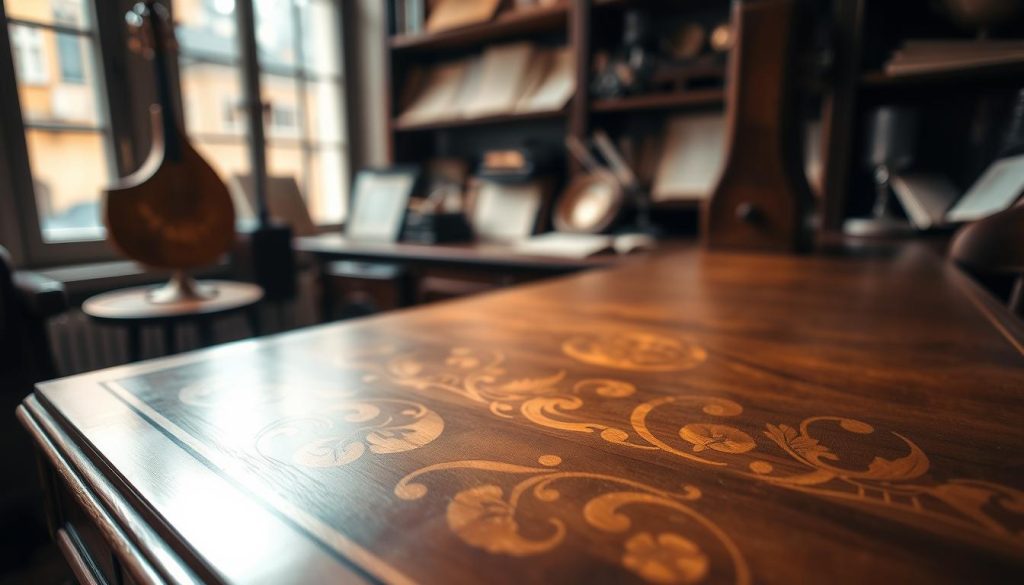
Beneath the soundboard, the bracing remains one of the makers’ secrets. It is a structure composed of glued components that stiffens the soundboard.
The thinness of the soundboard determines sound quality under the tension of the strings. On a well-regulated instrument, the registers and keys reveal rich harmonics.
Soundboard decoration
Decoration transformed every instrument into a work of art. Floral designs, rosettes and paintings adorned the unvarnished surface, allowing the wood to breathe.
- The case supports the soundboard and unifies the vibrations.
- Unlike a piano soundboard, it is generally left unvarnished to optimize resonance.
- The bracing, discreet but crucial, balances rigidity and flexibility.
To explore a technical aspect of the soundboard further, consult this entry on the soundboard and its role in the instrument.
The strings and the rule of proper proportion
The strings follow a mathematical rule: their length, diameter and tension form a balance. This rule produces a consistent sound across the harpsichord’s entire range.
Each string is selected according to its material and diameter. The jack must pluck the string at the right point to produce a clear attack and rich harmonics.
The harpsichord uses iron, brass or copper strings. Unlike the piano, it does not use wound strings to increase power.
The soundboard and case must withstand the total tension. The choice of wood directly influences the timbre and resonance of each key.
- Precision: the hitch point stabilizes the tuning.
- Variety: the registers allow strings and colors to be combined.
- Maintenance: tuning remains a demanding task for the musician.
| Element | Role | Sonic impact |
|---|---|---|
| Material (iron, brass, copper) | Determines the timbre | Clarity or warmth |
| Hitch point | Tuning stability | Accuracy of intonation |
| Wooden soundboard and case | Support the tension | Tone color and sustain |
The harpsichord in composers’ repertoire
The Baroque repertoire places this instrument at the center of compositional and performance practices.
The art of basso continuo
Basso continuo made the harpsichord an essential partner in accompanying voices and instruments. The keyboards established the harmony while allowing registers to be adapted to the context.
Baroque counterpoint
The precise mechanism and clarity of the jack favored clearly defined contrapuntal lines. Composers wrote pieces in which the keys revealed each voice with great clarity.
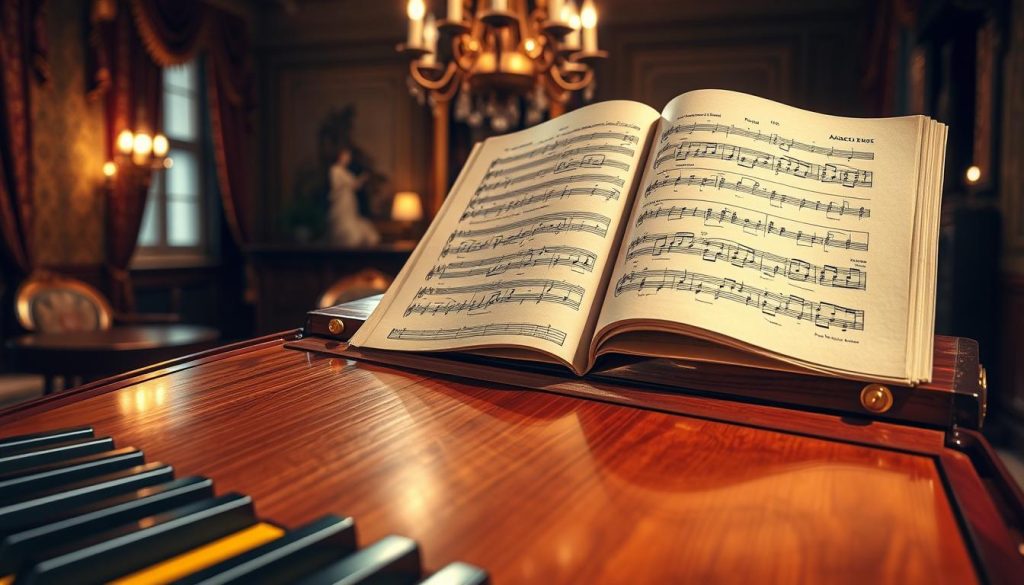
Johann Sebastian Bach exemplifies this use. His French Suite No. 6 in E major, BWV 817, exploits the full palette of the registers and the delicacy of the strings.
- The harpsichord remained central to chamber music until the end of the century.
- Makers improved the soundboard, case and registers to meet composers’ demands.
- Each piece required mastery of the keyboard and a sense of playing to vary the colors.
| Function | Advantage | Example |
|---|---|---|
| Basso continuo | Reliable accompaniment | Vocal ensembles |
| Counterpoint | Clarity of voices | Fugues & suites |
| Colors | Varied registers | Registers and doubled registers |
Historical variants such as the spinet and virginal
Adaptations of the instrument addressed both spatial constraints and musicians’ sonic needs.
The spinet, whose earliest known example dates from 1493, is a smaller version of the harpsichord. It was ideal for domestic music and teaching.
The virginal, highly prized in England, is another stringed instrument from the same family. Its rectangular shape provided a flat soundboard and an intimate sound.
Makers and craftspeople created numerous variations to adapt the keyboard to drawing rooms, modest churches and workshops. The spinet’s name often refers to its plucking mechanism, which shares the same technical origin as that of the larger instrument.
- Small size: better sound in a confined space.
- Shared principles: jack, plectrum and strings.
- The harp’s influence on the search for resonance.
| Variant | Characteristic | Use |
|---|---|---|
| Spinet | Compact, flat soundboard | Drawing room, teaching |
| Virginal | Rectangular shape, gentle timbre | English repertoire, domestic music |
| Harpsichords | Larger, varied registers | Concert halls, composition |
The decline in the face of the pianoforte
The transition to the pianoforte redefined composers’ sonic expectations in the 18th century. Beginning in Florence around 1690, Cristofori laid the foundations for a struck-string mechanism that would transform playing.
Unlike this older instrument, the piano allowed variations in volume. The name pianoforte—soft-loud—illustrates this decisive advantage.
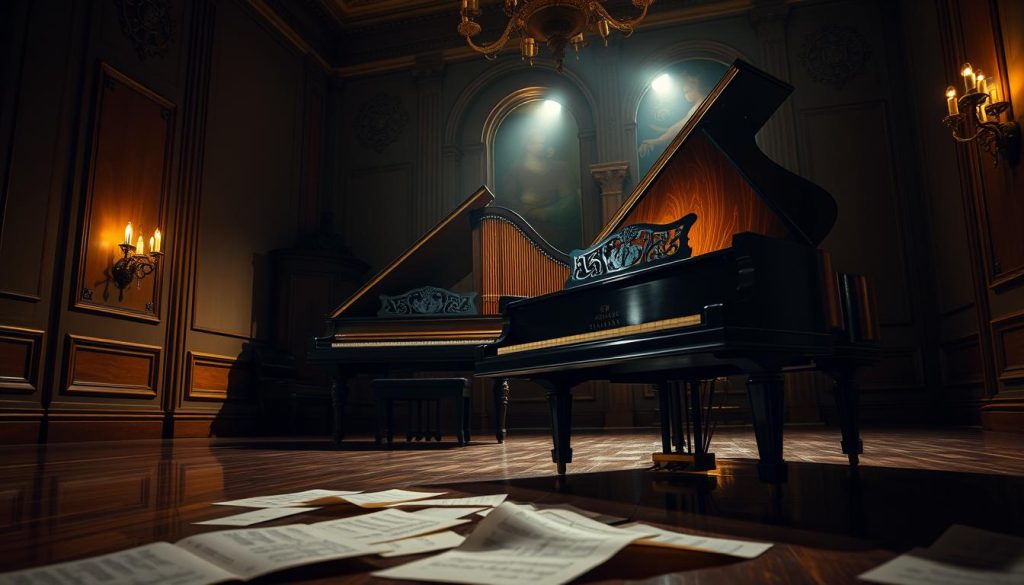
The shift from plucked strings to a hammer system gradually displaced the jack. Finger technique changed: the key became a means of dynamic expression.
Makers attempted adaptations to modernize the older instrument, but the piano’s case and soundboard supported far greater string tension. Composers seeking crescendo and decrescendo effects adopted the piano.
| Element | Consequence | Musical impact |
|---|---|---|
| Mechanism (hammers) | More dynamic variation | Crescendo and decrescendo |
| String tension | Reinforced structure | Greater projection |
| Playing technique | A new approach to touch | Renewed repertoire |
The instrument’s modern revival
In the 20th century, renewed interest brought this instrument back to stages and workshops.
Makers restore and reconstruct historical models. They reproduce the soundboard, case and registers according to characteristics documented in archives.
Contemporary composers incorporate the harpsichord into new works. Its dialogue with the piano or harp enriches sonic textures.
Modern playing embraces a vast repertoire: Baroque pieces, avant-garde creations and mixed arrangements. The virginal and spinet are also returning for their distinctive timbres.
The art of instrument making is recognized as valuable expertise. It ensures the transmission of techniques and the lasting preservation of strings, keyboards and keys.
| Action | Result | Musical impact |
|---|---|---|
| Faithful restoration | Reconstruction of registers | Tonal authenticity of works |
| Contemporary creation | Integration into ensembles | A new palette of registers |
| Rediscovery of old models | Use of the virginal and spinet | Variety of timbres for the stage |
Conclusion
In summary, the journey of this instrument reveals technical ingenuity in the service of musical creation. The harpsichord shaped several centuries through its mechanisms, the precision of its keyboard and the richness of its strings.
It inspired composers and gave rise to major works. Although the piano took its place, the harpsichord remains alive on stage and in workshops.
The instruments in this family continue to fascinate through their craftsmanship and the variety of playing possibilities they offer. Preserving them helps us understand sonic history and the diversity of timbres.