
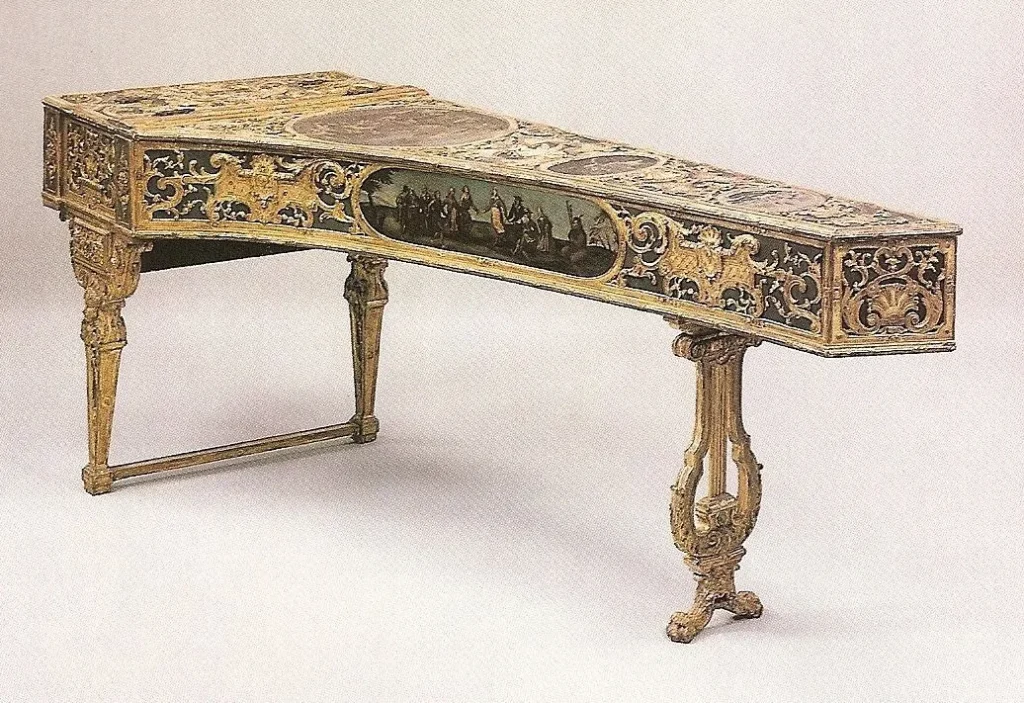
The harpsichord is a plucked-string instrument descended from the medieval psaltery. Emerging in the early 16th century, this family of instruments flourished until the 18th century. Its bright timbre left its mark on Baroque music.
Each key controls a jack that raises a plectrum to pluck a string. Formerly made from goose quill, the plectrum produces the instrument’s characteristic short attack.
Its close relatives include the spinet and the virginal, each with its own shape and case. Their construction requires particular care to harmonize the keys, strings and case.
This mechanism distinguishes the instrument from modern keyboards. The piano gradually took its place during the 18th century, while the organ differs through its use of air and its dynamics.
Understanding the harpsichord family
Several early keyboards share the same plucked-string mechanism and form a coherent group. These instruments use a keyboard to operate jacks that pluck the strings and produce sound.
The harpsichord remains the best-known example. Its bright tone suits the polyphonic textures of European Baroque music.
Each model differs in its case, range and timbre. These variations explain why some instruments have distinct names despite sharing a similar mechanism.
To understand this instrument, one must study the interaction between the key and the string. The key’s simple movement becomes a short attack, followed by resonance through the soundboard.
- Polyphonic clarity: essential for early repertoire.
- Shared mechanism: keyboard + plectrum + string.
- Variants: differences in shape and tuning.
Historical origins and the instrument’s emergence
In the 14th century, adding a keyboard to the psaltery gave rise to a new stringed instrument. This transformation enabled more precise playing and provided a new range of sounds for accompaniment.
The oldest surviving example dates from 1521 and comes from Italy. Its Italian design served as a model for several centuries.
During the 17th century, the Ruckers makers in Antwerp improved construction and string stability. Their expertise raised the quality of these instruments and influenced makers throughout Europe.
The harpsichord first replaced the lute as an accompaniment to court singing. Later, composers such as Bach, Couperin and Rameau explored its possibilities. They placed the instrument at the heart of the Baroque era.
To explore this subject further, see this history of the harpsichord, which describes its technical and stylistic evolution.
The harpsichord and its relatives in the jack-action family
The outline of a horizontal harp conceals a simple and effective mechanism. The strings run parallel to the keys, and each jack raises a plectrum that plucks the string.
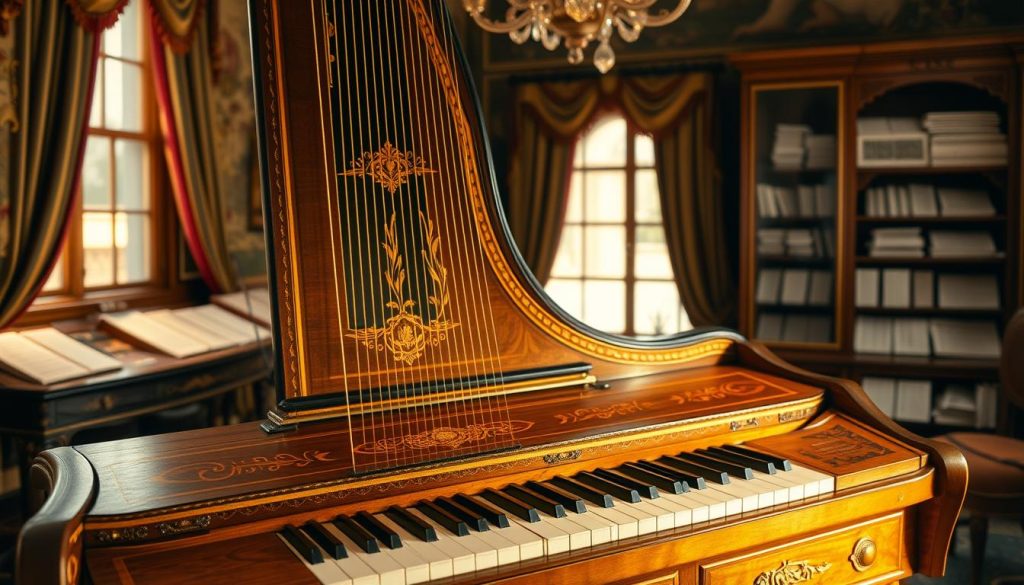
The double-manual harpsichord
French models from the 18th century often feature two manuals and a variety of stops. Coupling makes it possible to play two strings simultaneously for a stronger sound.
“Coupling expands the tonal palette without changing the musician’s technique.”
Traditional construction
Construction focuses on the mechanism: jacks, plectra and keys. The legs are often removable to make the instrument easier to transport between drawing rooms.
- Shape: horizontal harp.
- Stops: inspired by the organ to vary the tone.
- Relatives: the spinet and virginal offer different string arrangements.
| Feature | Function | Sound effect |
|---|---|---|
| Double manual | Coupling | Stronger sound and variations in timbre |
| Jack + plectrum | Plucking the string | Short attack rich in harmonics |
| String arrangement | Parallel to the keys | Clear transmission of the note |
| Removable legs | Mobility | Use in drawing rooms |
To learn more about the harpsichord, see this dedicated page describing its history and variants.
The virginal’s distinctive technical features
The virginal has a rectangular outline, with strings running parallel to the keyboard. Its compact case directly affects the timbre. Unlike the harpsichord, the virginal’s soundboard often leaves more room for vibration.
Each key activates a jack that plucks the string at a precise point. This produces a gentler attack and a rounder tone than those of a traditional harpsichord.
The muselar and the ottavino
The muselar is a Flemish variant. Its keyboard is off-center, usually positioned toward the right. This arrangement changes the strings’ tension and tonal color, creating a distinctive timbre.
The ottavino is a small virginal that sounds one octave higher. It creates a bright effect in Baroque pieces and complements an ensemble’s tonal palette.
- A rectangular shape with strings parallel to the keyboard: a defining feature of the virginal.
- A less restricted wooden soundboard, encouraging projection.
- Domestic use during the 17th century: Byrd and Gibbons made it an instrument of choice.
- The spinet also requires careful construction for every string.
“The virginal’s simplicity conceals remarkable precision in its construction.”
The spinet and its variations in shape
The spinet can be recognized by its angular case and diagonally arranged strings. This drawing-room instrument belongs to the same lineage as the harpsichord.
The Italian spinet follows a pentagonal plan with an angle of about 10 degrees. The French version instead has an angle of 25 degrees and a more highly decorated, concave case.
The legs are often screwed to the body to make transportation easier. The instrument can be placed on a table or raised as needed.
Despite being smaller than the harpsichord’s, the compact soundboard plays a major role in resonance. Each string is plucked by a mechanism related to the harpsichord keyboard action, ensuring its characteristic tone.
- A pentagonal or triangular shape, depending on the model.
- The arrangement of the strings affects tension and timbre.
- Widespread domestic use during the 17th century.
To learn more about the variants and their construction, see these definitions and explanations.
The jack mechanism and how it works
The jack turns each impulse from the key into a precise pluck. An essential component of the harpsichord, it combines a small movable tongue and a spring to raise a plectrum against the string.
The plectrum may be made from quill, leather or synthetic material. Its flexibility and shape directly influence the tone color of the note.
Attached to the jack, the damper stops the vibration as soon as the key is released. This prevents unwanted resonance and makes mastery of legato and detached articulation essential to playing.
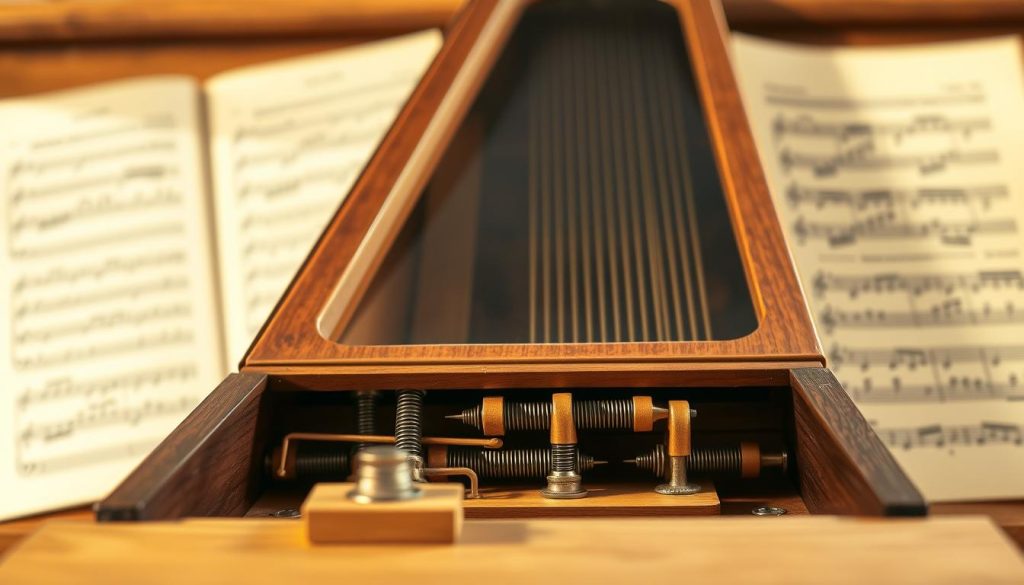
The role of the plectrum
The plectrum determines the attack and harmonics. Quill produces a crisp attack; leather provides a warmer tone.
Playing dynamics
Unlike the piano, the keyboard cannot vary the volume according to the pressure applied. Dynamics arise from phrasing, articulation and the chosen stops.
- The jack’s wood must remain light and stable to ensure a quick response.
- The mechanism rivals the organ in the precision of its attacks, despite having no sustain pedal.
- The lute-harpsichord variant shows how string tension alters the entire mechanism.
To learn more about the jack, see the dedicated technical guide.
Hybrid instruments and unusual designs
Craftspeople devised models that combined several mechanisms within a single case. These instruments blend innovation with careful decoration to suit the tastes of drawing rooms in the last century.
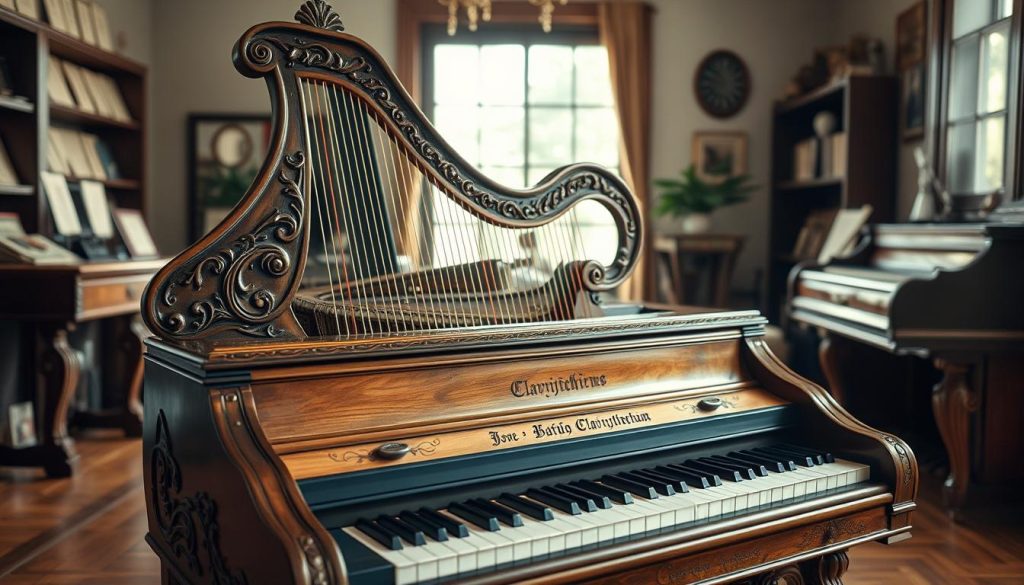
The clavicytherium arranges its strings vertically. It saves space without departing from the keyboard principle.
The lute-harpsichord uses gut strings. It offers a warmer harmony, close to that of the traditional lute.
The claviorganum combines an organ and harpsichord in a single piece. It is a superb example of ingenuity serving the Baroque continuo.
Strips of felt or leather modify the vibration of the string and create a variety of tonal effects. The spinet and harpsichord sometimes served as the basis for these experiments.
- Space saving: the clavicytherium’s vertical design.
- Color: gut strings for a gentler harmony.
- Versatility: the claviorganum combines a keyboard with pipes.
The construction of these pieces reflects the object’s social importance. Every detail aims to preserve the balance between the mechanisms and resonance.
The role of the harpsichord in Baroque music
At the heart of Baroque drawing rooms and churches, the harpsichord held a central position. It often provided the basso continuo in operas and concertos, supporting the harmony and rhythm.
Its bright, precise tone suited recitatives and polyphonic textures. The instrument offered clear articulation: every key enabled performers to execute the rapid ornaments essential to the style.
The great composers of the era
Domenico Scarlatti explored all the instrument’s technical possibilities and composed more than 500 keyboard sonatas. His works highlight the agility and chordal leaps typical of the period.
Johann Sebastian Bach contributed to the instrument’s renown with cycles such as The Well-Tempered Clavier and the Goldberg Variations. François Couperin composed pieces in which precision and expression take center stage.
- Range: about five octaves on a traditional instrument.
- Possibilities: two manuals for creating contrasts and richer textures.
- Development: the piano gradually dominated the following century without erasing the Baroque legacy.
“The harpsichord demands unique clarity of line and delicacy of ornamentation.”
Comparing the harpsichord and the piano
The way the string is set in motion changes everything: the attack, sustain and tonal color.
The harpsichord is a plucked-string instrument; a plectrum plucks the string and produces a bright, short sound.
The piano is an instrument whose strings are struck by hammers. This action makes it possible to vary the intensity and produce nuances ranging from pianissimo to forte.
By the end of the 18th century, the piano had gradually replaced the harpsichord because of this dynamic capability.
- Mechanism: plucking versus striking.
- Sound: fixed and articulate on the harpsichord, nuanced on the piano.
- Range: the modern piano keyboard exceeds seven octaves and therefore has a wider range than the traditional harpsichord.
Each instrument offers its own distinctive experience: the harpsichord favors articulation, while the piano favors expressive power.
The harpsichord revival in the 20th century
The 20th century brought a forgotten instrument back to life, restoring its place onstage and in music schools.
Wanda Landowska was the leading figure in this revival. Her dedication encouraged the restoration of instruments and performances of early pieces.
Modern composers such as Francis Poulenc and Manuel de Falla wrote for the harpsichord. These works demonstrate that the historic instrument can engage with contemporary musical language.
The rediscovery movement grew from the curiosity of performers and makers. They recovered old techniques and revised methods for constructing strings and mechanisms.
Thanks to this momentum, harpsichord studies returned to conservatories. Today, this instrument offers a tonal alternative to the piano and enriches recital programs.
“The revival returned the harpsichord to the heart of musical life, far from oblivion.”
- Restoration: revival of historical techniques.
- Repertoire: new works and contemporary adaptations.
- Use: a complement to the piano in concerts and teaching.
Conclusion
The harpsichord holds a distinctive place in the history of music. This plucked-string instrument relies on a jack mechanism that shapes its tone and its art of ornamentation.
From the spinet to the virginal, the diversity of forms and construction techniques illustrates the ingenuity of craftspeople. The manuals, stops and plectrum offer varied tonal possibilities that are valuable for performing the great Baroque pieces.
Although the piano later became dominant, this instrument remains essential to understanding Baroque history and harmony. To explore its role in classical music further, see this article on the role of the harpsichord.