
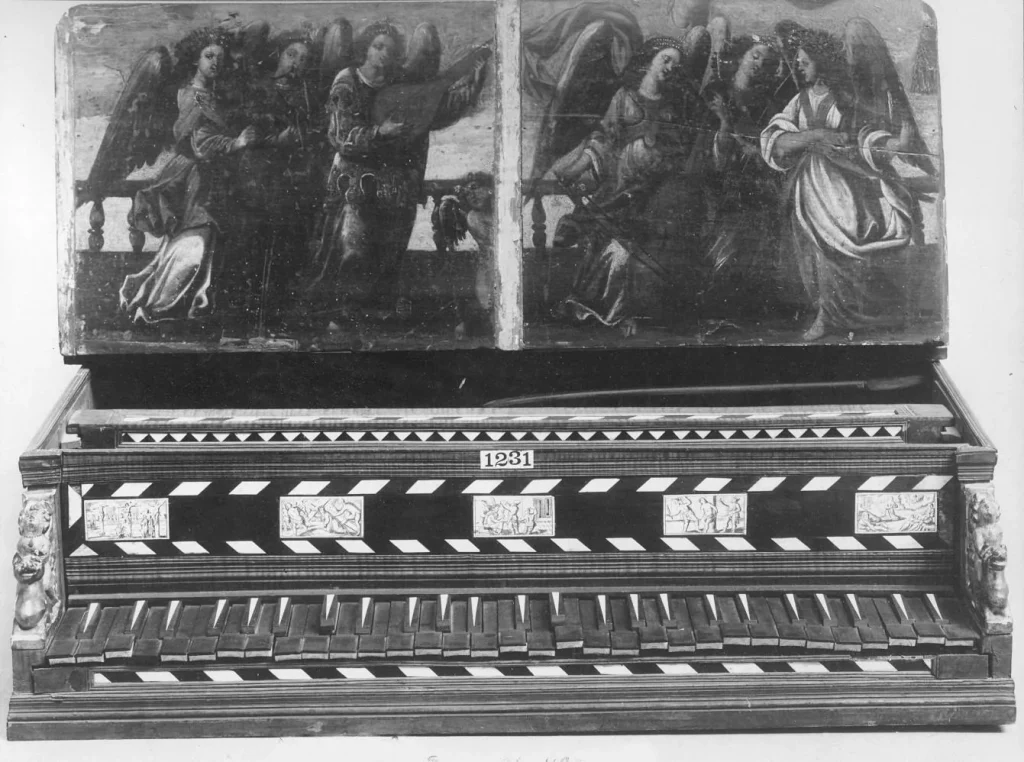
A simple question often conceals a long investigation. The history of this small keyboard instrument has been reconstructed from images, manuscripts, and instruments preserved in museums. Musicologists use these traces to follow its technical transformations over the centuries.
Understanding the history of the harpsichord requires a multidisciplinary approach: archives, iconography, and examination of surviving physical examples. Makers left clues to their choices of construction, decoration, and mechanisms.
Research into early instruments reveals that this instrument evolved from medieval forms into more sophisticated models. This evolution left a lasting mark on European secular music.
This short introduction invites you to follow the discoveries. Specialists continue a fascinating quest to trace the origins and spread of this instrument.
Where did the harpsichord come from?
Its origins date back to the fourteenth century, between the Burgundian courts and Italian workshops.
In the sixteenth century, this instrument spread rapidly. It won favor among princes and the bourgeoisie. The mobility of craftspeople encouraged this expansion throughout Europe.
The history of the harpsichord shows how the large harpsichord became a prestigious object. These models were far more complex than the earliest examples. Their construction varied by region and could be more or less sophisticated.
During the seventeenth century, this instrument became established as a continuo instrument in sacred and secular repertoires. Construction techniques gradually became standardized.
The eighteenth century marked the height of production and ornamentation, before a long eclipse in the following century. To learn more, see the origins of the piano and harpsichord.
The instrument’s medieval roots
Medieval documents shed light on prototypes with plucked strings. Treatises and inventories provide technical descriptions that inform our history of the harpsichord.
Henri Arnault de Zwolle’s manuscript
Dated 1440, Henri Arnault de Zwolle’s treatise remains unique for understanding the construction of the period’s musical instruments.
It details plans, measurements, and assembly methods. These instructions explain how the soundboard began to evolve.
The earliest written references
Later, court records mention devices with plucked strings. In 1360, John II received an eschiquier while held captive in London.
These early instruments laid important mechanical foundations. The subsequent spread of expertise enabled visible advances through the seventeenth century.
The soundboard became more complex so that it could better transmit the vibration of the plucked strings to the body. These advances laid the groundwork for the makers who later standardized many technical solutions in the seventeenth century.
The role of the psaltery and early keyboards
Early sixteenth-century treatises document the coexistence of plucked strings and the first keyboards.
In 1511, Sebastian Virdung published Musica getutscht. He classified musical instruments by their mechanism: plucked or struck strings. This distinction helps explain the technical lineage between the psaltery and keyboards that appeared later.
Among the most rudimentary instruments, the psaltery influenced sixteenth-century instrument making throughout Europe. Its simplicity inspired solutions for the soundboard and the transfer of vibrations.
The development of two keyboards broadened this instrument’s expressive possibilities, although its construction was far more complex. In the seventeenth century, more or less sophisticated systems appeared for coupling these two keyboards.
The soundboard had to withstand increasing tension, especially as the range expanded first to four and then to five octaves. In the eighteenth century, these developments paved the way for musical instruments capable of offering a broader tonal palette.
- 1511: Virdung’s classification.
- Influence: the psaltery throughout Europe.
- Technique: two keyboards and a reinforced soundboard.
The emergence of the clavicembalum in the fourteenth century
A note by Lodovico Lambertacci, dated 1397, launched the investigation into the jack mechanism.
Hermann Poll is named in it as the inventor of a device capable of plucking strings. This mechanism is the cornerstone of plucked-string instruments.
The soundboard, though still simple, already provided surprisingly effective resonance. It projected the sound despite the still-rudimentary construction.
In the sixteenth century, the large harpsichord was distinguished by a curved bentside, an innovation that strengthened the case and improved projection. Italian makers quickly adopted these solutions.
During the seventeenth century, this instrument became much more capable. Techniques spread and sound quality improved.
“It can be difficult to date each invention precisely, but the eighteenth century consolidated these advances.”
- 1397: reference to the jack.
- Sixteenth century: curved bentside and reinforcement.
- Seventeenth century: spread and refinement.
Italian construction and its technical features
In Italy, instrument making favored lightness and clarity of tone from the Renaissance onward.
Italian construction favored a thin soundboard and a string layout optimized for a crisp attack.
A famous example is Trasuntino’s harpsichord (1538): 2.08 meters long and weighing only 12 kg. This lightness explains why Italian instruments were often more portable.
The rule of correct proportion
Some makers applied the rule of correct proportion to balance length, tension, and timbre.
This sometimes made it possible to build a single harpsichord with two keyboards, although this configuration was more or less common. Frank Hubbard documented the frequent use of the curved bentside by Italian makers in the sixteenth and seventeenth centuries.
“Structural simplicity promotes a clear, immediate, and expressive sound.”
| Feature | Italian | Development in the eighteenth century |
|---|---|---|
| Weight | Very light (e.g., 12 kg) | More robust instruments |
| Keyboard | Single keyboard | Sometimes two keyboards or string choirs |
| Soundboard & bentside | Thin soundboard, curved bentside | Reinforced for greater power |
The influence of Venetian and Milanese makers
In the sixteenth century, masters from Venice and Milan fashioned instruments admired throughout Europe.
Italian construction then took on an air of luxury. The Italian makers associated with these cities produced sumptuous works. In 1577, Annibale dei Rossi made a heptagonal virginal decorated with ivory and precious stones.
To meet musical demands, some models included two keyboards. This arrangement enriched the tonal palette of the Italian harpsichord and enabled varied registration effects.
Italian instruments quickly left the peninsula. They were exported and copied, a sign of lasting technical supremacy. Venetian and Milanese influence helped shape standards for European keyboard construction.
“Decoration never stood in the way of the pursuit of excellent acoustic quality.”
- Renowned workshops: Venice, Milan.
- Rich ornamentation, carefully refined acoustics.
- Adoption of the two-keyboard system for greater expressiveness.
The development of Flemish instrument making
In Antwerp, construction became more robust, combining tradition and innovation.
The influence of the guilds
The Guild of Saint Luke regulated manufacturing and quality. It imposed standards that favored a select group of makers capable of producing a single exceptional instrument.
Hybrid instruments
In 1548, Joost Karest built a virginal now preserved in Brussels. This model exemplifies Flemish harpsichords: a decorated soundboard and a sturdier case than the Italian model.
Frank Hubbard notes that, from the seventeenth century onward, these more complex instruments often incorporated two keyboards and several string choirs.
“Flemish examples offered unprecedented power and harmonic richness.”
In the eighteenth century, these models traveled to other countries. English makers adopted ranges of up to five octaves, while later some keyboards reached four octaves and beyond.
| Workshop | Feature | Impact |
|---|---|---|
| Antwerp (Saint Luke) | Strict standards | Consistent quality, more durable instruments |
| Joost Karest (1548) | Hybrid virginal | Exported model, influence throughout Europe |
| Seventeenth–eighteenth centuries | Two keyboards, string choirs | Greater power and tonal variety |
The importance of the Ruckers dynasty in Antwerp
Hans Ruckers, admitted to the Guild of Saint Luke in 1579, laid the foundations for a renowned dynasty of craftspeople.
The Ruckers dynasty dominated the manufacture of the large harpsichord for more than a century. Their instruments had a remarkable soundboard, highly prized by seventeenth-century musicians.
The use of a curved bentside optimized the tension of the string choirs. The result was greater sound power and improved tuning stability.
The introduction of two keyboards on certain models transformed performance practice. These devices enabled new combinations of timbres and a dialogue between registers.
“Ruckers instruments became benchmarks throughout Europe, sought after for their reliability and harmonic richness.”
- Technical standard: carefully crafted soundboard.
- Advanced use: two keyboards for dynamic contrasts.
- Legacy: influence on Flemish harpsichords through the eighteenth century.
| Period | Strength | Impact |
|---|---|---|
| Seventeenth century | Exceptional soundboard | Standard for northern European construction |
| Late sixteenth century → eighteenth century | Curved bentside & two keyboards | Greater power and tonal color |
| Exports | Reliability | Increased demand throughout Europe |
Features of the large French harpsichord
Parisian workshops redesigned the architecture of the large instrument to suit eighteenth-century tastes. The aim was to obtain greater power and nuance for court and salon music.
The role of Parisian makers
Parisian makers, including Pascal Taskin, modernized the shape and mechanism from 1707 onward. They favored an instrument with two keyboards, an upper manual and a lower manual.
With this arrangement, the range often reached five octaves. The soundboard was optimized to accommodate the string layout and provide an even response across four octaves.
Pascal Taskin often adapted models derived from Flemish harpsichords, including Ruckers instruments. These borrowings combined northern European harmonic richness with French elegance.
“Although much more complex, this instrument may be more or less fragile than some Italian models.”
- Structure reinforced by a curved bentside and a solid frame.
- Two keyboards for alternating combinations and registration effects.
- Soundboard crafted for precision and tuning stability.
| Element | Parisian solution | Musical impact |
|---|---|---|
| Keyboards | Instrument with two keyboards (upper + lower) | Contrasting timbres, solo effects |
| Range | Often five octaves | Range suited to the modern eighteenth-century repertoire |
| Soundboard & strings | Soundboard optimized for four octaves | Greater evenness and power |
To explore the history further, read a detailed entry on this instrument.
The evolution of stops and string choirs
The use of stops transformed the way players selected choirs and tone colors. From the seventeenth century onward, the choice between 8-foot and 4-foot registers shaped the disposition of the strings.
The addition of three string choirs offered a much broader palette. These choirs could be combined using stops operated by either the upper or the lower manual.
In the eighteenth century, the two-manual instrument became widespread. It allowed players to juxtapose choirs and achieve greater harmonic richness. Frank Hubbard notes that the soundboard had to be reinforced to withstand this increased tension.
Later, makers often standardized a range of four octaves. The string layout was calibrated to ensure consistent tuning along the curved bentside.
“The combination of three string choirs and two keyboards transformed both timbre and musical practice.”
To compare these developments with other traditions, see the history of the harpsichord, which also explains the various ways it was adopted by English makers and in other countries.
The complex structure of the soundboard
At the heart of the instrument, a thin sheet of wood transforms vibration into sound. This soundboard is generally between 2.2 mm and 4.2 mm thick and covers almost the entire internal surface.
Frank Hubbard analyzed this membrane and demonstrated its crucial role: it is the instrument’s true acoustic heart.
The bracing beneath the board distributes the tension of the string choirs and maintains tuning across four octaves. On some models, the curved bentside reinforces the case and assists with this distribution.
One sensitive technical point concerns the space between the two keyboards. The distance between the upper manual and the lower manual demands rigidity that the soundboard helps provide.
Regional differences are clear: Flemish harpsichords often have a decorated soundboard, whereas Italian instruments favor unfinished wood.
- Soundboard: a thin, essential membrane.
- Bracing: distributes tension for two keyboards.
- The string layout and eighteenth-century adjustments produce a more or less powerful sound according to taste.
“The soundboard can be the deciding factor between a fragile instrument and a more robust one.”
The jack mechanism and the plucking of the strings
Beneath the key, a small lever orchestrates the plucking action that defines each note’s timbre. This mechanism remains central to sound production in the large harpsichord.
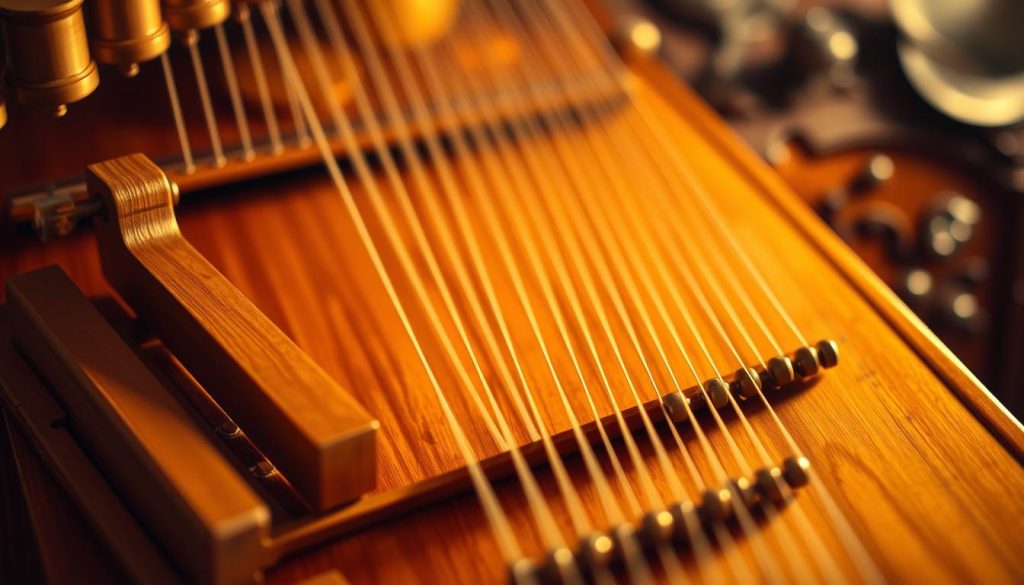
The jack is a strip of hardwood fitted with a plectrum. When the key is depressed, the plectrum plucks the string and then quickly retracts. This repeated action animates the plucked strings and produces a crisp attack.
The role of the plectrum
Formerly made from raven quill, the plectrum determines the attack and softness of the sound. Across three string choirs, it produces varied nuances depending on the material chosen.
How the dampers work
Later, cloth dampers were added to stop the vibration. They enable more precise and much more articulate playing.
The upper and lower manuals operate separate jacks. This separation provides a wealth of registrations and makes full use of the soundboard, which amplifies each pluck.
To learn more about this instrument, the reference entry provides useful technical details.
The transition to the piano in the late eighteenth century
Toward the end of the eighteenth century, the fortepiano revolutionized keyboard performance. Its hammer mechanism struck the strings instead of using plectra.
By the late eighteenth century, this instrument offered new dynamic possibilities. Nuance became possible under the musician’s fingers, unlike on the traditional upper manual.
This transition, marked by widespread adoption in the eighteenth century, encouraged composers to favor sensitivity over complex mechanisms.
Later in the eighteenth century, the old instrument’s gradual disappearance accelerated. Instrument making changed radically to meet the tastes of salons and larger halls.
“The shift to the piano was a turning point: expressiveness, power, and a new relationship to touch.”
- Innovation: hammers replacing plectra.
- Musical impact: dynamics and nuance.
- Timeline: accelerated adoption in the late eighteenth century.
| Element | Before | After (late eighteenth century) |
|---|---|---|
| Mechanism | Plectra and jacks | Hammers and dampers |
| Expression | Constant, limited | Variable, expanded |
| Use | Court, salon | Concert hall, composition |
The nineteenth-century eclipse
Between Romanticism and industrialization, the nineteenth century almost erased the memory of traditional expertise. After the end of the eighteenth century, this old keyboard instrument lost its place in salons and on stages.
Throughout the nineteenth century, the piano became the dominant instrument. Its power and dynamic range met new tastes.
The nineteenth century relegated the small instrument to private collections and museums. Workshops abandoned techniques that took a long time to pass on.
This eclipse lasted more than a century. Traditional construction and its subtleties were almost forgotten in favor of an aesthetic focused on expressive power.
“The transition to the piano transformed musical practice to the point of erasing an entire generation of makers.”
- Consequence: gradual disappearance of old techniques.
- Context: a taste for power and expressiveness.
- Revival: interest returned only at the end of the nineteenth century.
| Period | Situation | Consequence |
|---|---|---|
| Late eighteenth century | Still highly popular | Transition to the piano |
| Nineteenth century | Widespread abandonment | Technical knowledge lost |
| Late nineteenth century | Beginning of a revival | Research and restoration |
The modern revival of early music
A collective revival in the twentieth century gave a voice once again to the instruments and techniques of the past.
A return to traditional methods
During the twentieth century, musicians and researchers revived historical practices and sources.
Contemporary makers studied plans, treatises, and surviving early examples. They reproduced eighteenth-century solutions to reconstruct historical instruments faithful to the original models.
This return to the sources now allows us to hear the Baroque repertoire with a sound close to that so highly valued in the eighteenth century.
Modern performers use these musical instruments to explore a broad repertoire, from the seventeenth century to contemporary composition.
“Careful replication of historical techniques restores the works’ color and depth.”
- Revival of historically informed performance practices.
- Specialized workshops’ renewed use of eighteenth-century construction methods.
- Ongoing research to strengthen the authenticity of the sound.
Conclusion
In short, this object’s trajectory illustrates the dialogue between technique and aesthetics.
The history of the harpsichord shows continuous development: from the psaltery to large two-manual instruments, then into oblivion and, finally, revival.
The rediscovery of traditional construction methods restored a sound close to that of the original instruments.
Today, this instrument holds an essential place in Baroque music and European craftsmanship.
To explore its origins and influence further, discover who inspired it in who invented the harpsichord.