
Two famous instruments have shaped the history of Western music. The harpsichord appeared as early as the 16th century and reached its height in the 17th and 18th centuries. The piano, invented later, became especially prominent in the 19th century.
This article explores the fundamental distinctions between these two instruments. They may have a similar shape, but their mechanisms make all the difference: one plucks the strings, while the other strikes them. These technical choices alter the tone, touch, and repertoire.
We will see how each period favored a particular use, from the Baroque to the Romantic era. Understanding these differences helps music lovers appreciate the distinctive tonal richness of each instrument.
For a more detailed examination of their mechanisms and historical development, read this comprehensive article.
Harpsichord and piano: what are the differences?
The history of keyboard instruments reveals construction choices that completely change the way they are played.
The oldest surviving example dates from 1521, a milestone marking the rise of instrument making in Europe. Italian makers in Venice, Milan, Florence, Rome, and Naples established standards of quality as early as the Renaissance.
The harpsichord quickly became established as an instrument for secular music in European courts. It retained a central role until the 18th century and was used by numerous composers to create the characteristic textures of Baroque music.
Contrary to a common misconception, the harpsichord is not the piano’s direct ancestor. Their mechanical principles differ, giving the harpsichord a lively, brilliant tone, while the piano offers a more adaptable range of expression.
| Aspect | Harpsichord | Piano |
|---|---|---|
| Key date | 1521 (surviving example) | Early 18th century (Cristofori) |
| Tone | Lively, brilliant | Wide dynamic range |
| Historical role | Court, secular music, Baroque | Romanticism, symphonic repertoire |
| Renowned makers | Venetian, Milanese, Florentine, Roman, Neapolitan | Modern European makers |
The evolution of keyboards allowed composers to explore new playing techniques. Each innovation transformed the way musicians interacted with their instrument.
To learn more about the origins of the harpsichord, follow this link.
Sound-production mechanisms: plucked and struck strings
The internal mechanisms define how each keyboard turns a key press into sound.
The jack and plectrum
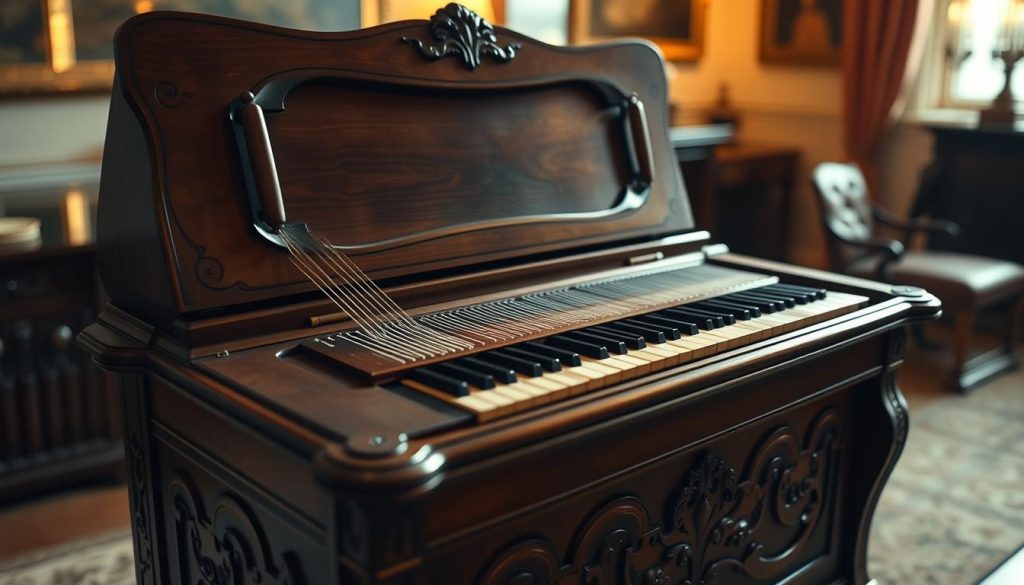
In a harpsichord, a jack raises a plectrum that plucks an iron or copper string.
The note sounds immediately, and its volume remains relatively constant regardless of how much force is applied to the key.
Cristofori’s hammer mechanism
Bartolomeo Cristofori introduced a mechanism around 1700 in which small hammers strike the strings.
This system allows the player to vary force and volume. It provides a wide variety of nuances for each note.
- The harpsichord plucks the strings; its timbre is brilliant and stable.
- The piano strikes the strings and uses dampers that control the duration of the sound.
- Instruments with multiple keyboards offer an even richer variety of timbres.
| Feature | Jack and plectrum | Cristofori’s hammers |
|---|---|---|
| Action | Plucks the string | Strikes the string |
| Volume control | No (constant volume) | Yes (nuances depend on force) |
| Duration and damping | No modern damper | Dampers for greater precision |
Historical development and instrument makers
The great instrument-making houses transformed the keyboard’s role in European music.
The Ruckers family, based in Antwerp, established manufacturing standards in the 18th century. Its instruments became benchmarks for the quality of their strings and sound.
At the turn of the 19th century, the mechanical innovations of Bartolomeo Cristofori encouraged the piano’s development. Composers were then able to explore new nuances.
- Domenico Scarlatti wrote pieces that exploit the harpsichord’s harmonic richness.
- European makers adapted the mechanism to meet composers’ expectations.
- The 20th century saw a revival of the harpsichord through historically informed performance.
In short, the history of the keyboard reflects continuous evolution. Through their technical choices, workshops expanded the tonal palette. To learn more about the origins of the piano, follow this link.
Playing techniques and musical expressiveness
Playing techniques shape expressiveness far beyond the mechanism alone. They determine how a work comes to life according to the chosen instrument and historical style.
The art of Baroque ornamentation
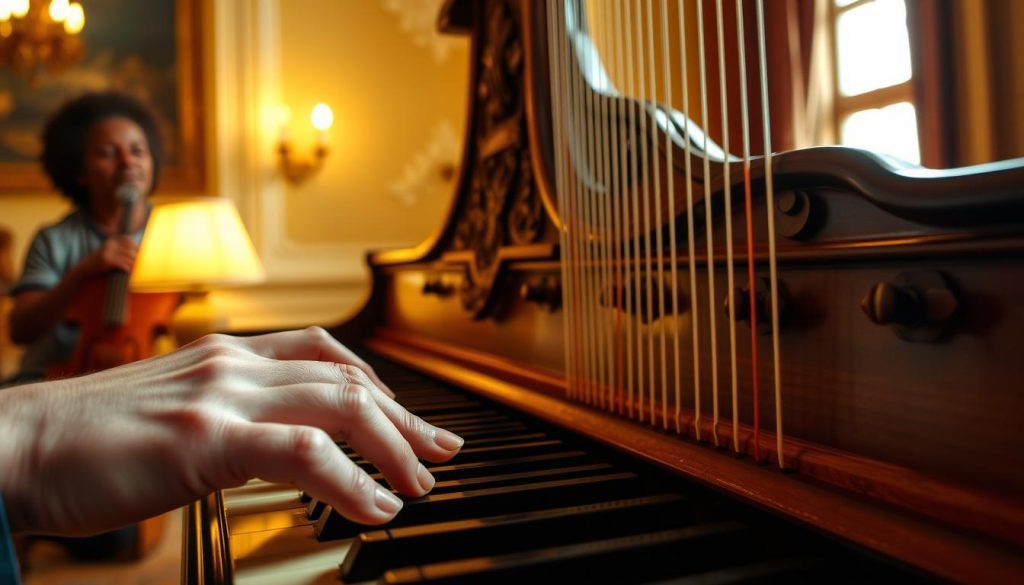
On the harpsichord, ornamentation is central: trills, mordents, and ornaments reinforce the melodic line.
The jack mechanism requires precise articulation to compensate for the lack of volume variation.
On certain models with multiple keyboards, layering timbres enriches the music.
Piano dynamics and touch
The piano offers a broader tonal palette thanks to the sensitivity of its keys.
The applied force affects the volume; composers write works that take advantage of this extensive variety.
The use of pedals
Pedals extend resonance, create legato effects, and enrich the tone color.
Their use changes the approach to playing and enables nuances that would otherwise be impossible.
An in-depth discussion of Baroque music interpretation and the practice of playing techniques.
Conclusion: two complementary legacies
The evolution of their mechanisms shaped two distinct voices in the service of music.
The harpsichord retains its place in Baroque and Classical music thanks to its plucked strings and crystalline timbre. It inspired composers such as Domenico Scarlatti in the 18th century.
The piano expanded the expressive palette through its struck strings, especially from the 19th century onward. Its playing technique offers nuances that makers continued to enrich through the 20th century.
By understanding this evolution, music lovers can better appreciate the richness of these works. To choose an instrument or learn more about brands, read about good piano brands.