
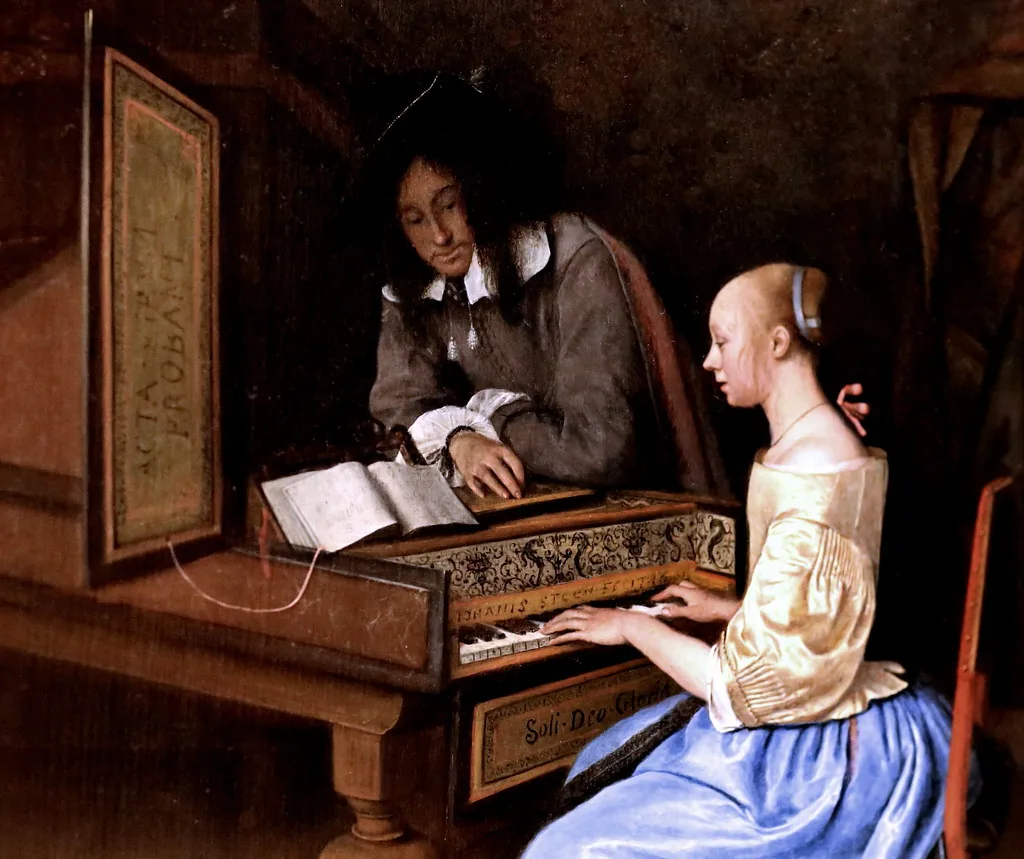
The harpsichord is a plucked-string musical instrument that shaped European history for several centuries. It is often distinguished from the piano by its bright sound and distinctive mechanism.
Its structure is based on a soundboard and a sturdy case. A mechanism called a jack plucks each string when a key is pressed. The registers and keyboards allow performers to vary the playing style and pitch.
French models, such as the one made by Jean-Paul Rouaud after a 1707 instrument by Nicolas Dumont, demonstrate the refinement of the craft. Some harpsichords even have two keyboards, offering possibilities similar to those of the organ.
This family of instruments also includes the spinet and the virginal. Many composers wrote a rich repertoire for the instrument, which remains prized for its tone and precision.
What is a harpsichord?
A plucked-string instrument, the harpsichord is defined by a mechanism in which each key operates a plectrum. The sound comes from the vibration of the strings, not from the force applied to the keyboard.
This feature makes the performance highly dependent on tone color and registration. Historical harpsichords preserved in museums demonstrate the variety of forms and temperaments.
Each instrument has its own sonic identity, shaped by the wood, soundboard, and craftsmanship. Studying these elements sheds light on its technical development.
“The harpsichord’s charm lies in its clarity and the delicacy of its attacks, qualities that define a Baroque aesthetic.”
To explore the subject further, see the section devoted to its history and models, which illustrates the diversity of instruments across Europe.
| Feature | Effect on sound | Example |
|---|---|---|
| Mechanism (jack) | Clear, brief attack | Flemish harpsichords |
| Soundboard | Projection and resonance | French models |
| Registers and keyboards | Tonal colors and limited dynamics | Double-manual harpsichord |
Origins and historical development
During the seventeenth and eighteenth centuries, the instrument became central to musical life and royal courts. It became composers’ preferred instrument for basso continuo and counterpoint.
The Baroque golden age
During this golden age, construction techniques advanced rapidly. Makers used precious woods and refined the mechanism to achieve greater clarity.
The soundboard was optimized to project sound in salons and chapels. Composers wrote an extensive repertoire for the harpsichord, spinet, and virginal.
The period of decline
The nineteenth century marked the instrument’s long disappearance from major concert halls. The piano came to dominate concerts and musical education.
In the twentieth century, performers such as Wanda Landowska revived interest in the early repertoire. Conservatories gradually reintroduced Baroque works.
“The historical revival restored instrument making and the soundboard to their rightful place in instrumental art.”
| Period | Development | Result |
|---|---|---|
| 17th–18th centuries | Refinement of construction and the mechanism | Preferred instrument for counterpoint and basso continuo |
| 19th century | Gradual replacement by the piano | Decline of harpsichords and the keyboard-instrument family |
| 20th century | Revival and restoration of instruments | Reintroduction of the Baroque repertoire |
The structure of the case
The case forms the framework that gives the harpsichord its visual and sonic presence.
Built from solid wood, it serves as a resonating body that amplifies the vibration of the strings. Internal reinforcements, such as bottom braces, withstand the considerable tension exerted by the strings.
Unlike the piano, the historical instrument has no metal frame. This construction choice keeps it surprisingly light for an object that could measure between 2 and 2.5 meters long in the eighteenth century.
The upper section ends in the soundboard, which is essential to the projection of every note. The case remains separate from the stand, making it easier to move between salons or concert halls.
- Primary role: reinforce and project the sound.
- Materials: solid wood and bottom braces.
- Dimensions: up to 2.5 m to enrich the tone.
The role of the plucked strings
The strings are the active element that converts the keyboard’s action into sound. Their vibration produces rich harmonics and gives the instrument its distinctive tonal palette.

Materials and tension
Each string rests on nuts and bridges that ensure the accuracy of its pitch. The position of the nuts also influences the color and sustain of the sound.
The jack, fitted with a plectrum, plucks the string consistently. Consequently, the force of the hand on the key does not change the dynamics, requiring an adapted touch.
- Iron wire or brass changes the tone and the tension on the soundboard.
- By the eighteenth century, instrument making had optimized the arrangement of the strings to balance the registers.
- Harpsichords remain distinct from the piano because of this mechanism and the response of their materials.
How the soundboard works
Beneath the keyboard, a very thin sheet of wood captures and amplifies the vibration of each string.
The soundboard acts as the sonic heart of the instrument. The bridge transfers energy to it, and it projects that energy into the case.
The harpsichordist uses the registers to select sets of strings. These choices alter the overall tone and the balance produced by the soundboard.
The shape and internal bracing remain instrument-making secrets inherited from the eighteenth century. They influence the color and sustain of the notes.
- Each string is tuned to a precise pitch, and the soundboard provides resonance.
- The jack and key work together to pluck the string.
- The bottom of the case completes the acoustic projection.
- The rose contributes to ventilation and the soundboard’s moisture balance.
| Component | Role | Effect on sound |
|---|---|---|
| Soundboard (sheet) | Amplification of vibrations | Clarity and projection |
| Internal bracing | Structural support | Color and sustain |
| Rose | Moisture balance | Tonal stability |
| Case bottom | Additional resonance | Volume and body |
The jack mechanism
The jack acts as a responsive joint that transforms pressure on the key into a sonic attack. It directs the plectrum toward the string and then allows the sound to stop cleanly.
The role of the plectrum
The plectrum plucks the string when the key is depressed. Formerly made from quill, it is often made from plastic today.
This development provides greater durability while preserving clarity of pitch. The quality of the plectrum influences the shape and color of the tone.
The key’s return
When the key is released, the jack descends and the damper stops the vibration. The upper part pivots out of the way to prevent a second pluck.
The construction of the jack, including its tongue and spring, determines the speed and precision of the action. The registers move the rows of jacks so that stops can be combined and the harmony varied.
| Component | Function | Effect |
|---|---|---|
| Jack | Pluck the string | Attack and articulation |
| Plectrum | Contact with the string | Color and duration |
| Damper | Stop the vibration | Precise silence |
| Construction | Tongue and spring | Fluidity of the action |
To learn more about the harpsichord jack and its variants, see the dedicated reference.
Keyboards and compass
The keyboards define the instrument’s ergonomics and expressive range.
The keyboard compass generally ranges from four and a half to five octaves. This range is sufficient for most of the Baroque repertoire and for more recent works.
French models often have two keyboards. These allow stops to be coupled and produce contrasts similar to those of the organ.
The main keyboard, inherited from historical construction, also controls stops at different pitches. Each key operates a dedicated jack, ensuring an immediate and precise response.
The arrangement of the keys and the form of the keyboards vary according to national traditions. These differences reflect playing style, the makers’ expertise, and development over the centuries.
- Compass: 4½–5 octaves, suitable for counterpoint.
- Two keyboards: a variety of couplings and tonal colors.
- Keys and jacks: precision for complex performances.
The diversity of registers
Registers allow the musician to shape the tonal color according to the ensemble and character of the piece. They can activate or deactivate different sets of strings to alter the tone and the instrument’s presence in the hall.

The art of coupling
Coupling the two keyboards, a technique borrowed from the organ, often doubles the power by bringing several ranks of strings into play. The harpsichordist can combine 8-foot and 4-foot stops to alter the perceived pitch and enrich the harmonics.
A dedicated register activates the lute stop, which produces a softer, more intimate tone. This palette is ideal for eighteenth-century chamber music.
“The precision with which the registers are made determines the difference between smooth coupling and an intrusive noise during performance.”
To explore historical practice and arrangements further, consult resources such as these transcriptions and studies. The diversity of its registers makes the instrument highly versatile and suitable for every style of its period.
Differences between the harpsichord, spinet, and virginal
The family of plucked-string keyboard instruments encompasses a variety of forms, each with its own tonal color and construction.
The virginal is distinguished by its rectangular shape and strings running parallel to the keyboard. Its ornamentation and range inspired many seventeenth-century composers.
The spinet often has a polygonal shape. More compact, it was prized at courts and in private salons for its size and price.
The larger harpsichord sometimes has two keyboards and a curved case that projects the sound. Harpsichords offer a different kind of power from the piano and other instruments of the same period.
All share a soundboard and a wooden case, but their arrangement changes the tone. Regional construction traditions also influenced the form and number of keyboards: Italy often favored a single keyboard, while France preferred double-manual designs.
For a detailed overview of the forms and terminology, see this guide to forms and definitions.
| Instrument | Shape | Use |
|---|---|---|
| Virginal | Rectangular | Solo repertoire, domestic music |
| Spinet | Polygonal, compact | Private use at court |
| Harpsichord | Asymmetrical, sometimes with two keyboards | Concert hall, concerto, accompaniment |
Famous makers and construction traditions
Historical workshops developed distinct construction traditions in different regions. These schools responded to the needs of composers and the expectations of period salons.

The Italian school
The Italian school favored lightweight instruments, often with a single keyboard. The carefully made case and decoration protected the soundboard and the soundboard itself.
The Ruckers dynasty
Based in Antwerp, the Ruckers dynasty established construction standards that influenced all of Europe. Their harpsichords served composers and guided production for several centuries.
French ravalement
In the eighteenth century, ravalement expanded the compass of Flemish instruments. Masters such as Pascal Taskin and François-Étienne Blanchet adapted older models to the demands of the repertoire.
- Woods such as spruce ensure the resonance of each string.
- Development led to models with two keyboards and richer stops.
- The precision of the mechanism strengthened the relationship between craftsmanship and music.
The Baroque repertoire and beyond
Suites, sonatas, and character pieces created a unique body of literature for the instrument. François Couperin, Domenico Scarlatti, and Johann Sebastian Bach are among the composers who enriched its repertoire.
The harpsichord played a central role in the basso continuo of period operas and concertos. Its sonic precision supports counterpoint and makes every voice distinct.
In the nineteenth century, the piano often displaced these instruments. In the twentieth century, however, composers such as Francis Poulenc rediscovered the keyboard’s palette and wrote for it.
“The clarity of the tone and the delicacy of the gesture call for writing that celebrates articulation rather than dynamics.”
- Principal repertoire: Couperin, Scarlatti, Bach.
- Functions: basso continuo, accompaniment, solo performance.
- Modern technique: present-day instrument making embraces both historical authenticity and sonic innovation.
| Period | Use | Feature |
|---|---|---|
| 17th–18th centuries | Basso continuo and suites | Clarity, counterpoint |
| 19th century | Replacement by the piano | Reduced role in concert halls |
| 20th–21st centuries | Revival and new compositions | Modern construction and historical fidelity |
Playing on two keyboards remains a signature feature. It offers performers and music students unique contrasts and expressive possibilities.
For an orchestral perspective, see the article on the harpsichord in the Baroque orchestra.
The instrument’s place in the salon
In eighteenth-century salons, the harpsichord played both a decorative and a social role. It occupied pride of place as a prestigious piece of furniture and encouraged people to share music.

The case was decorated with paintings, marquetry, and veneers of precious woods. These choices reflected the owner’s status and the taste of the period.
The maker often worked with cabinetmakers. Together, they ensured that the soundboard was as carefully finished as the exterior.
- Production included varnishes to protect the wood from humidity and climatic variations.
- The internal structure—the bottom and reinforcing braces—ensured longevity and made the instrument a family heirloom.
- The keyboard was used to accompany singers or enliven evenings with small ensembles.
This musical furniture embodied the union of artisanal craftsmanship and social life. For a broader historical perspective, see this history of the harpsichord.
The contemporary revival
Renewed interest in historical tone colors has returned the instrument to the center of contemporary musical life.
Wanda Landowska was one of the key figures in this resurgence. Her stage presence demonstrated that the early sound could remain alive in the twenty-first century.
Today, composers are once again writing for the instrument and exploring the colors offered by its registers and lute stop.
Modern instrument making draws inspiration from historical models while incorporating durable materials. Makers improve the stability of the strings and jacks to meet the demands of touring and present-day venues.
The keyboard and soundboard retain their roles; the case, legs, and keys are still designed with projection in mind. The tone remains distinct from that of the piano and appeals to audiences and performers alike.
Conservatories now offer specialized courses. Contemporary production combines artisanal tradition with acoustic requirements to serve the music of both the past and the present.
Conclusion
A relationship between expertise, repertoire, and modern practice thus emerges.
The instrument retains its place thanks to careful craftsmanship and the richness of its playing technique. The soundboard and legs reveal engineering devoted to sound.
The harpsichord continues to inspire musicians and makers; today’s harpsichords combine tradition and invention. Performance remains central to passing on the musical history of the past century.
Anyone wishing to explore keyboard posture and teaching methods further can consult this study of posture and pedagogy.
In short, the instrument provides a unique sonic experience that meets the demands of both early and contemporary music.