
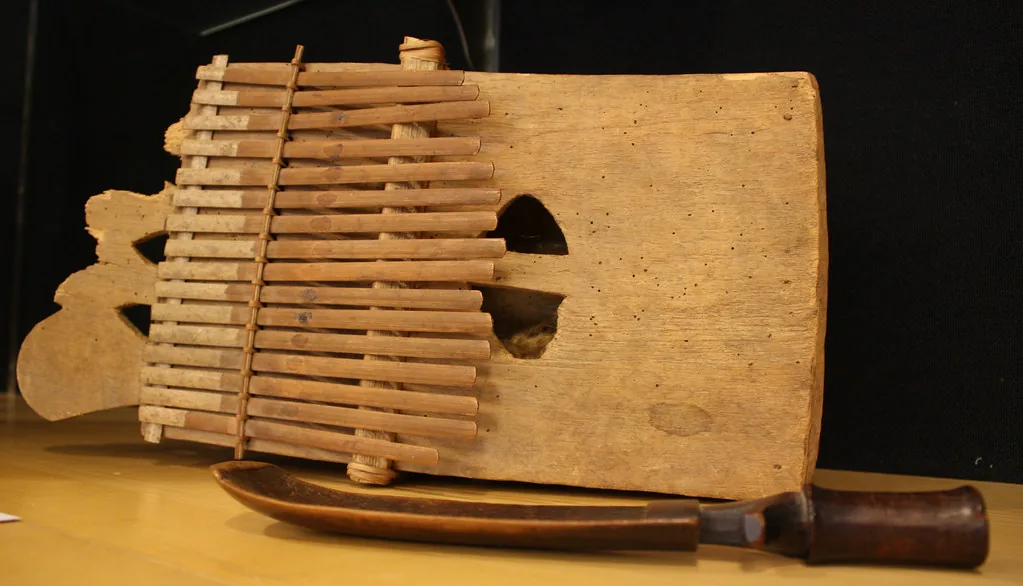
The kalimba, often called a thumb piano, is much more than a simple musical instrument. It embodies a profound connection between ancestral traditions and modernity. With its metal tines attached to a wooden or acrylic sound box, it produces soothing, mesmerizing sounds.
Used for thousands of years, this instrument has found a place in music therapy and is now embraced by international artists. Its history goes back more than 3,000 years, and its recognition by UNESCO in 2020 marked a turning point in the appreciation of its cultural value.
Recent archaeological discoveries in Zimbabwe and Mozambique have revealed fascinating traces of its ancient use. Join us as we delve into the captivating world of this unique instrument, where past and present meet in harmony.
Introduction to the African kalimba
This musical instrument with mesmerizing tones is a cultural treasure. The kalimba, also known as a thumb piano, is an idiophone consisting of 9 to 17 tunable metal tines. Attached to a sound box, these tines produce unique vibrations when pressed with the fingers.
Depending on the region, this instrument may have different names: mbira in Zimbabwe, sanza in Congo, or likembe in the Democratic Republic of the Congo. This diversity of names reflects its cultural importance across the continent.
What is the kalimba?
The modern kalimba, popularized by Hugh Tracey, differs from traditional versions in its design and ease of use. Whereas older models were often made from bamboo, current versions use modern materials such as acrylic.
The vibration mechanism of the metal tines is simple but effective. When a tine is plucked, it vibrates and produces a clear, melodic sound. This principle distinguishes it from other idiophones such as the marimba, which uses wooden bars.
Why explore its history?
Studying the kalimba offers a fascinating insight into Bantu migrations in Africa. This musical instrument was used as a tool for communication and cultural transmission. João dos Santos, a Portuguese missionary, described the Mozambican ambira as early as 1607, attesting to its historical importance.
Moreover, the popularity of the kalimba continues to grow. According to French market data, sales have increased by more than 400% since 2010. This enthusiasm shows how the instrument forms a bridge between ancestral traditions and modernity.
| Feature | Kalimba | Marimba |
|---|---|---|
| Tine or bar material | Metal | Wood |
| Type of idiophone | Metal-tine idiophone | Wooden-bar idiophone |
| Use | Traditional and modern music | Mainly classical music |
The ancestral origins of the kalimba
The earliest traces of the kalimba reveal a fascinating history marked by archaeological discoveries. This instrument, with its deep kalimba origins, dates back more than 3,000 years. Remains of bamboo tines dating from 1000 BC were found at the Nkang site in Cameroon.
In 2019, a major discovery in the Zambezi Valley uncovered metal kalimbas from the seventh century. Analyzed through spectrography, these finds show acoustic similarities spanning three millennia. They attest to the instrument’s enduring presence through the ages.
The earliest archaeological traces
The earliest archaeological traces of the kalimba are not confined to a single site. They extend across several African regions, revealing its ancient spread. Carbon-14 dating techniques have been used to analyze organic remains associated with these discoveries.
Swahili and Sahelian versions have distinct characteristics. These differences reflect local cultural influences and trade. Blacksmith guilds played a key role in preserving manufacturing techniques.
The African regions where it originated
The kalimba has its origins in several African regions. Ancient trade routes facilitated its spread, creating regional variants. German ethnographic missions between 1890 and 1914 helped document these traditions.
In the 1950s, researchers studied these instruments in greater depth, revealing their cultural importance. Today, these discoveries continue to inspire musicians and historians, connecting past and present.
The cultural significance of the kalimba
At the heart of ancestral rituals, it stands as a powerful cultural symbol. With its unique sound box, this instrument has always been much more than a musical object. It embodies profound social, spiritual, and historical values.
Its role in traditional ceremonies
In many African cultures, this instrument plays a key role in ceremonies. Among the Shona of Zimbabwe, for example, the bira ritual lasts 72 hours. During this time, musicians play continuously to communicate with the ancestors.
In Mali, it is used in initiation schools to memorize genealogies. These practices show how it serves as an essential link between generations.
A tool for oral transmission
This instrument has also served as a medium for transmitting knowledge. A UNESCO study conducted in 2018 found that 152 proverbs had been preserved through its melodies. Coded rhythms, such as those of the Mau Mau in Kenya, were even used during resistance to colonial rule.
Mnemonic techniques such as “nyimbo za makala” (songs with coded messages) illustrate its importance. To choose the right repertoire, musicians relied on these traditions.
The evolution of materials and designs
Over the centuries, the materials and designs of this instrument have evolved significantly. Metal tines replaced the old bamboo strips, offering greater durability and a richer tone. This transition marked a turning point in the instrument’s history.

From bamboo to metal tines
The earliest versions were made from bamboo, a natural but relatively short-lived material. With the introduction of metal tines, sound quality improved. Stainless steel, for example, can last more than 50 years, compared with 2 to 5 years for bamboo.
In addition, new alloys such as anodized aluminum and phosphor bronze have made it possible to explore previously unheard tones. These innovations have redefined the instrument’s acoustic possibilities.
The impact of innovation on sound
Technological innovations have also influenced sound volume. A mahogany sound box, for example, can increase volume by 15 dB compared with a traditional gourd. Gecko’s 2021 innovation, with its magnetic amplification system, pushed these limits even further.
Acrylic glass is another modern material that has gained popularity. It offers a unique aesthetic while improving sound projection. These advances show how modern materials can transform an ancestral instrument.
Lastly, environmental concerns have led to the use of FSC-certified woods such as acacia. These responsible choices reconcile tradition and sustainability while preserving the instrument’s cultural heritage.
The spread of the kalimba across Africa
The spread of the kalimba across Africa is a rich story of exchange and adaptation. Often called a finger piano, the instrument traveled through different regions, carrying unique traditions and sounds. Migration and cultural exchange played a key role in its dissemination.
Migration and cultural exchange
Trans-Saharan caravans were an essential vehicle for the spread of the kalimba. These trade routes allowed the instrument to cross borders and adapt to local cultures. The Mozambican timbila, for example, with its bells made from soda-bottle caps, demonstrates an ingenious adaptation to available resources.
Decorative motifs, whether animal-inspired or clan-related, also reflect cultural influences. These artistic details attest to the richness of exchanges between communities.
The different regional variants
The Hornbostel–Sachs catalogue lists 87 variants of this instrument, each with its own characteristics. The Mozambican version, for example, is distinguished by its use of recycled materials, while Dogon models are known for their termite-resistant treatment.
The “Ubuntu Sound” project has archived more than 1,200 recordings, offering valuable insight into these variants. These digital archives help preserve and share this musical heritage.
| Variant | Region | Feature |
|---|---|---|
| Timbila | Mozambique | Bells made from soda-bottle caps |
| Mbira | Zimbabwe | Forged-metal tines |
| Likembe | Democratic Republic of the Congo | Gourd sound box |
The Musée des Confluences in Lyon houses an exceptional collection of these instruments. Its partnership with LVMH aims to preserve traditional expertise, particularly that of Dogon craftspeople.
Compared with other instruments, the kalimba has a unique ability to adapt to extreme climates. Craftspeople very often use innovative techniques to ensure its durability.
The kalimba in traditional African music
For centuries, this instrument has provided the rhythm for African ceremonies and stories. With its unique tones, it has captured the essence of local traditions. Its role extends far beyond music: it serves as a bridge between generations and cultures.
Characteristic rhythms and melodies
Kalimba rhythms are deeply rooted in African traditions. The “kushaura,” popularized by Stella Chiweshe, is a complex rhythmic signature. Often transmitted orally, these melodies tell stories and legends.
Among the Lunda people of Zambia, the “mukanda” is another striking example. Used during initiation ceremonies, this rhythm symbolizes the transition to adulthood. These world instruments continue to inspire modern musicians.
Iconic musicians
Among the iconic musicians, Thomas Mapfumo, nicknamed “the Lion of Zimbabwe,” redefined the use of the kalimba. His exclusive interview reveals how he incorporated the instrument into contemporary music.
João dos Santos, a Portuguese missionary, also documented its use as early as the seventeenth century. These figures helped turn the kalimba into a global cultural symbol.
The “Kalimba Kids” educational program, present in 23 African countries, demonstrates its importance. This project aims to preserve and pass on this musical heritage to future generations.
The kalimba’s arrival on the world stage
Having become a musical symbol, it crossed borders and established itself on the world stage. Its unique timbre and mesmerizing melodies captivated listeners far beyond Africa. This rise demonstrates its power to transcend cultures and adapt to modern musical trends.
Early encounters with the West
The first encounters between the kalimba and the West date back to the 1950s. Hugh Tracey, a British ethnomusicologist, played a key role in this introduction. He popularized the instrument by presenting it at international concerts and exhibitions.
In 1994, the kalimba reached a turning point through its use in the soundtrack of The Lion King. For 23 minutes, its melodies enchanted millions of viewers, increasing its visibility on the world stage.
Its influence on modern music
The kalimba has profoundly influenced modern music. Artists such as Ali Farka Touré incorporated the instrument into their work, including the album Talking Timbuktu. This recording contributed to the rise of Afro-jazz, a genre that blends African traditions with contemporary sounds.
Innovative collaborations, such as the one between Burna Boy and Yoruba craftspeople, have also redefined its role. These partnerships show how the kalimba continues to inspire creators around the world.
| Event | Impact |
|---|---|
| Exhibition at the Met (2023) | Presentation of rare nineteenth-century pieces |
| Exports in 2022 | 1.2 million units exported from Africa |
| Guitar/kalimba hybridization | Innovation in modern instrument making |
These advances show how the kalimba has adapted to the expectations of modern music while preserving its cultural heritage. Its influence continues to grow, making it an essential instrument in today’s musical landscape.
Hugh Tracey and the modernization of the kalimba
In the 1950s, an ethnomusicologist transformed an ancestral instrument. Hugh Tracey, who was passionate about African traditions, played a key role in modernizing the kalimba. His work made the instrument accessible to a worldwide audience.
The creation of the diatonic kalimba
In 1954, Hugh Tracey filed a patent for the diatonic kalimba. Tuned to G major, the instrument was easy to use while retaining traditional tones. This innovation opened up new musical possibilities.
The G-major tuning allowed better integration into Western musical styles. Musicologists welcomed this advance, which made the instrument easier to learn and helped it spread.
International commercialization
The international commercialization of the kalimba began in the 1950s. Between 1955 and 1975, more than 450,000 units were sold worldwide. This success marked a turning point in the instrument’s history.
In 1968, 78% of British schools incorporated the kalimba into their curricula. This widespread adoption demonstrates its impact on music education.
| Period | Units sold | Impact |
|---|---|---|
| 1955–1975 | 450,000 | Worldwide commercialization |
| 1968 | N/A | Adoption by 78% of British schools |
Thanks to Hugh Tracey, the kalimba crossed borders and became an essential instrument. His legacy continues to inspire musicians and educators around the world.
The kalimba in music therapy
The kalimba’s unique vibrations have found an important place in modern music therapy. With its gentle, soothing tones, the instrument is increasingly used to improve emotional and mental well-being.
Mental-health benefits
A 2022 INSERM study found that using the kalimba reduced anxiety by 37% among patients with Alzheimer’s disease. These mental-health benefits are attributed to the subtle vibrations of its steel tines, which create a calm, relaxing atmosphere.
Dr. Lefèvre of Pitié-Salpêtrière Hospital says:
“The kalimba has transformed our therapeutic approach, offering an effective non-drug alternative.”
Its use in modern care
Montpellier University Hospital introduced a protocol of 15 45-minute sessions to incorporate the kalimba into care. This approach is certified to the AFNOR NF S 97-550 standard, ensuring high quality standards.
The kalimba has also been adapted for visually impaired people through a tactile marking system. Compared with other instruments, such as the hang drum, it offers greater accessibility and effectiveness.
In the workplace, the “Sound Healing” program has been adopted by several CAC 40 companies to reduce employee stress. This partnership with the French Federation of Psychiatry shows how the kalimba fits into modern care.
To learn more about the soothing benefits of the kalimba, explore our comprehensive guide.
International artists and the kalimba
It quickly became a universal musical symbol. Its unique timbre and mesmerizing melodies have captivated international artists, who have incorporated it into their work. From Paul Simon to Björk, the instrument has established itself across varied genres, from folk to electronic music.

Famous groups and musicians
Paul Simon made history by using the kalimba on his album Graceland, particularly on the track “Under African Skies.” This collaboration helped the instrument gain visibility on the world stage. Björk modified her kalimba with electronic effects, creating innovative sounds.
Ludovico Einaudi also explored the instrument’s possibilities on his album Kalimba Suite, offering a contemporary interpretation of its traditional melodies. These examples show how the kalimba inspires renowned artists.
The kalimba across varied musical genres
The instrument has adapted to varied genres, from jazz to pop. The unexpected collaboration between Daft Punk and Toumani Diabaté produced hybrid sounds that blend African traditions with modernity.
In video games, the kalimba was used in the soundtrack of Assassin’s Creed Origins, adding an authentic touch to the atmosphere. The Spotify playlist “Kalimba Global,” with 1.3 million followers, demonstrates its growing popularity.
Jacob Collier, known for his innovative techniques, shared an exclusive tutorial on using the kalimba. These initiatives show how the instrument continues to evolve and adapt to current musical trends.
Handcrafting the kalimba
Creating a kalimba is an art that combines tradition and innovation. Each instrument is the product of meticulous expertise passed down from generation to generation. Craftspeople use ancestral construction techniques to shape unique pieces while incorporating modern materials to improve durability and tone.
Traditional and modern materials
The selected wood species play a crucial role in the kalimba’s quality. Mahogany, teak, and ebony are favored for their density and resonance. Metal tines, often made from stainless steel, replace the old bamboo strips and offer greater durability.
Recent innovations include the use of titanium, particularly through a collaboration with Airbus DS. These modern materials make it possible to create lightweight, durable kalimbas while retaining traditional tones.
Construction techniques
The handcrafting of a kalimba follows a rigorous process. From felling the wood to final tuning, every stage is completed with care. Craftspeople use traditional tools such as wood chisels while also incorporating CNC machines for greater precision.
The process comprises 18 stages, from drying the wood to attaching the tines. Particular attention is paid to acoustic balance, ensuring a harmonious, rich sound.
“Making a kalimba is a dance between past and present, in which every gesture matters.”
| Stage | Description |
|---|---|
| Wood selection | Selection of wood species for the sound box |
| Cutting | Use of saws and wood chisels |
| Attaching the tines | Positioning and adjustment of the metal tines |
| Tuning | Precise adjustment of the notes for optimal tone |
The “Origine Afrique Garantie” certification ensures that each kalimba is made according to strict standards, thereby preserving its cultural heritage. Participatory workshops such as the one at the Cité de la Musique offer a close look at this fascinating process.
The kalimba in popular culture
The kalimba has become a fixture of popular culture, transcending musical boundaries. Its unique timbre and mesmerizing melodies have found a place in various fields, from media to cultural events.

Its appearances in the media
The kalimba has made a strong impression through its use in major advertising campaigns. An Apple advertisement highlighting its simplicity and authenticity, for example, reached millions of viewers. Google likewise incorporated its tones into a campaign celebrating cultural diversity.
The television program “Slam” also contributed to its popularity, reaching a record audience of 4.7 million viewers. These media appearances increased its visibility and appeal among the general public.
Its role in festivals and events
In 2024, 23 festivals devoted to the kalimba were scheduled across Europe, demonstrating its growing influence. Combining musical performances with educational workshops, these events attract thousands of enthusiasts.
The PSG Africa Tour also adopted the instrument as a cultural symbol, incorporating its melodies into sporting events. In addition, an international composition competition offers a €10,000 prize, encouraging musical creation centered on the kalimba.
The Philharmonie de Paris recently hosted an immersive exhibition showcasing its history and evolution. These initiatives show how the kalimba continues to inspire and bring communities together.
Finally, the “Kalimba Heroes” NFT project offers virtual kalimbas certified through blockchain technology, merging tradition and innovation. To discover how more than 20 notable musicians have incorporated this instrument into their compositions, explore our comprehensive guide.
The challenges of preserving the kalimba
In the face of contemporary issues, safeguarding this ancestral instrument presents a major challenge. The preservation challenges include the loss of artisanal expertise and the increasing scarcity of traditional materials. Collective efforts are needed to protect this cultural heritage.
Safeguarding initiatives
UNESCO allocated a budget of €2.3 million between 2021 and 2025 to support safeguarding initiatives. Among them, the “Adopt a Kalimba” program enabled 420 instruments to be restored. A map of 147 threatened traditional workshops was also created.
In Mali, a bill aims to protect local expertise. The British Museum partnered with craftspeople to return historic pieces. These actions demonstrate the importance of preserving ancestral techniques.
Recognition as cultural heritage
Recognizing the kalimba as cultural heritage is a crucial step. A nature reserve for precious woods was created in Ghana to ensure the supply of materials. The NGO Sound Matters trained 120 young instrument makers, ensuring that skills are passed on.
A mobile application was developed to teach manufacturing techniques. These safeguarding initiatives show how technology can support traditions.
“Preserving the kalimba is a collective duty that connects past and future.”
These efforts demonstrate the importance of protecting this instrument, a symbol of rich and diverse cultural heritage. Together, we can ensure its survival for future generations.
How do you choose a kalimba today?
With a variety of models available, choosing a kalimba can seem complicated. To make the right choice, it is essential to understand the key selection criteria and know the recommended brands.

Criteria to consider
Several factors should guide your decision:
- Materials: favor dense woods such as mahogany or ebony for better resonance.
- Ergonomics: try several models to find the one that suits your body shape.
- Quality labels: look for AFNOR or ISO 9001 certification to ensure durability.
A tuning expert notes:
“A good kalimba should offer a perfect balance between design and tone.”
Recommended brands and models
Among the recommended brands, Gecko and Trekel stand out for their quality. Here is a comparison:
| Model | Price | Features |
|---|---|---|
| Gecko | €29 | Ideal for beginners, optimally lightweight. |
| Trekel | €890 | High-end, with a rich and precise tone. |
Finally, do not forget essential accessories such as protective cases and capos, which will help extend the life of your instrument.
Learning to play the kalimba
Playing the kalimba is a rewarding experience accessible to everyone, even without prior musical knowledge. With its soothing tones and ease of use, the instrument is perfect for exploring music in a playful way. Whether you are a beginner or an experienced musician, the kalimba offers a gentle, intuitive learning curve.
To learn to play effectively, it is essential to master the basic techniques and have the right beginner resources. Here is a guide to help you get started.
Basic techniques
Start by understanding hand positioning. The thumbs do most of the work, but the other fingers can support the instrument. Use gentle, steady movements to pluck the tines, avoiding sudden gestures.
The “Kalimba Pro” method offers a 12-week progression that is ideal for beginners. With a 92% success rate thanks to its tab notation system, this method is recognized for its effectiveness.
“The kalimba lends itself to exploration and creativity. Every note is a discovery.”
Resources for beginners
Several tools are available to make learning easier:
- Video tutorials: learn arpeggios and basic melodies with visual guides.
- Apps: compare Yousician and Simply to find the one that suits your learning style.
- Online courses: the partnership with imusic-school offers 35 hours of lessons adapted to all levels.
For those who want to go further, the international certification program (Grades 1–8) is an excellent option. You can also join an active Discord community of 250,000 members to exchange advice and tips.
Lastly, the teaching kit for primary schools, approved by the French Ministry of Education, introduces younger children to this fascinating instrument.
Conclusion: the timeless legacy of the kalimba
Through the ages, this instrument has crossed cultural and temporal boundaries. Its timeless legacy lies in its ability to connect generations and traditions. A young instrument maker from Ouagadougou says: “Every kalimba I create carries part of my story and that of my ancestors.”
To preserve this art, supporting local craftspeople is essential. Their expertise is a cultural bridge between past and future. Future innovations, such as the connected kalimba and the integration of musical AI, open up new possibilities while respecting its roots.
As Youssou N’Dour says: “The sound of the kalimba is universal; it speaks to the soul.” Its enduring influence continues to inspire and unite cultures around the world.