
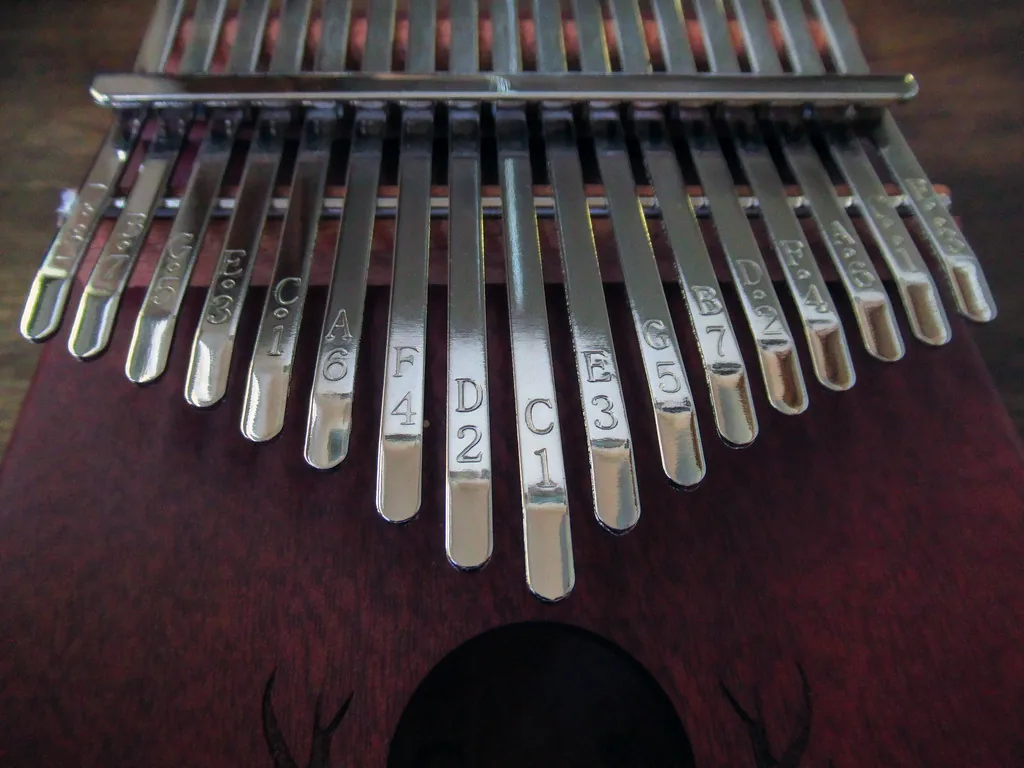
The kalimba, a musical instrument with African origins, is gaining popularity as a modern therapeutic tool. Its soothing sounds and ease of use make it a valuable aid for relaxation and well-being.
According to a 2020 study led by Dr. Léonie Kausel, playing music stimulates the brain and improves cognitive functions. This research confirms the growing interest in music therapy, with a 40% increase in searches in France since 2020.
Music therapists, such as those in Lyon, use the kalimba to support patients with cognitive disorders such as Alzheimer’s disease. This instrument helps people reconnect with cultural traditions while promoting relaxation and concentration.
To learn more about the benefits of this instrument, read our detailed article here.
Introduction to the kalimba
For thousands of years, the kalimba has resonated throughout African cultures. Both simple and fascinating, this instrument is much more than a musical tool. It embodies a rich tradition and a profound connection with history and ancestral rituals.
What is the kalimba?
The kalimba, also called the mbira, is an instrument with metal tines attached to a wooden resonator. Its gentle, enchanting melodies make it a popular choice for relaxation and meditation. Easy to play, it is accessible to everyone, from beginners to experienced musicians.
Origins and history of the kalimba
The kalimba’s African origins date back more than 3,000 years to the Shona people of Zimbabwe. Used during traditional rituals, it served to communicate with ancestors and tell stories. Today, it is recognized as a key element of African culture.
In the 1950s, Hugh Tracey modernized the instrument, creating a more accessible Westernized version. Today’s kalimba differs from the traditional mbira in its size and design while retaining its unique essence.
| Aspect | Details |
|---|---|
| Origins | Shona people, Zimbabwe, 3,000 years ago |
| Traditional use | Rituals, communication with ancestors |
| Modern development | Hugh Tracey, 1950s |
| UNESCO status | Intangible heritage of Malawi since 2014 |
To learn more about this captivating instrument, read our guide to discover the kalimba.
Why choose the kalimba for music therapy?
Among the instruments used in music therapy, the kalimba holds a special place. Its unique characteristics make it an ideal tool for relaxation and well-being.
The soothing sounds of the kalimba
The kalimba’s gentle, enchanting melodies act as a true balm for the mind. Its soothing vibrations help reduce stress and create an atmosphere conducive to relaxation. An ideal instrument for those seeking to reconnect with themselves.
Accessibility and ease of use
The kalimba is designed to be accessible to everyone, even without musical experience. With a learning method that requires no music theory and a numbered-tine system, learning to play becomes child’s play. Starter kits also include an electronic tuner and thumb protectors to make the instrument easier to use.
For beginners, the Meinl KA5S model is recommended. With its 5 tines and affordable price (€30), it offers accessibility for every budget. Mobile apps such as Kalimba Real provide interactive tutorials, making learning even more accessible.
- Average learning time: 2 hours for a simple melody (compared with 20 hours for the guitar).
- Adaptations for motor disabilities: KORG KMB-1 ergonomic support.
The benefits of music therapy with the kalimba
The kalimba’s melodic vibrations act as a natural remedy for stress and mental fatigue. Thanks to its soothing sounds, this instrument creates a calm space conducive to relaxation.
Stress reduction and relaxation
The kalimba’s gentle melodies stimulate the production of endorphins, the feel-good hormones. According to a recent study, playing this instrument significantly reduces levels of cortisol, the stress hormone. A genuine tool for restoring emotional balance.
Improved concentration and memory
Playing the kalimba activates key areas of the brain, such as the hippocampus and prefrontal cortex. These regions are essential for memory and intellectual abilities. A study by Dr. Kausel found a 22% increase in participants’ memory scores.
- Progressive exercises: from reproducing patterns to improvisation.
- Application to dyslexia and related learning disorders through kinesthetic memory.
- “Neurokalimba” program in nursing homes to combat senile dementia.
“Music is a universal language that touches the soul and stimulates the mind.”
By incorporating the kalimba into your routine, you can not only improve your concentration but also strengthen your memory in a fun and enjoyable way.
The kalimba and hand coordination
Thanks to its metal tines, the kalimba promotes better hand coordination. This instrument requires synchronization between both hands, making it an effective tool for developing fine motor skills.

Improved dexterity
Playing the kalimba requires precise manipulation of the tines. This practice strengthens dexterity and improves fluidity of movement. An ideal exercise for anyone wishing to refine their manual agility.
The KPlay model, designed for visually impaired people, is an example of an innovative adaptation. It allows everyone to enjoy the benefits of this instrument, regardless of their level of mobility.
Benefits for children and older adults
The kalimba is particularly beneficial for children and older adults. In French primary schools, the KalimbaKids program is already established in 50 institutions. It follows a Montessori method adapted for children aged 3 to 6.
For older adults, intergenerational workshops are organized in nursing homes. These sessions help prevent Parkinson’s disease and maintain cognitive activity. A partnership with AP-HP reinforces these initiatives in geriatric departments.
| Beneficiaries | Benefits |
|---|---|
| Children | Development of fine motor skills and concentration |
| Older adults | Prevention of cognitive disorders and improved coordination |
| Visually impaired people | Accessibility with the KPlay model |
The kalimba as a meditation tool
The kalimba proves to be an ideal companion for meditation and relaxation. Its gentle, enveloping sounds create an atmosphere conducive to relaxation, allowing you to refocus on the present moment.
Creating a calm space
The kalimba’s vibrations act as a sound filter, keeping distractions at bay and fostering a state of inner calm. A serene space arises naturally, ideal for meditation.
The “Nidra Kalimba” program offers guided sessions for restorative sleep. The melodies are designed to soothe the mind and prepare the body for rest.
Use during yoga and relaxation
The kalimba fits perfectly into yoga practices, particularly Vinyasa flows and Yin Yoga. Its harmonious notes accompany the movements, strengthening the connection between body and mind.
For deep relaxation, pool sessions featuring an underwater kalimba are offered. The water amplifies the vibrations, providing a unique sensory experience.
- Collaboration with the Manduka brand for workshops combining yoga mats and the kalimba.
- Workplace workshops to combat burnout, with 30-minute sessions.
- A sequence of 7 poses synchronized with tuning in G major.
“The kalimba is a gateway to inner peace, a bridge between the outside world and our mind.”
| Application | Benefits |
|---|---|
| Yoga | Improved concentration and fluidity of movement |
| Pool relaxation | Sensory experience amplified by water |
| Workplace workshops | Stress reduction and burnout prevention |
The African origins of the kalimba
With roots reaching deep into ancient Africa, the kalimba embodies a rich and captivating musical tradition. Far more than a simple musical tool, this instrument is living testimony to African cultural heritage.
A profound cultural connection
The kalimba, also known as the mbira, is deeply connected to the rituals and traditions of African peoples. Used to communicate with ancestors and tell stories, it plays a central role in spiritual and social life.
The 1997 archaeological discovery of an ivory mbira dated to 1300 BC confirms the instrument’s antiquity. This find highlights its importance in the African origins of music.
The history of the mbira and its evolution
The history of the mbira was shaped by the Bantu migration, which helped spread it across Africa. The instrument also influenced modern blues, particularly through the slave trade, which carried its sounds to the Americas.
The British Museum houses a collection of rare instruments documenting this evolution. Every year, the International Mbira Festival in Zimbabwe celebrates this heritage, attracting musicians and enthusiasts from around the world.
- Bantu migration and pan-African diffusion.
- Influence on modern blues through the slave trade.
- Collection of rare instruments at the British Museum.
- International Mbira Festival in Zimbabwe.
- 3D reconstruction of an ancient mbira by the CNRS.
These elements show how the kalimba has crossed borders over the centuries while preserving its cultural essence.
How do you play the kalimba?
Learning to play the kalimba is an enriching and accessible experience. Whether you are a beginner or an accomplished musician, this instrument offers a gentle learning curve and quick results.
Basic techniques for beginners
To begin, it is essential to master the basic techniques. The kalimba is played with the thumbs by plucking the metal tines. Good posture and light pressure are essential for producing clear, harmonious sounds.
The tablature notation system is particularly well suited to beginners. It shows which tines to play without requiring any knowledge of music theory. This method simplifies learning and makes the instrument accessible to everyone.
Sheet music and resources for improving
To improve, many resources are available. The Kalimba Academy platform offers more than 500 free tablatures covering a variety of styles. This sheet music is ideal for exploring new pieces and improving your skills.
Books such as Kalimba for Dummies (First Éditions) provide comprehensive guides for beginners. YouTube channels such as Kalimba Magic and Mbira Lessons offer video tutorials that are perfect for visual learning.
Learning apps with sound recognition are also useful. They allow you to check note accuracy in real time, a valuable tool for self-taught players.
| Resource | Benefits |
|---|---|
| Kalimba Academy | More than 500 free tablatures |
| Books | Comprehensive guides for beginners |
| YouTube channels | Visual tutorials |
| Apps | Real-time sound recognition |
Finally, the annual France Kalimba Challenge is an excellent opportunity to stay motivated and share your passion with other musicians.
The kalimba for every skill level
Whether you are a novice or an expert, the kalimba adapts to every profile. This instrument offers great flexibility, allowing everyone to find a model suited to their needs and skill level.
Beginner-friendly models
Simple, affordable models are available for beginners. The Hugh Tracey Alto chromatic kalimba, with its 34 tines, is an excellent choice for anyone wishing to explore complex melodies. Its €450 price makes it an accessible option for serious enthusiasts.
Basic instruments, often fitted with 5 to 10 tines, are perfect for gentle learning. They allow players to master fundamental techniques before moving on to more sophisticated models.
Options for experienced musicians
For experienced musicians, professional kalimbas offer advanced features. These include instruments with pedal systems and electro-acoustic versions with MIDI output, allowing integration into complex setups.
- Specialized effects modules (reverb and delay) to enrich the sound.
- Collaborations with IRCAM on contemporary repertoire.
- Classical concerts at the Philharmonie de Paris showcasing the instrument’s versatility.
These options allow musicians to push their limits and explore new musical dimensions.
The kalimba and memory
Playing the kalimba offers unexpected cognitive benefits. Thanks to its simple, repetitive melodies, this instrument stimulates memory and improves brain function. A recent study shows that regularly playing the kalimba increases memory capacity by 22%.
Cognitive stimulation through practice
Kalimba melodies activate key areas of the brain, such as the hippocampus and prefrontal cortex. These regions are essential for long-term memory and concentration. A genuine mental workout through music.
The method of loci, adapted to melodic sequences, helps players memorize complex patterns. Used by memory champions, this technique becomes accessible to everyone through the kalimba.
Exercises to strengthen memory
Several exercises are suggested to strengthen memory. The 30 Melodies in 30 Days Challenge is a popular method. It involves learning a new melody each day, thereby stimulating short-term memory.
Melodic flashcards and apps such as EarMaster Pro are also effective. These tools make practice fun and interactive.
| Exercise | Benefits |
|---|---|
| 30 Melodies Challenge | Improved short-term memory |
| Melodic flashcards | Visual and auditory stimulation |
| Memory apps | Interactive and progressive learning |
Finally, memory tournaments organized by the French Kalimba Federation offer a unique opportunity to challenge yourself. One participant says: “The kalimba helped me recover a memory I thought I had lost.”
The kalimba in music therapy
In the field of mental health, the kalimba is emerging as an innovative therapeutic tool. Its soothing sounds and ease of use make it a valuable aid for healthcare professionals.

Use by healthcare professionals
Therapists are increasingly incorporating this instrument into their practice. A recent study shows a 31% increase in serotonin levels measured in patients’ saliva. A significant result for mood management.
Emotional journaling combined with kalimba practice allows patients to express their feelings creatively. This method is particularly effective in programs devoted to bipolar disorders.
Effects on mood and emotional well-being
The kalimba’s vibrations act directly on the nervous system. They promote relaxation and improve emotional well-being. Physiological measurements such as heart-rate variability and skin conductance confirm these effects.
In post-attack crisis units, the kalimba is used to soothe victims. Accounts from patients in cancer remission highlight its positive impact on their recovery journey.
“The kalimba helped me restore an emotional balance I thought I had lost.”
| Application | Effect |
|---|---|
| Emotional journal | Creative expression of feelings |
| Programs devoted to bipolar disorders | Mood stabilization |
| Crisis unit | Soothing victims |
| Physiological measurements | Improved heart-rate variability |
The kalimba and deep relaxation
The kalimba’s gentle, enveloping melodies offer a unique experience of deep relaxation. Through its soothing vibrations, this instrument creates a calm space that is ideal for unwinding and refocusing.
Gentle sounds and soothing vibrations
The kalimba’s harmonious notes act as a true balm for the mind. They stimulate endorphin production, thereby promoting a natural state of well-being. Regular listening can reduce stress and improve sleep quality.
Combining the music with dynamic lighting, such as the Philips Hue Sync system, amplifies the experience. Lighting variations synchronized with the melodies create a Zen atmosphere conducive to relaxation.
Creating a Zen atmosphere
Multisensory spaces can be arranged to optimize the kalimba’s relaxing effect. These environments incorporate ambient fragrances such as palmarosa or incense and custom-made acoustic furniture. Total immersion in a soothing world.
Self-installation guides are available for individuals who wish to recreate this atmosphere at home. “Kalimba Night” events in planetariums also provide a unique experience combining music and star projections.
| Element | Contribution to relaxation |
|---|---|
| Dynamic lighting | Creates a soothing visual atmosphere |
| Ambient fragrances | Olfactory stimulation for relaxation |
| Acoustic furniture | Optimizes sound quality |
| Kalimba Night events | Unique immersive experience |
The kalimba and African culture
An ancestral instrument, the kalimba embodies profound cultural richness. Its origins go back thousands of years, when it played a central role in African rituals and ceremonies. Today, it continues to symbolize a living heritage passed down from generation to generation.

An instrument with ancient roots
The kalimba is much more than a simple musical instrument. It is a direct link to the oldest African traditions. During the Kurova Guva ceremony, for example, it is used to communicate with family spirits. This practice highlights its importance in spiritual and social life.
The decorative patterns engraved on the resonator are not purely aesthetic. Each symbol tells a story or represents a specific belief. These details show how deeply the kalimba is imbued with symbolism.
Symbolism and traditions
Modern griots, guardians of oral tradition, use the kalimba to transmit stories and teachings. This practice helps preserve a rich and diverse cultural heritage. A genuine bridge between past and present.
Ritual tattoos inspired by kalimba patterns are another form of cultural expression. They often symbolize values or important events in a person’s life.
- Influence on contemporary African art: artists often incorporate elements of the kalimba into their work.
- Artist residencies in West Africa: programs allow participants to rediscover and reinterpret this instrument.
“The kalimba is a window into the African soul, living testimony to its history and culture.”
| Element | Meaning |
|---|---|
| Decorative patterns | Representation of beliefs and stories |
| Oral transmission | Preservation of cultural heritage |
| Ritual tattoos | Expression of values and events |
| Contemporary art | Integration of traditional elements |
The kalimba and children
For children, the kalimba is a gateway to the world of music. Simple and playful, this instrument is perfect for introducing younger children to making music. Its gentle melodies and ease of use make it an ideal choice for parents and educators.
Benefits for cognitive development
The kalimba stimulates several aspects of children’s development. It improves hand-eye coordination and strengthens fine motor skills. It also fosters concentration and memory, which are essential for learning at school.
Educational entertainment apps such as Kalimba Kids allow children to learn while having fun. These tools use interactive games to teach the basics of music intuitively.
- Adaptations for small hands: models with 8 tines.
- Holiday courses in partnership with Vivaldi Summer Camp.
- Badge-based reward system to motivate children.
An instrument for young musicians
The kalimba is particularly well suited to young musicians. Its compact size and light weight make it easy to handle, even for the youngest players. Children can quickly play simple melodies, which strengthens their self-confidence.
The annual “Kalimba Junior” competition attracts more than 500 participants every year. This event encourages children to explore their creativity and share their passion for music.
“The kalimba allowed my child to discover music while having fun. It is a genuine tool for personal development.”
| Benefit | Impact |
|---|---|
| Hand-eye coordination | Improved fine motor skills |
| Concentration | Stronger learning abilities |
| Self-confidence | Encouragement to explore creativity |
The kalimba and its affordability
The kalimba’s affordability makes it an instrument for everyone. Whether you are a beginner or an accomplished musician, there are options for every budget. This flexibility allows anyone to discover the instrument without breaking the bank.
Options for every budget
The market offers a wide range of kalimbas, from budget models to high-end versions. For smaller budgets, 5-tine instruments are available from €20. These models are perfect for an introduction to making music.
For those wishing to invest more, professional kalimbas offer better resonance and greater durability. The choice depends on your needs and level of commitment.

Comparing models
A comparison of the Gecko, Hugh Tracey and Meinl brands reveals notable differences. Each model offers specific advantages in terms of sound, ergonomics and durability.
| Model | Resonance | Sustain | Tuning accuracy |
|---|---|---|---|
| Gecko | Warm and deep | Medium | Excellent |
| Hugh Tracey | Clear and bright | Long | Precise |
| Meinl | Balanced | Short | Good |
Acoustics laboratory tests confirm these observations. Experts recommend choosing according to your sound preferences and budget.
Wood guide and value for money
The choice of wood influences sound quality. Mahogany offers warm resonance, while ebony produces brighter sounds. Bamboo is an environmentally friendly and economical option.
In 2024, the Hugh Tracey Alto model is considered the best value for money. With its 34 tines and €450 price, it combines performance with accessibility.
- Technical criteria: resonance, sustain and tuning accuracy.
- Wood guide: mahogany, ebony and bamboo.
- Acoustics laboratory testing.
- Reviews from experts and music therapists.
In conclusion, the kalimba is an accessible instrument offering options for every budget. Choose the model that suits your needs and begin your musical journey today.
Maintaining your kalimba
Taking care of your instrument is essential if you want to enjoy it for years to come. Regular maintenance ensures a longer lifespan and optimal sound quality. Here are some tips for preserving your kalimba.
Tips for extending its lifespan
To keep your kalimba in good condition, avoid exposing it to moisture and extreme temperatures. Use a protective case when transporting and storing it. Regularly cleaning the stainless-steel tines prevents oxidation and preserves their shine.
Annual professional calibration is recommended to guarantee perfect tuning. Collaborative workshops also provide opportunities to learn maintenance techniques while talking with other enthusiasts.
Tuning and cleaning your instrument
Tuning is crucial for preserving sound quality. Use an electronic tuning fork to adjust the standard A4 frequency to 442 Hz. The Peterson Strobe tuner is a precise tool for this task.
To clean your kalimba, choose environmentally friendly solutions such as a mixture of water and white vinegar. This removes deposits from the tines without damaging them. A microfiber cloth is sufficient for wiping the wooden resonator.
“A well-maintained instrument is an instrument that lasts.”
By following these tips, you will get the most out of your kalimba while extending its lifespan.
Conclusion
Exploring the benefits of this ancestral instrument opens up unique possibilities for well-being. From reducing stress to improving memory, the kalimba stands out as a versatile tool. Its soothing sounds and ease of use make it a valuable companion for everyone.
In the future, innovations such as a connected kalimba with biofeedback could expand its applications even further. These advances promise to make playing still more personalized and effective.
To discover this instrument, take advantage of a free in-store trial. Additional resources, such as books and masterclasses, will help you deepen your experience.
Music is universal, transcending borders and generations. With the kalimba, you embark on a sonic journey that nourishes the soul and stimulates the mind.