
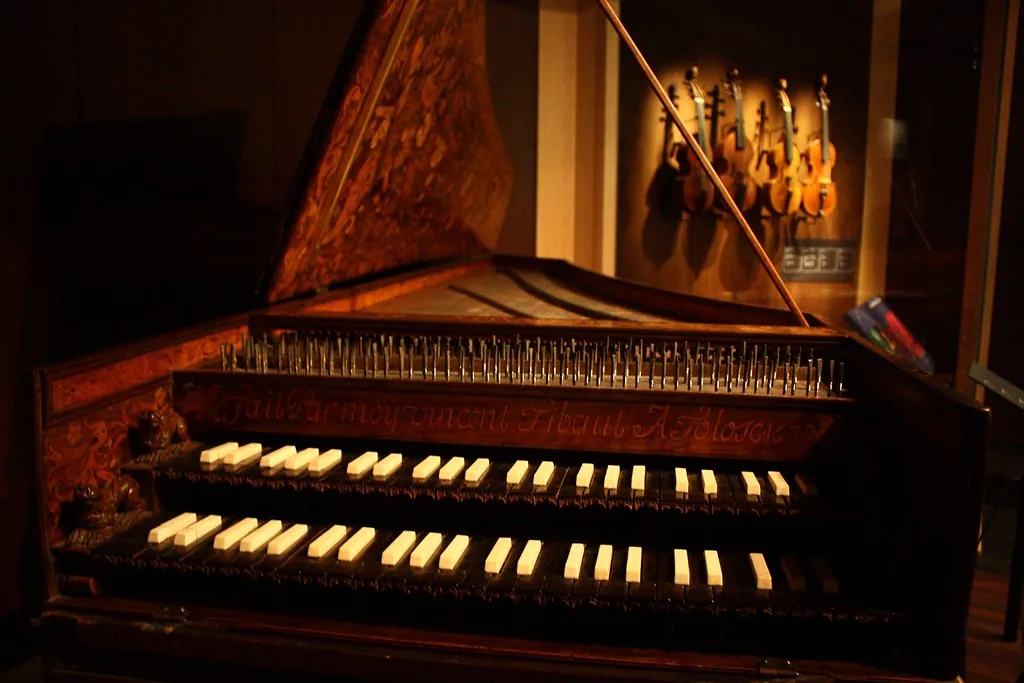
Let us explore a simple and fascinating question in music history.
The harpsichord is a plucked-string instrument, often equipped with one or more keyboards. Its timbre shaped Baroque music and salon music-making in Europe.
Understanding the origin of this instrument requires examining instrument-making workshops, developments in its mechanism, and construction choices. The fortepiano mechanism later influenced the case and mechanics mastered by its inventors.
This article explains how the harpsichord established itself in ensembles and among composers. Here you will find key information about its technical transformations and the place of this instrument in the French musical tradition.
Who invented the harpsichord?
By the late 14th century, texts already mentioned a plucked-string instrument associated with the development of the keyboard. Historians debate the names and dates because physical evidence did not appear until later.
Hermann Poll
Hermann Poll is mentioned in a letter dated 1397. This early reference presents him as a key craftsman in the instrument’s history. However, the source remains disputed and provides no indisputable physical evidence.
The earliest documented evidence
Records indicate that the oldest surviving harpsichord was made by Jerome of Bologna in 1521. It is now held at the Victoria and Albert Museum in London and illustrates the instrument-making practices of that period.
Among the historical accounts, Lodovico Lambertacci reports references dating back to 1397. At around the same time, other instruments—including the spinet and virginal—shared certain characteristics of shape and sound.
To explore this chapter in the history of musical instruments in greater depth, consult studies by instrument makers and period inventories.
The instrument’s medieval origins
The earliest evidence places the emergence of the harpsichord in the 14th century, between Burgundy and Italy. Networks of craftspeople and musicians encouraged innovations in sound in these regions.
In 1388, a royal chronicle from Aragon described a device resembling an organ but producing sound through strings. This passage suggests that keyboard-and-string prototypes already existed.
Several factors prepared the way for this development:
- research into stringed instruments such as the monochord;
- the gradual organization of medieval instrument making;
- the technical transition to plucked strings, which changed musicians’ approach.
These developments allowed the new instrument to gain precision and expressiveness. Composers gradually adopted it to enrich court and salon music.
Anatomy and case structure
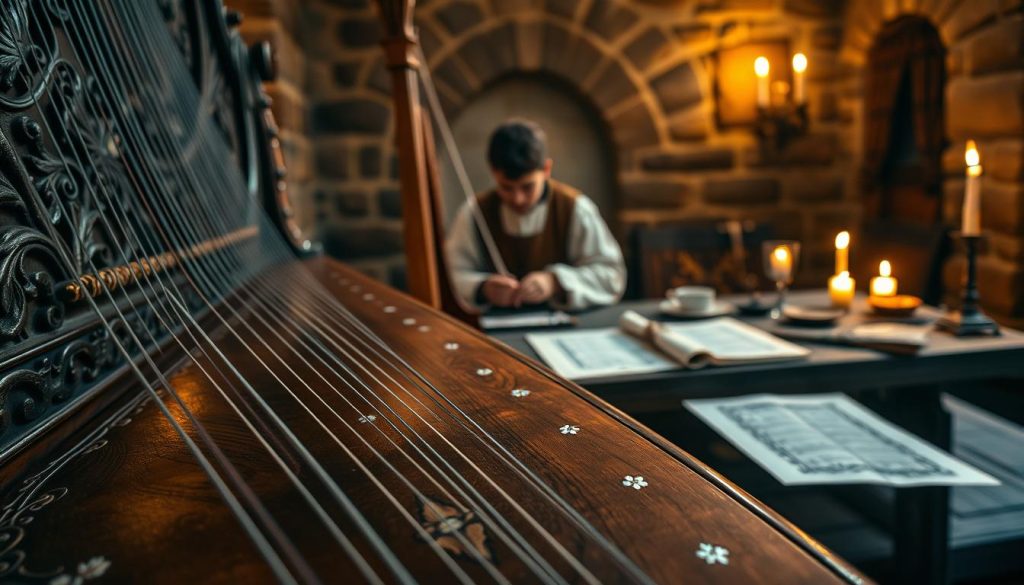
The case forms the visible and acoustic framework of this keyboard instrument. It brings together the components that govern the projection and color of the sound.
The role of the wrestplank and case sides
The wrestplank is a piece of solid wood that serves as a foundation. It withstands the tension of the strings and maintains the overall shape.
Around the wrestplank, the case sides form the curved edges. They give the instrument its silhouette and transmit vibrations toward the soundboard.
The soundboard, located in the upper section, amplifies the sound produced by each plucked string. This construction feature distinguishes historical harpsichords from modern pianos.
- The case acts as a resonator essential to sound projection.
- Early harpsichords use solid wood, bottom braces, and a wrestplank to ensure their strength.
- Unlike the piano, the case bears the tension without a heavy metal frame.
The keys, often made of wood or bone, allow the harpsichordist to operate the mechanism. The keyboard range generally varies from four to five octaves, depending on the maker and period of manufacture.
The complex jack mechanism
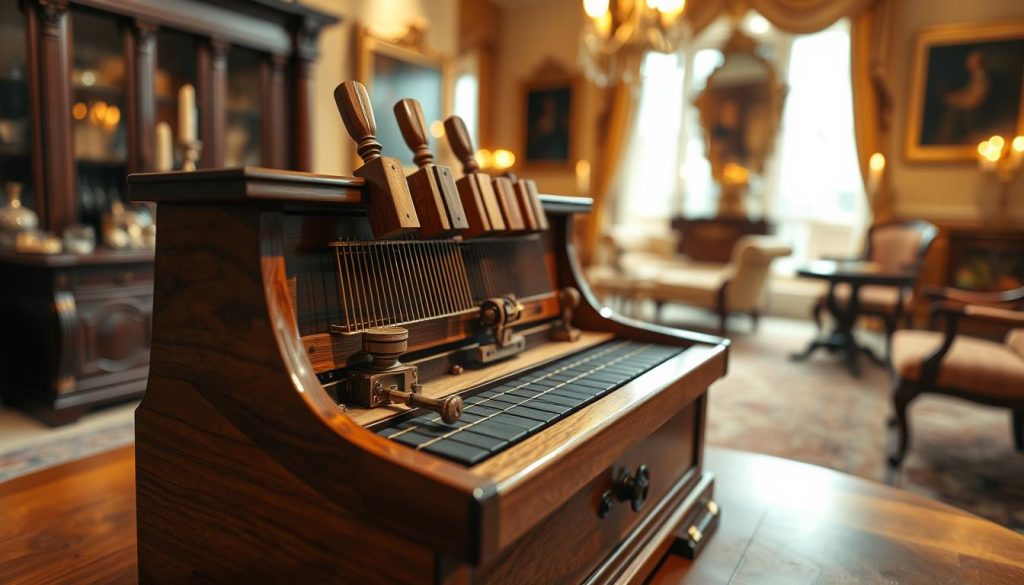
At the heart of the mechanism, the jack transforms the movement of a key into the vibration of a string. This strip of hard wood carries a plectrum that plucks the string precisely.
When the harpsichordist presses a key, the jack rises and releases the string. Unlike the piano, the resulting sound does not vary with the force of the finger. Playing therefore requires a specific technique.
Each jack includes a small section fitted with a wool-cloth damper. This damper stops the vibration as soon as the key is released.
- Central component: plucks the string at the right moment.
- Return: a hinged tongue ensures a silent return.
- Maintenance: fine adjustments are necessary for tonal balance.
| Part | Material | Function |
|---|---|---|
| Jack | Hardwood | Pluck the string |
| Plectrum | Ebony or ivory | Precise contact with the string |
| Damper | Wool cloth | Stop the vibration |
The soundboard and resonance
The soundboard transforms the plucking of a string into projected sound. This broad, very thin sheet of wood occupies almost the entire surface of the instrument. It serves as the main amplifier.
The role of the soundboard is to transmit the vibrations of the strings through the bridge. Reinforcing bars ensure stable, lasting resonance.
The details of the bracing were often kept secret by makers. The shape of the soundboard and the placement of the bars vary according to the school of instrument making and alter the final sound.
“The rose balances humidity and adds a visual signature to the soundboard.”
The jack remains the mechanical trigger; the soundboard then projects the sound. To learn more about the history of the harpsichord, consult conservation studies and monographs on instrument makers.
The different European schools of instrument making
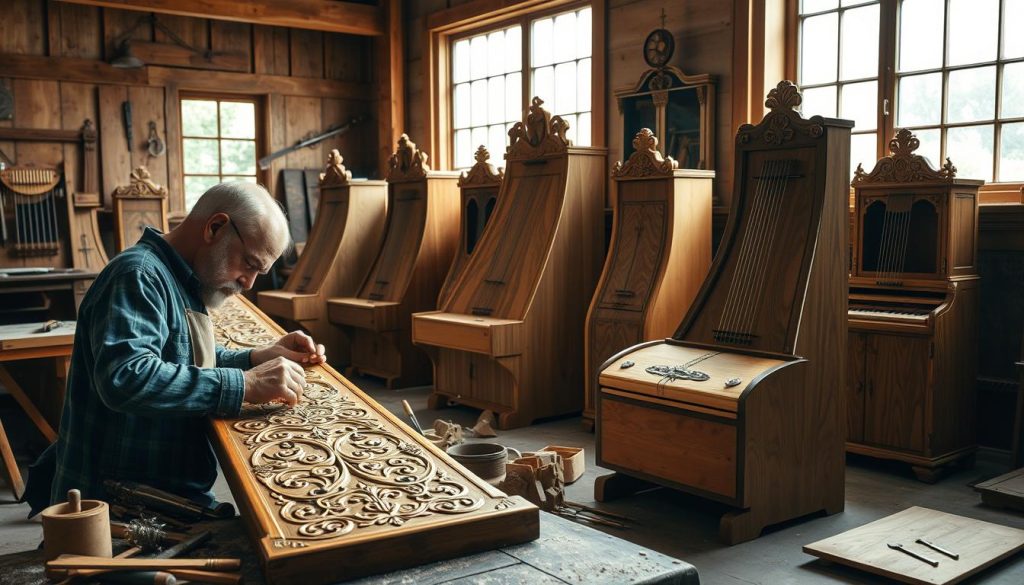
National traditions gave rise to instrument designs with highly distinctive timbres and forms.
The Italian tradition
Italian makers favored lightweight components. Italian harpsichords offer a crystalline, clear sound.
Characteristics: often a single keyboard, responsive keys, and a thin soundboard.
Flemish influence
Flemish makers strengthened the structure. They introduced longer strings to obtain a more powerful sound.
These models often featured multiple keyboards and robust mechanics suited to full-scale playing.
The French style
In France, appearance mattered as much as sound. Makers paid close attention to decoration and embellished the soundboard.
The French style multiplied the registers and adapted the jack to vary the nuances.
- Each school influenced the string layout and construction.
- Local makers adapted the soundboard and mechanism to the musical demands of the century.
The role of the harpsichord in Baroque music
During the 17th and 18th centuries, this instrument was at the heart of musical practice. It was used primarily for basso continuo and ensemble accompaniment.
Its clear, precise sound allowed musicians to articulate counterpoint with great clarity. Composers used this definition to make their harmonic writing more complex.
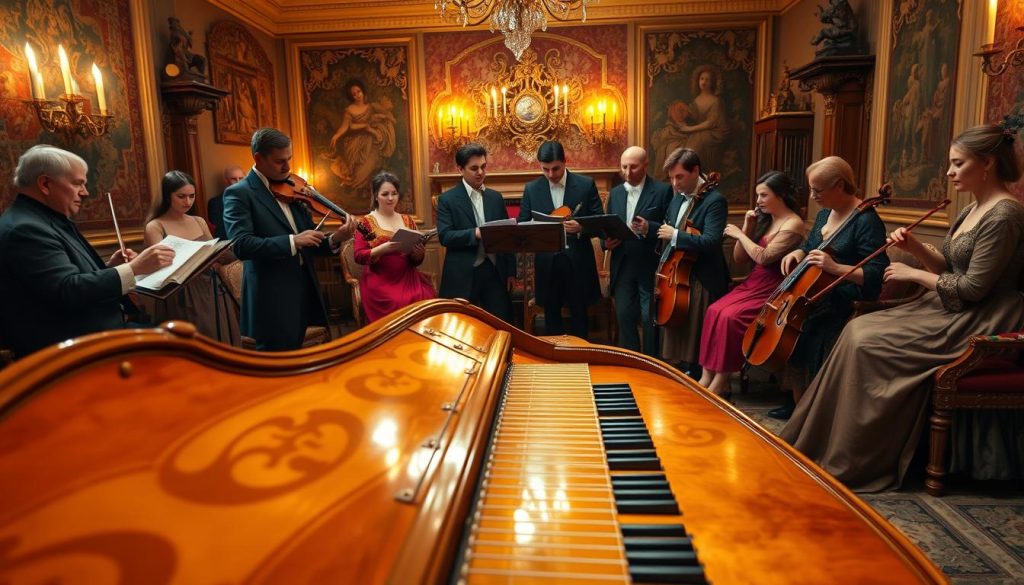
Johann Sebastian Bach used this keyboard as a contrapuntal and teaching instrument. Domenico Scarlatti wrote virtuosic sonatas that showcase the harpsichordist’s brilliant technique.
- Solo role: keyboard pieces and technical studies.
- Accompanying role: basso continuo in cantatas and operas.
- Prestige: an instrument of courts and palaces, symbolizing refinement.
“The precision of the plucked strings transforms harmony into sonic architecture.”
This period confirmed the keyboard’s central place among the instruments of Baroque music. Harpsichords remained the standard before the rise of the piano.
The transition to the piano and the decline
At the turn of the 18th and 19th centuries, the fortepiano offered a dynamic range eagerly sought by audiences and composers.
This technological innovation brought the keyboard into a new era. The sound could now vary according to the force of the finger. The piano gained the advantage in concerts and salons.
During the 19th century, many musicians abandoned older instruments. The harpsichord was often regarded as a piece of musical furniture from another era.
The years following the Revolution favored more powerful aesthetics. The harpsichord’s timbre, centered on plucked strings, seemed limited beside the power of the new keyboard.
- The invention of the piano in the 18th century marked the beginning of the decline of harpsichords.
- In the 19th century, the preference for power and nuance shifted musical practice.
- Nevertheless, early instrument-making methods provided the basis for the first piano designs.
“The piano’s dynamics reshaped the musical stage and transformed audience expectations.”
For a broader historical overview, consult the history of the harpsichord.
The harpsichord revival in the 20th century
In the 20th century, an artistic movement revived interest in this early instrument.
Wanda Landowska played a central role in this revival. She popularized historically informed playing and returned the Baroque keyboard to the stage.
Its public reappearance also occurred through events such as the 1889 Paris Universal Exposition. Manufacturers, particularly Pleyel, launched models inspired by historical harpsichords.
Modern composers, including Manuel de Falla, wrote for the instrument. These works enriched the repertoire and attracted performers concerned with authenticity.
This renewed interest enabled harpsichords to be restored, soundboards to be reproduced, and historical construction settings to be used again. Recordings and concerts restored the instrument to musical life.
“The harpsichord’s unique sound still appeals today to those seeking the color and precision of plucked strings.”
- Renewed interest beginning in the 1900s.
- The role of manufacturers and makers in production.
- A repertoire expanded by composers of the century.
Learning to play this instrument
Mastery of music theory remains the foundation for every aspiring early-keyboard performer.
Music theory makes it possible to interpret scores and internalize the Baroque style. Without this foundation, harmonic and rhythmic reading remains imprecise.
The importance of music theory
Reading a score makes it easier to respect composers’ intentions and reproduce phrasing. Theory also helps performers understand the ornaments and conventions of the repertoire.
Lessons can be taken at a conservatory, a music school, or with a private teacher. These paths provide suitable guidance for making rapid progress.
- Precision of touch and hand coordination require regular practice.
- Lessons help students acquire techniques specific to early keyboards.
- Careful score reading remains essential for playing Baroque music.
| Path | Advantage | Audience |
|---|---|---|
| Conservatory | Professional instruction and examinations | Long-term training |
| Music school | Structured, collaborative approach | Teenagers and adults |
| Private teacher | Personalized, flexible instruction | Beginners to advanced players |
To explore historical techniques in greater depth, consult the L’Art de toucher le clavecin method. It remains an essential reference for every harpsichordist in training.
“Regular practice develops hand independence and motor memory.”
Great composers and their works
The Baroque repertoire offers works in which polyphony and keyboard clarity occupy a central place.
Great composers left major works that define the sonic identity of this stringed instrument. They exploit its harmonic richness and the precision of its keys.
The use of multiple keyboards made it possible to create contrasts and dynamic effects. This feature expanded the harpsichordist’s expressive palette and inspired new forms.
Domenico Scarlatti, among others, pushed the technical limits of playing with leaps, trills, and demanding passages alternating between the right and left hands.
- The instrument’s construction, particularly that of the jack, dictated the form and style of the works.
- Harpsichord pieces favored polyphony and dense harmony.
- Studying these works helps explain the evolution that preceded the arrival of the piano.
“The mechanism and soundboard shaped the music and virtuosity of the period.”
| Composer | Emblematic works | Characteristic |
|---|---|---|
| Domenico Scarlatti | Sonatas | Brilliant technique and leaps |
| Johann Sebastian Bach | Partitas, suites | Polyphony and counterpoint |
| Manuel de Falla | Modern pieces | 20th-century revival |
To explore the repertoire of composers in greater depth, consult specialist studies and historical courses.
Conclusion
Its historical journey continues to enrich contemporary musical practice.
The harpsichord remains a fascinating instrument, the result of a long evolution. Its timbre, produced by plucked strings, offers a unique color that appeals to musicians and audiences.
Every harpsichordist helps keep this heritage alive through faithful, committed interpretations. Taking lessons helps musicians master techniques specific to the instrument and understand construction choices.
In short, this instrument retains a central place in history and on today’s stage. Whether you are curious or studying the instrument, this guide aims to illuminate the role of the harpsichord in our musical heritage.