
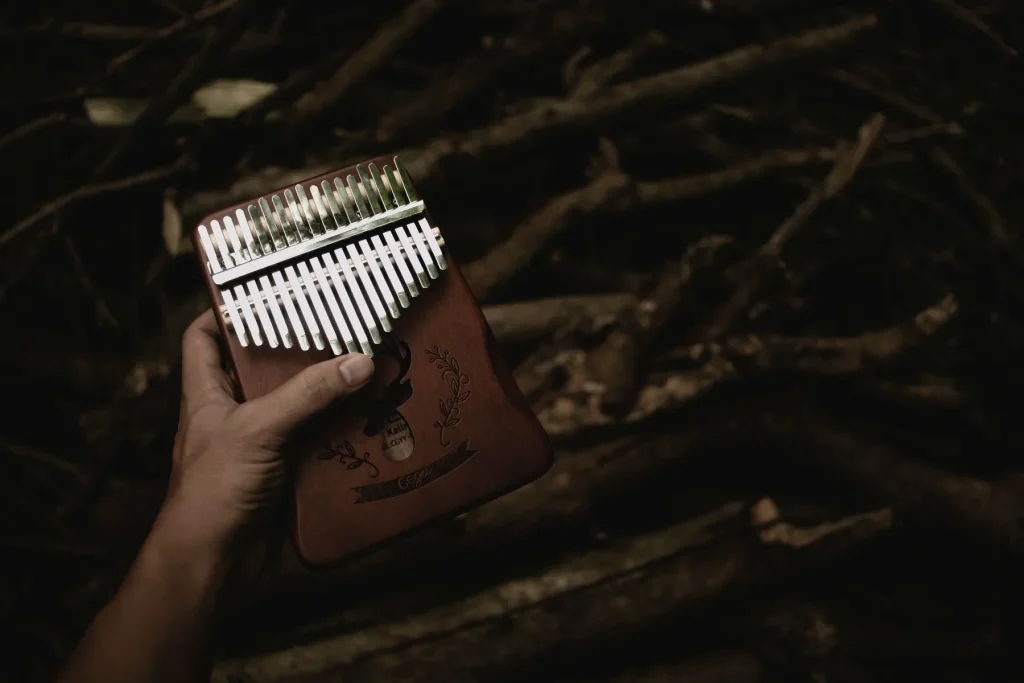
This unique instrument, known for its enchanting melodies, has its roots in a rich and fascinating history. For more than 3,000 years, it has held a central place in African culture, symbolizing both heritage and spirituality.
Originally, its tines were made of bamboo before being replaced by metal tines around 1300 CE. This transformation marked a key stage in its development, strengthening its role in ancestral rituals and oral transmission.
Today, this instrument continues to captivate people and has found a place in music therapy and world music. In 2020, UNESCO granted major recognition to the Zimbabwean mbira, highlighting its cultural importance.
Introduction to the traditional African kalimba
Born of a long history, the kalimba is much more than a simple instrument. With its vibrating metal tines and wooden body, it produces unique sounds that resonate deeply.
What is the kalimba?
The kalimba, often called a thumb piano, is a musical instrument consisting of 17 metal tines attached to a wooden or acrylic body. When the tines are plucked, they vibrate and create soothing melodies.
Compared with a traditional piano, it is more compact and offers a diatonic scale. Its ergonomic design makes it accessible to musicians of all levels.
The cultural importance of the kalimba
Originating in Africa, this instrument holds a central place in many communities. Among the Shona, it serves as a tool for social cohesion, bringing people together during ceremonies.
It also plays a spiritual role, serving as a bridge between the living and their ancestors. For example, during Bamileke initiation rites in Cameroon, it is used to convey sacred messages.
| Aspect | Description |
|---|---|
| Materials | Metal tines, wooden or acrylic body |
| Uses | Music, rituals, social cohesion |
| Symbolism | Spiritual bond between the living and their ancestors |
Although the kalimba belongs to the family of percussion instruments, it stands out for its simplicity and emotional depth. It continues to inspire musicians and listeners around the world.
The historical origins of the kalimba
Let us delve into the deep roots of this melodious instrument. Its history stretches back thousands of years and reveals an unsuspected cultural richness. Discover how it evolved to become an essential musical symbol.

The earliest archaeological evidence
Archaeological excavations have uncovered bamboo instruments dating back more than 3,000 years. These discoveries, made in Cameroon, demonstrate the age of this art form. In 2018, primitive sanzas were found in Mozambique, confirming its African origin.
These rudimentary instruments were made using ancestral techniques, such as carving with a crooked knife. They mark the beginning of a tradition that has endured through the centuries.
The birth of the kalimba in Africa
In the seventh century, a technical revolution took place in the Zambezi Valley. Bamboo tines were replaced by metal ones, producing a richer, longer-lasting sound. This innovation allowed the instrument to spread across the continent.
Bantu migrations played a key role in this expansion. The instrument reached regions such as the Congo, where it was adopted and adapted. One famous account relates that the “mbira dzavadzimu” was used as a royal instrument in the Monomotapa kingdom.
The slave trade also influenced the dispersal of expertise, allowing this art to travel as far as the Atlantic coast. Today, it remains a living testament to African history.
The kalimba in African rituals and ceremonies
The kalimba’s vibrations transcend the boundaries between the spiritual and the social. For centuries, this instrument has held an essential place at key moments in the lives of African communities. Whether communicating with spirits or celebrating important milestones, it is a powerful symbol of connection and tradition.
Its role in spiritual rituals
In many cultures, this instrument is used to establish a connection between the living and the spirits. For example, during bira ceremonies in Zimbabwe, kalimba melodies are used to invoke the ancestors. Shamans also use it to treat conditions such as depression, thanks to its soothing sounds.
Ethnomusicologist Gerhard Kubik observed that repetitions of notes in G-sharp minor can induce a trance state. This phenomenon is often used during rituals to facilitate spiritual communication.
Use at weddings and funerals
At weddings, this instrument accompanies dances and songs, symbolizing union and joy. At funerals, it plays a more solemn role. Among the Ndebele, for example, it is played continuously for 72 hours to honor deceased royalty.
In Mali, it is often associated with Dogon masked dances, creating an atmosphere that is both mystical and festive. These practices show how this instrument adapts to the emotional needs of each occasion.
“The kalimba is much more than a musical instrument. It is a bridge between the visible and invisible worlds.”
To learn more about the differences between the kalimba and the mbira, read our detailed guide.
The evolution of the kalimba through the centuries
Over the centuries, this instrument has undergone major transformations. These changes have not only improved its sound quality but also broadened its use in various cultural contexts.

Changes in materials and construction
Originally, the tines were made of bamboo, but they were replaced by metal around 1300 CE. This innovation provided better resonance and increased durability. The body, once made from a hollowed-out gourd, evolved to use materials such as wood and acrylic glass.
In 1954, Hugh Tracey revolutionized the design by introducing a rectangular resonator box. This innovation improved the acoustics and facilitated mass production. In the 2000s, brands such as Hokema adopted acrylic glass, offering a modern and attractive solution.
The spread of the kalimba across Africa
Trans-Saharan trade routes played a key role in spreading this instrument. Griot craftspeople preserved traditional techniques while adapting its forms to local needs. In the Congo, for example, the wooden body was replaced by inner tubes for greater portability.
The Musée des Confluences in Lyon houses a collection of 147 historical specimens, bearing witness to this diversity. These pieces illustrate the evolution of tunings from the pentatonic to the diatonic scale, thereby offering greater musical flexibility.
| Element | Evolution |
|---|---|
| Tine materials | Bamboo → metal |
| Body materials | Gourd → wood/acrylic glass |
| Key innovation | Rectangular body (Hugh Tracey, 1954) |
| Spread | Trans-Saharan trade routes |
The kalimba and traditional African music
For centuries, this melodious instrument has shaped African music and served as a cultural pillar. Its unique notes have influenced a variety of genres while providing a bridge between generations for passing on ancestral knowledge.

Influence on musical genres
The traditional repertoire includes more than 7,000 melodies catalogued by UNESCO. Among them, those of the Mbuti hunters of the Congo illustrate the richness of this art form. These tunes, often improvised, reflect everyday life and local beliefs.
In South African jazz, artists such as Abdullah Ibrahim have incorporated this instrument to create innovative sounds. This blend of tradition and modernity has enabled the kalimba to establish itself on the international stage.
The kalimba as a tool for oral transmission
This instrument plays a key role in transmitting knowledge. Musical proverbs based on mnemonic techniques make melodies easier to learn. In rural schools in Malawi, for example, it is used to teach history and community values.
The “Tales of the Kalimba” project digitally archived thousands of melodies, thereby preserving a valuable heritage. Writer Amadou Hampâté Bâ also collaborated on this initiative, emphasizing the importance of this art in African culture.
“The kalimba is a voice that travels through the ages, carrying the stories and emotions of an entire people.”
- Analysis of the Mbuti hunters’ repertoire (Congo)
- Integration into South African jazz (Abdullah Ibrahim)
- “Tales of the Kalimba” project: digital archiving of melodies
- Educational use in rural Malawian schools
- Collaboration with writer Amadou Hampâté Bâ on cultural transmission
The kalimba on the world stage
Having become a musical symbol, this instrument has won over the entire world. Its introduction to the West marked a turning point in its history, opening up new artistic and cultural possibilities.
The introduction of the kalimba to the West
In the 1960s, Hugh Tracey played a key role in popularizing this instrument. Thanks to his efforts, it was presented at Expo 67 in Montreal, where it was amplified for the first time. This event allowed Western audiences to discover its unique sounds.
In the years that followed, artists such as Earth, Wind & Fire incorporated this instrument into their compositions, notably on their 1974 album “Open Our Eyes.” This breakthrough paved the way for wider adoption in modern music.
The influence of the kalimba on modern music
This instrument has crossed borders and influenced a variety of genres. Björk used it on her album “Biophilia,” creating innovative sonic textures. Likewise, the soundtrack to “Black Panther” showcased its melodies, reinforcing its global stature.
Technical innovations, such as Tobias Preisig pairing it with a loop pedal, have expanded its possibilities. These advances have contributed to a 450% increase in sales on Amazon France since 2015.
- Annual “Afrika Kalimba” festival in Marciac since 2018
- Jacob Collier’s viral tutorial on micro-intervals
- Rising sales figures on Amazon France
“The kalimba is a universal voice, capable of transcending cultures and generations.”
The kalimba in music therapy and relaxation
Kalimba melodies are not limited to music: they also touch the soul. Thanks to its soothing vibrations, this instrument has become a valuable tool in music therapy and relaxation. Its impact on mental and physical well-being is gaining increasing recognition.

The therapeutic benefits of the kalimba
A 2019 study conducted by Inserm found that listening to kalimba sounds reduced salivary cortisol, a marker of stress, by 37%. This discovery led to its incorporation into the MBSR (Mindfulness-Based Stress Reduction) protocol at 15 French clinics.
The frequency-resonance technique used with this instrument has proven effective in relieving anxiety. The “Sound Healing” workshops at the Cité de la musique in Paris demonstrate this by offering deep-relaxation sessions.
Patients with Parkinson’s disease have also reported improved motor function after therapy sessions involving the kalimba. Paired with Tibetan singing bowls, it creates a unique energy-based experience.
Using the kalimba in meditation
In meditation, the sounds of the kalimba act as a bridge between the body and mind. Its gentle music aids concentration and helps practitioners reach a state of deep calm. Many practitioners use it to accompany mindfulness sessions.
Public Health France has even launched a kalimba therapy kit for the general public. The kit includes guided exercises designed to maximize the benefits of this instrument in everyday life.
“The kalimba helped me regain an inner balance I thought I had lost.”
Tips for choosing and caring for your kalimba
Choosing and maintaining your musical instrument is essential if you want to get the most from it. Whether you are a beginner or an experienced player, these tips will help you make the right choice and extend the life of your kalimba.
How to choose the right kalimba
The choice of material is crucial. Models made from kiaat wood offer superior sound projection, while mahogany models are prized for their warm resonance. Stainless-steel tines provide optimal durability.
For precise tuning, use a laser tuning device set to 442 Hz. This ensures perfectly accurate notes. Brands such as Hugh Tracey are renowned for their quality and exceptional sound.
- Gecko versus Hugh Tracey Original comparison: durability tested.
- French brand Lâlû recommended for beginners.
Kalimba care and maintenance
To preserve the quality of the tines, apply beeswax once a month. This prevents oxidation and keeps them easy to play. Use a magnetic brush to remove dust from between the tines.
If your instrument needs restoration, consult experts. The Montpellier workshop, which specializes in antique sanzas, offers high-quality services to bring your kalimba back to life.
- Beeswax technique for maintaining the tines.
- Tip: use a magnetic brush to remove dust.
Conclusion
Since its beginnings 3,000 years ago, this instrument has endured through the ages to become a universal musical symbol. Its rich history and distant origin make it an essential cultural treasure.
Today, the kalimba continues to evolve, with innovations such as IK Multimedia’s MIDI prototype. These technological advances open up new possibilities while reminding us of the importance of preserving traditional craftsmanship.
As Toumani Diabaté points out, “The kalimba is a voice that unites the past and the present.” To discover this instrument and its heritage, take part in the African Musical Heritage Days. It is a unique experience through which to explore a world of timeless melodies.