
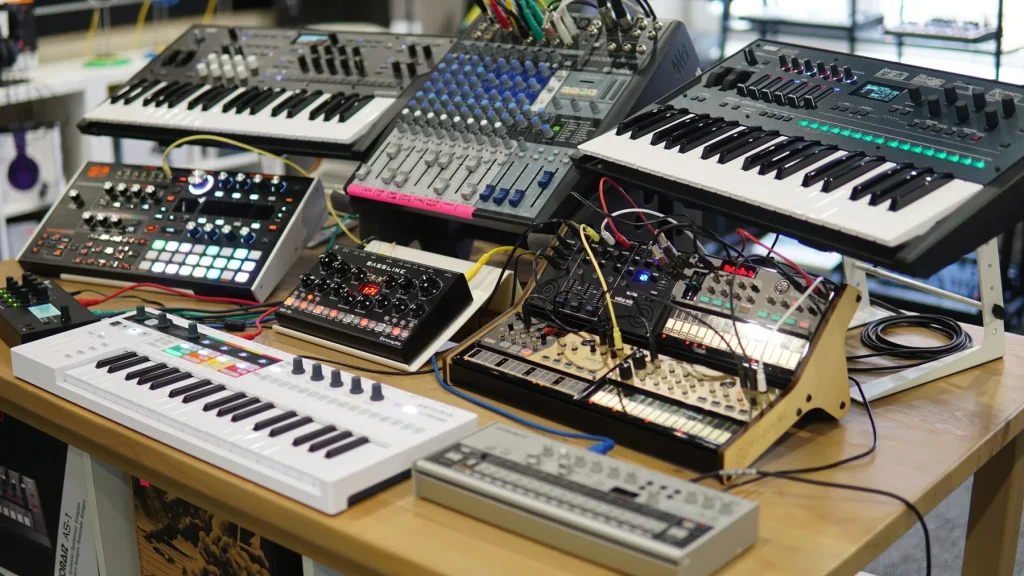
The 1980s were a crucial period in the rise of analog synthesizers. With the arrival of new models such as the Moog Modular System 55 and the Minimoog, artists gained access to an unprecedented sonic palette. This revolutionized music production.
Genres such as synthpop and new wave developed around these instruments. Iconic tracks by Depeche Mode, Kraftwerk, New Order and many others emerged. This decade marked a decisive turning point in the use of synthesizers.
The rise of synthesizers in the 1980s
The use of synthesizers exploded during the 1980s. The Moog Modular System 55, the Minimoog, the Yamaha DX7 and the Roland Juno-6 opened up new possibilities. Analog synthesizers won people over with their warm sound. Digital synthesizers, such as the DX7, stood out for their crystal-clear sound.
Landmark instruments
These tools helped create genres such as synthpop and new wave. They enabled artists to distinguish themselves. Their influence shaped the sound of the 1980s.
| Synthesizer | Features |
|---|---|
| Moog Modular System 55 | Modular analog synthesizer offering extensive programming flexibility |
| Minimoog | Compact and powerful monophonic analog synthesizer that became indispensable |
| Yamaha DX7 | Digital FM synthesizer recognizable by its crystal-clear sound |
| Roland Juno-6 | Polyphonic analog synthesizer known for its rich sonic textures |
Essential synthesizer songs
The 1980s produced numerous hits thanks to synthesizers. These tools helped artists create unique sounds. They reached an entire generation.
Depeche Mode released “Just Can’t Get Enough.” Yazoo released “Don’t Go.” Meanwhile, Harold Faltermeyer made a name for himself with “Axel F.” These songs became classics thanks to synthesizers.
New Order made history with “Blue Monday.” The Pet Shop Boys caused a sensation with “West End Girls.” Synthesizers helped Van Halen create “Jump” and Europe release “The Final Countdown.”
These songs made synthesizers indispensable to 1980s music. They created a unique sound that left a profound mark on the era’s musical imagination.
Pioneering artists and bands
Three bands rank among the pioneers of the 1980s synthesizer era: Kraftwerk, Depeche Mode and New Order. They used new technologies to create innovative sounds. These bands forever changed synthpop, new wave and electro.
Kraftwerk, Depeche Mode, New Order
Kraftwerk helped give birth to modern electronic music with its minimalist style. The album “Trans-Europe Express” (1977) is a cornerstone of synthpop and electro.
Depeche Mode popularized synthpop with hits such as “Just Can’t Get Enough.” With more than 100 million records sold, the band became highly influential in pop rock.
New Order blended new wave and dance to create classics such as “Blue Monday.” Released in 1983, the track became a major electronic-music hit.
These bands demonstrated the full potential of synthesizers. They changed 1980s pop and rock and paved the way for many other groups.
“Their innovations made it possible to explore new sonic dimensions and push the boundaries of musical creation.”
Synthesizer music: iconic songs of the 1980s
The 1980s were marked by the arrival of numerous pop and rock hits. These tracks were made possible by the use of analog synthesizers. Bands such as Depeche Mode, Kraftwerk, New Order, Eurythmics, OMD, Visage and The Art of Noise used these instruments to create unique sounds.
The sound of Depeche Mode’s “Just Can’t Get Enough” and Visage’s “Fade to Grey” became iconic. New Order’s “Blue Monday” also defined the era. These songs influenced 1980s pop music and remain popular today.
Indochine’s “L’Aventurier” and Michael Jackson’s “Billie Jean” are considered iconic songs of the 1980s.
New wave revolutionized 1980s music. Thanks to it, bands such as Depeche Mode, Kraftwerk and New Order created unique sounds. Those sounds made music history.
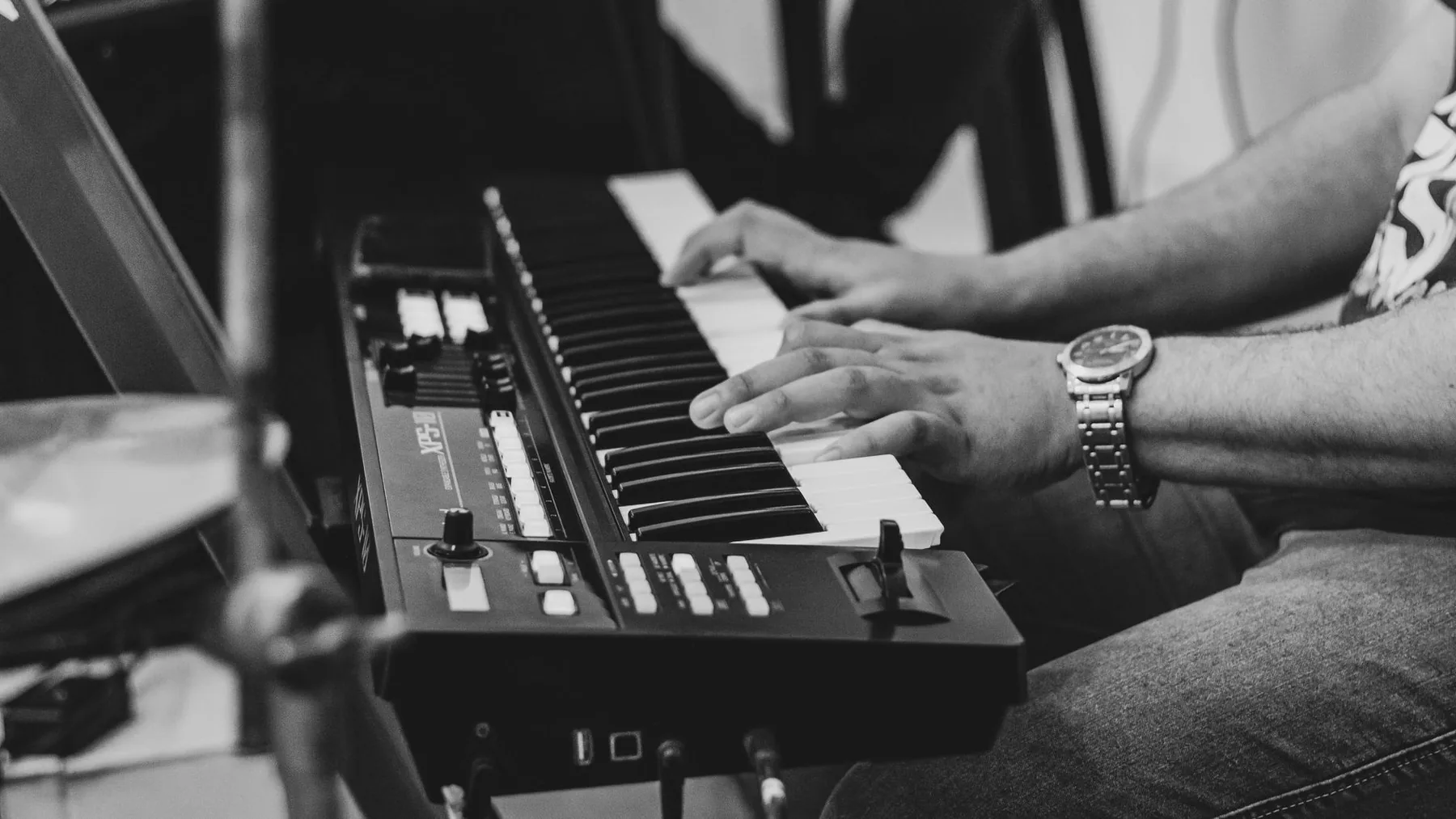
Some iconic songs of the 1980s
- “Just Can’t Get Enough” by Depeche Mode
- “Fade to Grey” by Visage
- “Blue Monday” by New Order
- “Sweet Dreams (Are Made of This)” by Eurythmics
- “Maid of Orleans” by OMD
- “How Soon Is Now?” by The Art of Noise
| Artist | Iconic song | Musical genre |
|---|---|---|
| Depeche Mode | “Just Can’t Get Enough” | Synthpop |
| Visage | “Fade to Grey” | Synthpop, new wave |
| New Order | “Blue Monday” | New wave, synthpop |
| Eurythmics | “Sweet Dreams (Are Made of This)” | New wave, synthpop |
| OMD | “Maid of Orleans” | New wave, synthpop |
| The Art of Noise | “How Soon Is Now?” | New wave, synthpop |
The lasting influence of the 1980s synth sound
The analog synthesizers of the 1980s profoundly shaped music. Many contemporary artists draw inspiration from this style. They reinvent the sounds of synthpop and new wave to create new songs.
Their influence can be heard in the music of Stranger Things and in artists such as The 1975 and The Weeknd. 1980s synthesizers left an indelible mark.
That decade changed music forever. Polyphonic and modular synthesizers opened new paths for artists. They enabled them to create fresh, innovative sounds.
“The 1980s shaped a unique sound that profoundly influenced the evolution of popular music. This legacy continues to inspire and shape contemporary musical creation.”
Contemporary music is full of references to the 1980s. Analog synthesizers and modular synthesizers are being used more and more. This demonstrates the influence of the 1980s on today’s music.
This lasting impact proves the importance of the synth sound in modern music. It shows that the sound of the 1980s is still relevant today.
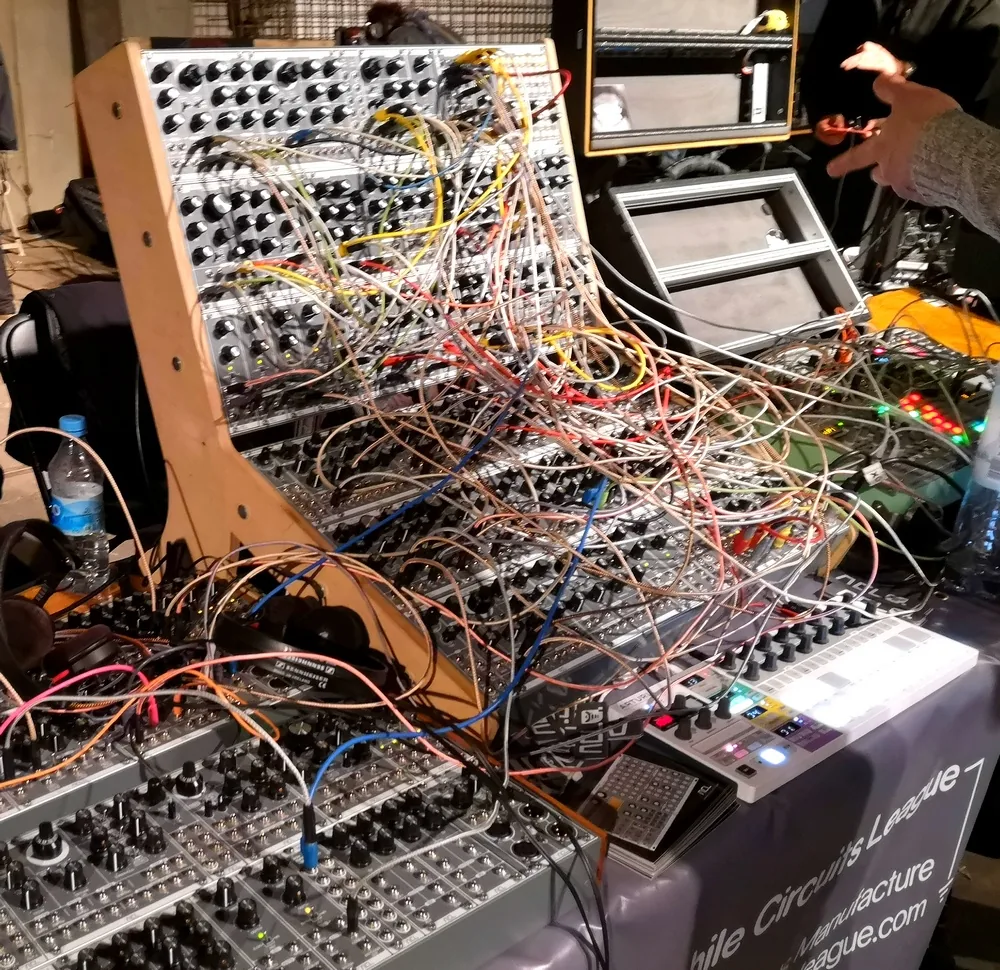
Conclusion
The 1980s were essential to the rise of synthesizers in music. They enabled artists to create new sounds. This gave rise to genres such as synthpop and new wave.
Bands such as Depeche Mode, Kraftwerk and New Order defined the decade. Their music created a unique sonic identity.
Today, the sounds of the 1980s continue to inspire artists. Their legacy demonstrates the importance of synthesizers in music.
The sound of the 1980s is not merely nostalgic. It changed popular music by opening up new creative avenues. Synthesizers played a key role in this evolution.
FAQ
Which landmark instruments drove the rise of synthesizers in the 1980s?
Which iconic 1980s songs were shaped by synthesizers?
Which bands pioneered the use of synthesizers in the 1980s?
What lasting influence does the 1980s synth sound have on contemporary music?
Sources
- https://www.musicradar.com/artists/they-thought-it-was-going-to-be-the-biggest-flop-ever-but-there-were-two-guys-thinking-this-might-just-change-the-face-of-music-how-paul-hardcastle-created-his-sample-driven-masterpiece-19
- https://www.the1980s.co.uk/magazine/page002/page2.html
- https://tcu.primo.exlibrisgroup.com/nde/collectionDiscovery?collectionId=81360631540008721&vid=01TCU_INST:Digital_Repository&lang=en
- https://eighties-archive.com/
- https://www.smoothradio.com/features/best-electronic-synthpop-songs/
- https://www.smoothradio.com/features/best-electronic-synthpop-songs/
- https://www.thecure.com/bio/
- https://www.musicradar.com/news/everything-you-need-to-know-about-80s-synth-pop
- https://arxiv.org/abs/1502.05417
- https://www.cambridge.org/core/books/abs/popular-music-genres/synthpop-into-the-digital-age/1D323A93B510BA279A4F5849D43CF252
- https://americansongwriter.com/the-1980s-sound-explosion-how-synths-took-over-pop-and-rock/
- https://www.collectorsweekly.com/articles/rise-of-the-synthesizer/
- https://en.wikipedia.org/wiki/Synthesizer
- https://www.hearstnetworks.com/
- https://www.theguardian.com/music/2009/oct/04/spandau-ballet-new-romantics
- https://www.worldradiohistory.com/Archive-All-Music/RPM/80s/1984/RPM-1984-07-21.pdf
- https://cineuropa.org/en/newsdetail/265004/