
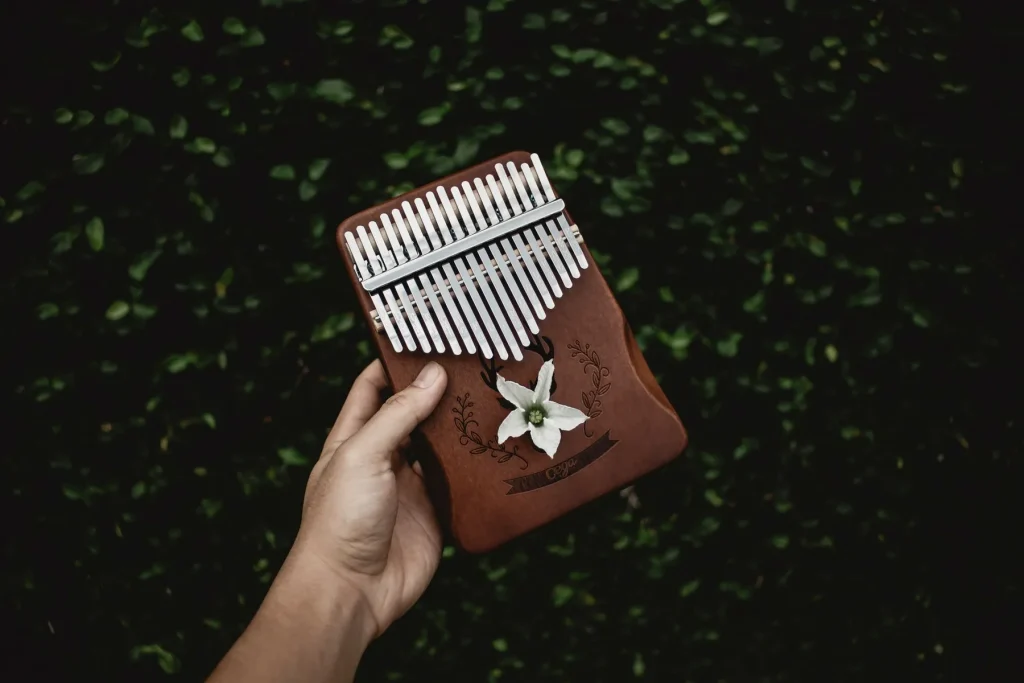
The kalimba is an increasingly popular instrument in France, particularly because of its accessibility. Whether you are a beginner or an experienced musician, this instrument offers an easy gateway into the world of music.
Its soothing sound and portability make it an ideal companion for anyone who enjoys gentle, harmonious tones. Unlike other instruments, learning the kalimba does not require complex music theory, making it perfect for beginners.
In this article, we will guide you step by step as you explore this musical world. We will cover basic techniques, tablature, and ways to unleash your creativity. Ready to begin?
Introduction to the kalimba
The kalimba, an instrument with African origins, is loved for its simplicity and unique charm. Nicknamed the “thumb piano,” it consists of a wooden resonator box and tunable metal tines. These elements give it a gentle, harmonious sound that is ideal for beginners and experienced musicians alike.
What is a kalimba?
The kalimba is a modernized version of the mbira, a traditional African instrument. It has a simple structure: a wooden body and metal tines that produce notes when plucked. Common models have 10, 17, or 21 tines, offering a variety of sounds.
Its anatomy also includes a bridge and resonance plates, which amplify the sound. Whether you choose a wooden, metal, or transparent model, each type has its own unique tone.
Why choose the kalimba for creating melodies?
This instrument is particularly well suited to learning to play music. The minimal coordination it requires and the quick results it produces make it an ideal choice for beginners. Its soothing sound is also often used for therapeutic purposes, promoting relaxation and concentration.
- Easy to carry and use.
- Does not require complex music theory.
- Lets you create a melody in just a few minutes.
Whether you want to explore music or simply relax, the kalimba is a versatile instrument that can meet all your needs.
The basics of playing the kalimba
Learning to play the kalimba begins with a few key steps. Whether you are a beginner or an experienced player, these fundamentals will help you progress quickly and get the most out of this instrument.
How to hold your kalimba correctly
Hand position is essential for playing smoothly. Place your thumbs on the metal tines while wrapping your fingers around the body of the instrument. This ergonomic technique prevents fatigue and allows you to play for long periods.
To protect your nails, consider using silicone thumb guards. These simple accessories are particularly useful if you play frequently.

Tuning your kalimba for the perfect sound
Proper tuning is crucial for achieving a harmonious sound. Use a tuner such as Smart Kalimba or gStrings to check the pitch of the tines. If a note is too low or too high, adjust it gently with a hammer.
Avoid covering the sound holes, as this can affect sound quality. To learn more about tuning techniques, read this comprehensive guide.
The first notes to master
Begin with the C major scale, starting from the central tine. Alternate between your left and right thumbs to create a natural rhythm. This method will help you become comfortable with the instrument in no time.
Here is a simple exercise: play the notes C, D, E, F, G, A, and B in order. Repeat this sequence until you feel comfortable.
Techniques for creating simple melodies
Exploring basic kalimba techniques opens the door to harmonious melodies. Whether you are a beginner or an experienced player, these methods will help you progress quickly and express your creativity.
Playing single notes with your thumbs
The first step is to master the basic notes. Use your thumbs to pluck the metal tines, alternating between left and right. This simple technique creates a natural, fluid rhythm.
Begin with the C major scale: C, D, E, F, G, A, B. Repeat this sequence until you feel comfortable. For a richer sound, try using the rear holes to create a vibrato effect.
Creating harmonious chords
Chords add depth to your playing. To form one, pluck two adjacent tines simultaneously. For example, try the C-E-G progression while alternating your left and right thumbs.
Here is a table to guide you:
| Chord | Tines |
|---|---|
| C-E | Tines 1 and 3 |
| E-G | Tines 3 and 5 |
| G-C | Tines 5 and 1 |
Linking notes to form a melody
To create a melody, learn to link notes and chords smoothly. Begin with simple sequences, such as the nursery rhyme “Frère Jacques.”
Vary the dynamics by playing some notes more softly (piano) and others more loudly (forte). This adds emotion and texture to your playing.
Improvisation is also an excellent way to develop your creativity. Try playing over a simple chord progression to explore new sounds.
Learning to read kalimba tablature
Mastering tablature is essential for making quick progress with this instrument. It allows you to play songs without needing extensive knowledge of music theory. Whether you are a beginner or an experienced player, understanding these scores makes learning much easier.

Understanding the structure of tablature
Tablature is a visual representation of the tines you need to play. Each number corresponds to a specific tine, and its position indicates the order of the notes. For example, a “1-3-5” sequence means that you should pluck tines 1, 3, and 5 in that order.
To make reading easier, some tablatures use colors to distinguish between octaves. This helps you identify notes quickly and play more smoothly.
Following tablature to play a song
To play a song, begin by breaking the tablature into sections. For example, for Leonard Cohen’s “Hallelujah,” divide the score into verses and choruses. This makes learning more approachable and less intimidating.
Use metronome apps to synchronize your playing with the rhythm. This helps you maintain a steady tempo and improve your accuracy.
Practical exercises using simple tablature
Begin with simple scores, such as nursery rhymes or short melodies. These exercises allow you to become familiar with reading tablature and develop your coordination.
Here are a few resources to help you get started:
- The “Tuto Kalimba” YouTube channel offers free tutorials for all skill levels.
- Books costing less than €8 are available online and provide beginner-friendly tablature.
- KalimbaTabs.com offers an extensive library of free scores.
With a little practice, you will be able to play your favorite songs in no time.
Practicing and developing your creativity
Regular practice and exploring your creativity are essential for making progress with this instrument. Whether you are a beginner or an experienced player, these tips will help you refine your playing and explore new musical possibilities.
Daily exercises to improve your playing
A daily practice routine is the key to mastering this instrument. Spend 15 minutes each day working on scales and arpeggios. These exercises strengthen your coordination and accuracy.
Record your sessions to analyze your progress. This allows you to identify areas for improvement and celebrate your achievements. Use apps such as Smart Kalimba to track your development.

Creating your own melodies
Creativity lies at the heart of music. Set yourself a challenge: compose a piece using only five notes. This constraint stimulates your imagination and encourages you to explore new sounds.
Draw inspiration from natural themes, such as birdsong or the sound of rain. These elements can enrich your compositions and give them a unique touch. Try the glissando technique to add fluidity to your melodies.
Sharing your creations with other musicians
Sharing your pieces is an excellent way to receive feedback and stay motivated. Use platforms such as SoundCloud or join Facebook groups dedicated to this instrument.
Collaborate online on group projects through Discord. These exchanges allow you to learn from others and develop your style. Here is an inspiring testimonial:
“In two weeks, I composed my first song thanks to advice from the community.”
| Platform | Benefits |
|---|---|
| SoundCloud | Large audience, monetization options |
| Facebook groups | Active community, direct interaction |
| Discord | Real-time collaboration, group projects |
Conclusion
Discovering the kalimba means opening yourself to an accessible and rewarding musical world. This instrument allows you to explore music without complex barriers, thanks to its easy tuning and intuitive tablature. Whether you are a beginner or an experienced player, regular practice will help you master the kalimba tines and unleash your creativity.
To go further, explore advanced models such as the 17-Tine Electric Kalimba for €54.90. These versions offer a variety of tones and an even richer musical experience.
Get a free PDF of tablature by subscribing to our newsletter. It is the perfect opportunity to begin or deepen your learning.
Finally, as one professional musician says: “The kalimba is an instrument that expresses the soul with simplicity and depth.” So let yourself be inspired and begin your musical journey today.