
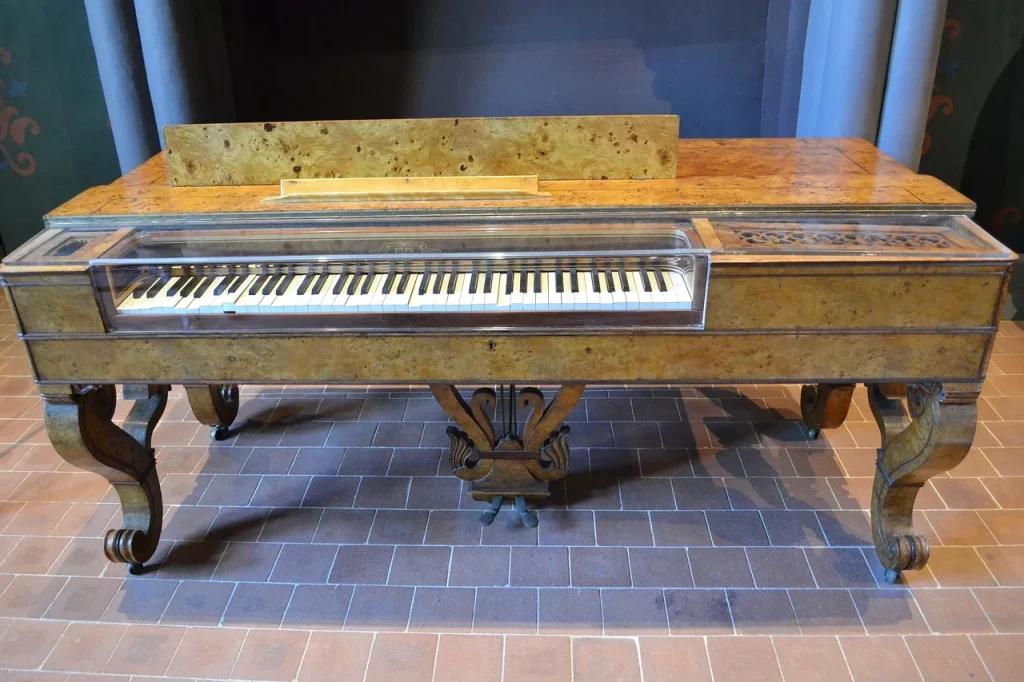
This guide provides a clear overview for choosing a modern instrument that recreates Baroque sounds. This article aims to guide you through the different options without unnecessary jargon.
Switching to electronic keyboards provides a sound experience faithful to that of a historical harpsichord. Musicians gain easier maintenance and quick access to a variety of registers.
We describe the essential technical criteria for comparing models and making the right choice. This instrument makes it possible to incorporate early music into a contemporary repertoire.
This short guide will help you assess each option according to your skill level and goals. By the end, you will know which models suit your playing and expectations.
Introduction to the digital harpsichord
Sound reproduction relies on multilayer recordings that capture every nuance of the performance.
The digital piano uses these samples to deliver timbres close to those of a historical harpsichord. The keyboard becomes the main interface for shaping attack and dynamics.
Unlike acoustic pianos, this instrument does not require regular mechanical maintenance. Modern models offer ready-to-use sounds, learning features, and settings suited to both early and contemporary music.
“Multilayer sampling can reproduce the soul of a piece while simplifying maintenance.”
- Sound fidelity thanks to multiple sample layers.
- Less maintenance than a traditional piano.
- Versatility across different repertoires.
| Feature | Samples | Maintenance | Use |
|---|---|---|---|
| Sound | Multilayer | Low | Classical and contemporary |
| Keyboard | Suitable touch | No mechanical adjustment | Learning |
| Models | From compact models to consoles | Electronic maintenance | Stage and home |
Digital harpsichord: advantages and limitations
The decision often rests on practical criteria: intended use, available space, and sound quality. First and foremost, you need to define what you expect from your instrument every day.
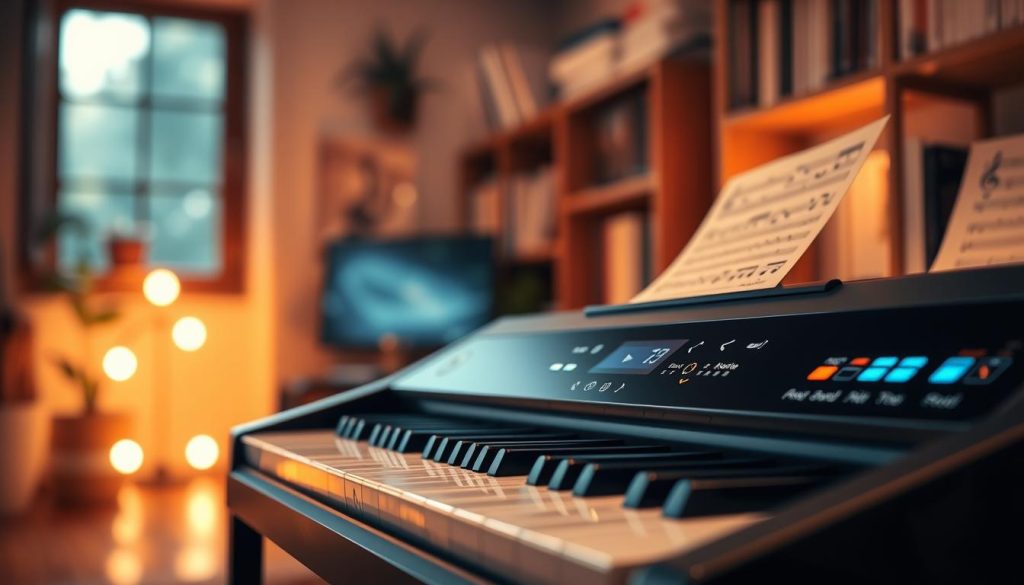
Key advantages
No string maintenance and lasting tuning stability reduce both costs and the time devoted to the instrument.
The digital piano can be played at any hour with headphones. This is practical for anyone living in an apartment.
Sampled sounds provide good quality and an immersive playing experience for fast notes and complex passages.
Limitations to consider
The natural resonance of an acoustic piano’s strings remains difficult to reproduce. Some musicians prefer the warmth of a real piano.
Electronic components may have a shorter lifespan than a well-maintained acoustic piano.
- A practical choice when space is limited.
- Modern technologies are narrowing the gap between acoustic and electronic models.
- Above all, choose according to your everyday playing needs.
To compare models and get buying advice, visit this piano resource for detailed information.
Technical differences from an acoustic harpsichord
The technical foundations differ significantly between a traditional piano and its electronic equivalent. The sound source is the key distinction: mechanical and resonant in an acoustic piano, electronic in a digital piano.
Weight and maintenance comparison
Weight varies enormously. For example, the Casio CDP-S110 weighs only 4.5 kg, making it easy to transport. This portability appeals to everyone, especially traveling musicians.
A real piano needs regular tuning. A digital piano avoids this requirement, reducing costs over several years.
- Keys and touch: modern keyboards reproduce key resistance to provide a better playing experience.
- Connectivity: some models, such as the Roland FP-30X, offer Bluetooth 5.0 for easy management of music and apps.
- Silent practice: headphones allow anyone to practice without disturbing the neighbors.
This article shows that the choice depends primarily on intended use, daily life, and priorities regarding transport, maintenance, and longevity.
Why choose this instrument as a beginner
Schools find that a suitable keyboard helps beginning students progress faster. In France, approximately 72% of music schools now use digital keyboards for introductory instruction.
This choice offers integrated learning features. These include exercises, metronomes, and modes for practicing each hand separately.
The weighted keyboard reproduces a sensation similar to that of a piano. It helps the hand develop strength and precision from the very first lessons.
Unlike an acoustic piano, a digital piano provides flexible access to online lessons. The price differences make this instrument accessible to families with beginners.
- Silent practice suited to apartment living.
- Built-in tools for structured learning.
- Reliability and ease of use for beginners.
“Choosing a good keyboard makes learning easier and motivates students.”
Essential criteria for a successful purchase
Choosing the right instrument begins with clarifying your budget and the space available to you.
Budget and investment
Your budget often guides the selection. Models such as the Roland C-30 offer excellent value for those seeking a reliable piano without paying a premium price.
Consider the price of accessories: headphones, a bench, and a cover can increase the total cost. Plan for a long-term investment by prioritizing durability.
“A good purchase combines quality and longevity, not merely a low price.”
Available space
The space available determines the format. Portable keyboards suit small apartments, while cabinet-style pianos require a permanent location.
For beginners, make sure the keyboard is weighted to obtain a feel similar to that of an acoustic piano. Differences in model dimensions make it possible to optimize space in a city studio.
- Budget: include accessories and maintenance.
- Format: portable or cabinet-style, depending on the available space.
- Connectivity: USB ports for recording your music.
Keyboard quality and touch
A keyboard’s touch immediately transforms the musician’s relationship with the instrument. It guides phrasing, dynamics, and note accuracy.
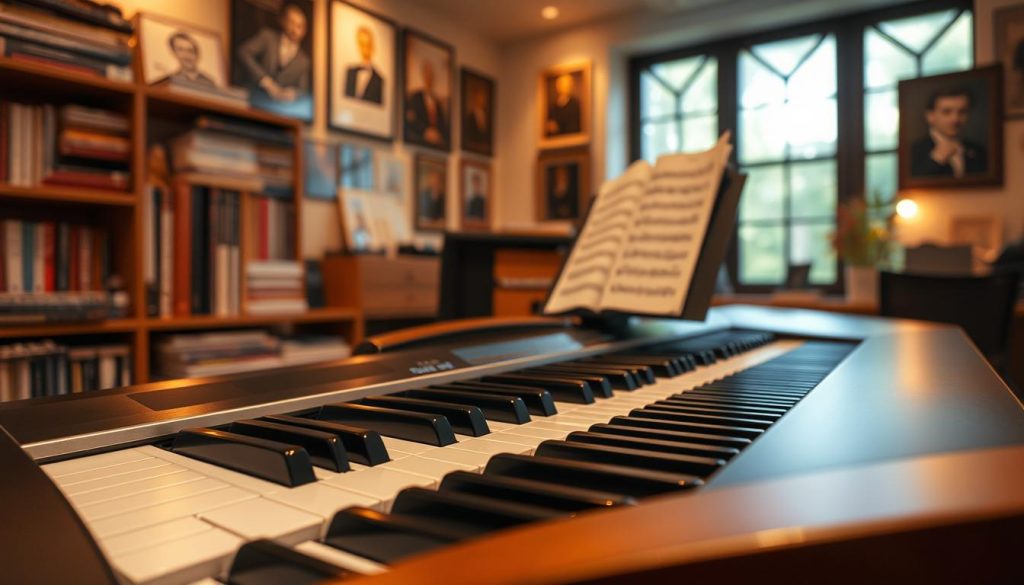
The Yamaha CLP-825 illustrates this well: its triple sensors provide precise keystroke detection. This produces a more natural response during rapid attacks.
Digital jack technology
The digital jack system simulates an acoustic piano’s mechanism to reproduce the weight of its hammers. The result is a nuanced playing feel that is useful for Baroque repertoire.
- Test the keyboard’s responsiveness before purchasing to assess its precision.
- A premium keyboard supports faster progress over the long term.
- Adjust the sensitivity to suit your playing and optimize the experience.
“Sound quality depends as much on the keyboard as on the samples.”
Exploring sounds and registers
Historical registers open up a vast landscape of timbres for curious musicians.
The Yamaha YDP-165 offers 15 historical registers. This variety makes it possible to vary the tonal colors, which resemble those of a quality acoustic piano.
Sample quality is essential for reproducing string resonance and Baroque harmonics.
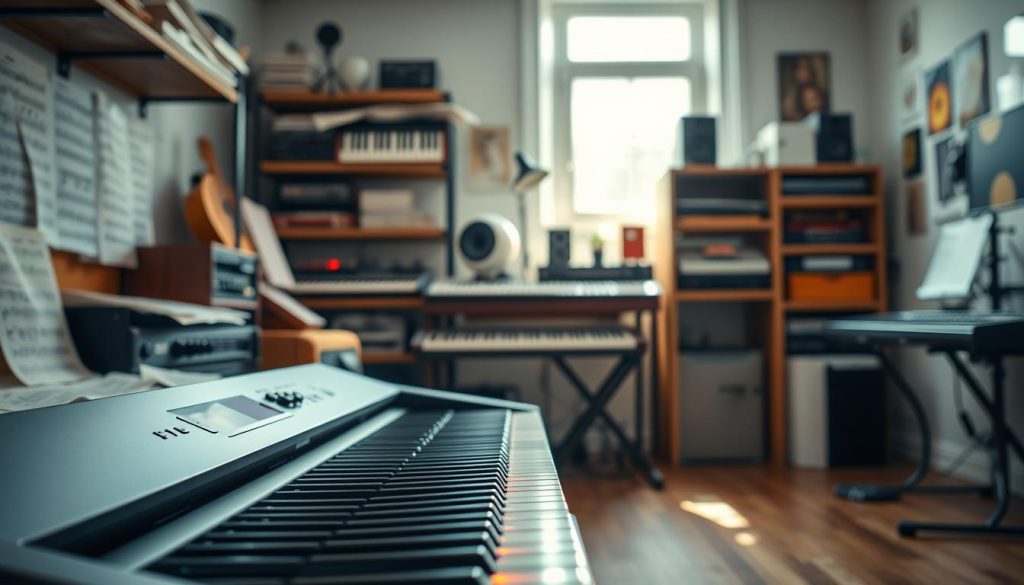
When making a purchase, check the polyphony to prevent notes from being cut off when several sustained notes sound simultaneously.
Reverb simulates the acoustics of large halls and enriches the listening experience. Modern pianos also allow sounds to be layered, creating textures that are impossible to obtain on an acoustic piano.
- Register control (8′, 4′) for faithful performances of Rameau.
- Premium sound banks require a larger budget.
- Each instrument retains a unique sound signature that guides your interpretation.
“Choosing a model means choosing a sonic personality.”
Connectivity and modern learning tools
Today, connectivity is transforming the role of the piano both in the studio and at home.
MIDI and USB ports
MIDI and USB ports turn the keyboard into a production interface. It can easily be connected to a computer for composing, recording, or controlling synthesizers.
This system expands the uses of the piano: it becomes a central part of a home studio and remote teaching setup.
Learning apps
Apps allow players to practice the right hand and left hand separately. They monitor progress and correct posture.
These tools make learning more enjoyable. Beginners benefit from interactive exercises and sheet-music libraries.
Recording and sharing
Recent models offer headphone outputs and built-in recording features.
Pieces can be sent to platforms with one click or synchronized with a tablet.
“Connectivity changes how we practice: playing, recording, and sharing all become seamless.”
| Feature | Use | Advantage | Example |
|---|---|---|---|
| USB/MIDI | Composition | Software control | Connection to a DAW |
| Headphone output | Silent practice | Consideration for neighbors | High-fidelity headphones |
| Apps | Learning | Real-time monitoring | Interactive sheet music |
| Sharing | Publishing | Fast distribution | Uploading to a platform |
For a practical guide to the features you should prioritize when choosing an interactive harpsichord, see the dedicated resource.
Overview of the different model types
Hybrid pianos that combine traditional mechanisms with modern technologies are now available. The Kawai NV-10S is a good example: it combines the touch of an acoustic piano with advanced electronic options.
“A hybrid offers the best of a classic cabinet and modern flexibility.”
On the market, models range from small portable keyboards to solid-wood cabinets. Each range addresses a specific need: mobility, a strong presence in the living room, or faithful touch.
- Portable models: lightweight and suitable for travel.
- Cabinet models: wood finish and decorative integration.
- Hybrids (for example, the Kawai NV-10S): acoustic mechanism and technology.
| Type | Features | Advantages | Indicative price |
|---|---|---|---|
| Portable | Compact, USB outputs | Easy to transport, small footprint | €300–€1,000 |
| Cabinet | Solid wood, living-room design | Attractive appearance, presence similar to an acoustic piano | €800–€3,000 |
| Hybrid | Keys and mechanism, integrated electronics | Authentic response, modern options | €2,000–€6,000 |
To guide your purchase, follow a buying guide that compares models, prices, and needs according to your available space and budget. This short article is intended to help you compare your options before trying an instrument in a store.
The leading brands on the market
In the keyboard market, a few manufacturers have become benchmarks thanks to their heritage and capacity for innovation. These companies offer broad ranges, from entry-level models to premium pianos, meeting the needs of students and professionals alike.
The excellence of Yamaha and Roland
Yamaha and Roland dominate the sector through recognized technical expertise and respect for sound traditions. Although the Yamaha P116 is an acoustic piano, it is often used as a point of comparison when assessing premium digital pianos.
These brands’ sampled sounds faithfully reproduce string resonance. Roland’s integrated systems provide expressiveness close to that of an acoustic piano.
- Sample quality for a natural result.
- A variety of models for every budget and use.
- Solid-wood finishes available for visual appeal and stability.
- Good resale value thanks to the manufacturers’ reputations.
“Choosing a major brand means investing in durability and consistent sound.”
Maintenance and installation advice
Installing a piano correctly prevents vibrations and protects the electronics. Choose a level surface to ensure keyboard stability and immediate playing comfort.
Place the cabinet away from radiators, windows exposed to moisture, and heat sources. The cabinet’s wood and internal components suffer from fluctuations in humidity and temperature.
Clean the keys regularly with a soft cloth. This preserves the instrument’s touch and appearance.
Unlike an acoustic piano, an electronic piano does not need to be tuned every year. This simplicity reduces the time spent on maintenance.
Using quality headphones lets you play without disrupting life in your household and preserves the room’s acoustics.
“Regular maintenance extends the piano’s life and keeps its touch consistent.”
| Action | Frequency | Reason | Tip |
|---|---|---|---|
| Stable surface | During installation | Prevents vibrations | Use a suitable cabinet or stand |
| Clean the keys | Weekly | Preserves the touch | Use a soft, slightly damp cloth |
| Check the settings | Monthly | Maintains playing response | Check sensitivity and response curves |
| Environmental protection | Continuous | Protects the wood and electronics | Recommended humidity: 40% to 60% |
To compare models and choose the right range for your needs, consult this piano comparison.
Conclusion
In summary, choosing a good modern piano makes daily practice and musical expression easier.
This guide has presented technical and educational criteria useful to beginners. It shows how a well-chosen instrument transforms hand technique, practice time, and progress.
Whether you choose a compact model or a cabinet piano, what matters most is finding a piano that inspires you. Music should remain at the heart of your life.
For additional practical information, consult this digital piano guide, which details models and features.