
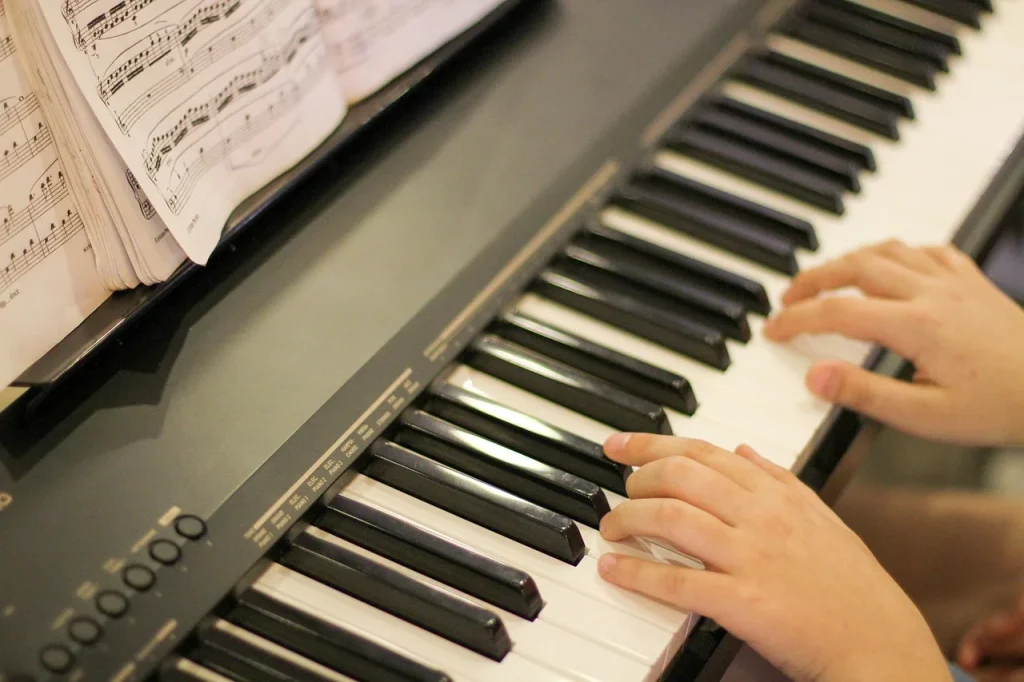
The harpsichord is a plucked-string instrument whose mechanism differs radically from that of the piano. A French copy by Jean-Paul Rouaud after Nicolas Dumont (1707), this instrument illustrates historical craftsmanship and the sound of an earlier age.
The manner in which a key is struck does not affect the volume. The jack plucks the string; the tone depends on the stops and registers, not on finger pressure.
In the eighteenth century, this keyboard dominated the European music scene before the rise of the fortepiano. The works of François Couperin clearly demonstrate the expressive possibilities and wealth of sound unique to this instrument.
Each instrument has a range that varies according to its maker, often between 4.5 and 5 octaves. The arrangement of the stops, the frequency of tuning and the soundboard account for its different sound compared with other keyboard instruments.
To learn more about its history and construction, consult the page devoted to the harpsichord.
Why Doesn’t the Harpsichord Play Like a Piano?
The harpsichord’s action differs profoundly from that of the modern piano, transforming the entire art of touch.
On a harpsichord, a jack plucks the string; on a piano, a felt-covered hammer strikes it. This distinction explains why volume does not vary with finger pressure.
Historically, the keyboard was the dominant instrument in the eighteenth century. At the time, harpsichords offered a variety of registers and stops that added color to Baroque pieces.
Historical harpsichords do not have a massive metal frame. They are lighter and more sensitive to variations in humidity. The case influences resonance and the way sound travels through a room.
Playing this type of instrument requires subtle mastery of touch and the keyboard’s stops. Understanding its mechanism makes it possible to take full advantage of the richness of its tone and repertoire.
- Mechanical difference: plucking versus striking.
- Design: no metal frame in historical harpsichords.
- Performance: playing depends on registration and the choice of stops.
A Fundamental Difference in Mechanism
The internal mechanism dictates how each key produces sound. Here, the keyboard’s design and action determine the available dynamics and tone color.
The Jack
The jack is the central component. It is a piece of hardwood that rises vertically when a key is depressed and plucks the string with a plectrum.
In the past, makers fashioned these plectra from raven quills. This technique provided the mechanical precision essential to the instrument.
The Hammer
By contrast, the piano’s hammer strikes the string. The force of the gesture alters the impact and produces dynamics that a jack cannot provide.
Eighteenth-century instrument making refined these systems. Builders sought to make the keyboard more responsive beneath musicians’ fingers.
- The strings are plucked, generating numerous harmonics.
- The alignment of the jacks ensures that every string is plucked at the right moment.
- Makers and restorers master this craft in order to preserve the original sound.
| Component | Action | Effect on Sound |
|---|---|---|
| Jack | Plucks the string with a plectrum | Harmonically rich tone, fixed dynamics |
| Hammer | Strikes the string with felt | Variation in volume and attack |
| Instrument making (eighteenth century) | Refinement of mechanisms | Improved keyboard responsiveness and precision |
| Restorers | Adjustment of the jacks | Authenticity and longevity of the sound |
To explore instrument making and restoration techniques in greater depth, this link provides useful references.
The Physics of Plucked and Struck Strings
The way the string is set in motion changes everything: whether plucked or struck, it acquires a tone color unique to each method.
On a harpsichord, plucking releases a strong series of harmonics from the initial attack. This action produces a bright, immediately defined sound.
By contrast, the piano uses hammers. They strike the strings and allow the volume to vary according to the intensity of the gesture.
Baroque music takes advantage of plucked strings. Pieces gain rhythmic clarity and precision of articulation.
Plucked-string instruments require a particular technique. The player compensates for the lack of touch-sensitive dynamics through ornamentation and changes of stops.
Other physical differences:
- String tension is lower than on a modern piano.
- The sound fades more quickly; attack takes precedence over sustain.
- This contrast defines the sonic identity of each instrument and distinguishes two musical eras.
The Harpsichord’s Lack of Touch-Sensitive Dynamics
On this instrument, finger pressure almost never changes the volume produced. The string is plucked by a jack, and the energy transferred remains constant. This calls for a different way of creating nuance.
Harpsichordists compensate through their choice of stops and the art of phrasing. Combining several stops enriches the tone color without increasing the intensity.
The keyboard’s tactile response remains direct and organic. Each key provides clear feedback, helping the player control attack and precision.
Tactile Response
Keyboard precision is crucial: every action must pluck the string consistently. Pedals and registers are used to vary the tone colors and create expressive effects.
“The harpsichord’s effect relies on articulation rather than brute force.”
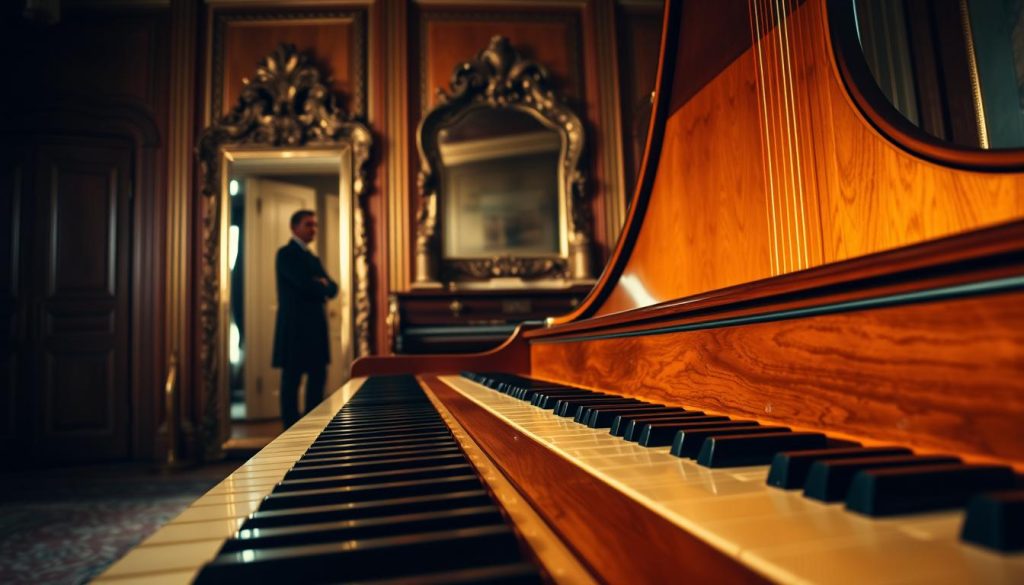
- No variation in volume through pressure.
- Stops and pedals for shaping the sound.
- Articulation and phrasing at the heart of expression.
The Internal Structure and Resonating Case
Beneath the lid, the internal structure transforms string vibrations into tangible sound.
The resonating case is often made of solid wood. It affects projection and sound quality.
A large harpsichord measures approximately 2 to 2.5 meters long and one meter wide. Depending on the model, this size allows for a range of 4.5 to 5 octaves.
The internal arrangement of the strings and the construction of the soundboard were refined over the course of the century. Every piece of wood, from the wrestplank to the curved bentside, supports the tension without warping.
The names of the components—bridge, nut, sound hole and rose—reflect the technical complexity of historical harpsichords. The sound hole also helps balance the humidity inside.
For makers, structural stability determines tuning. It is a constant challenge with period instruments.
- Solid wood: directly influences the warmth of the tone.
- String arrangement: influences harmonic richness.
- Stability: determines tuning and longevity.
The Role of Jacks and Plectra
Each jack acts as an intermediary between the keyboard and the string. It determines the precision of the attack and the consistency of the tone.
The Role of the Plectrum
The plectrum plucks the string at the exact moment the key is depressed. It produces an immediate attack and releases a rich series of harmonics.
Raven Quill
Traditionally, the plectrum is cut from a raven quill. This material offers flexibility and durability suited to historical instruments.
Some modern makers use Delrin for greater stability. The arrangement of the jacks and registers makes it possible to activate 8-foot or 4-foot stops.
The number of jacks corresponds to the number of strings: each key may control several stops. This configuration helps the harpsichordist vary the tone colors without changing the force of the gesture.
- Origin: a technique derived from the family of plucked-string instruments.
- Makers: adjust the plectrum to ensure stable tuning.
- Arrangement: allows stops and pitches to be combined to enrich the octave.
The Evolution of Instrument Making
Masters such as Ruckers, Blanchet and Taskin profoundly influenced harpsichord making from the beginning of the century.
Over the years, these makers improved the stability of the soundboard and the durability of the strings. Research into tension increased power without altering the characteristic sound.
French craftsmanship stood out for its great refinement. It produced instruments that were prized throughout Europe at the time.
However, the invention of the piano rapidly changed musicians’ expectations. The new mechanism offered dynamics that could not be reproduced and gradually relegated the harpsichord to the status of a historical instrument.
In response to this development, makers adapted their techniques. They diversified their models, adjusted their ranges and increased the number of stops to meet composers’ demands.
“The history of these workshops reveals a constant pursuit of improvement and a great variety of models.”
- Ruckers, Blanchet, Taskin: key names in instrument making.
- Improvements: string tension and structural stability.
- Result: a diversity of instruments and the transmission of craftsmanship.
Managing Registers and Stops
Managing the registers instantly transforms the keyboard’s tone color and power. On a harpsichord, the choice of stops makes it possible to alter the sound without changing the volume.
Common combinations pair 8-foot and 4-foot stops. Their arrangement on the instrument determines the number of available tone colors.
Movable registers engage or disengage rows of jacks. The harpsichordist can thus change the texture in real time, often by hand rather than with pedals.
Each string is plucked by a dedicated jack. Combining several stops increases the power and enriches the harmonics. This technique recreates the sonic density of an octave or more.
Mastering the registers becomes an essential skill for performing Baroque music. Knowing how to select one stop or combine several clearly influences the phrasing and overall balance.
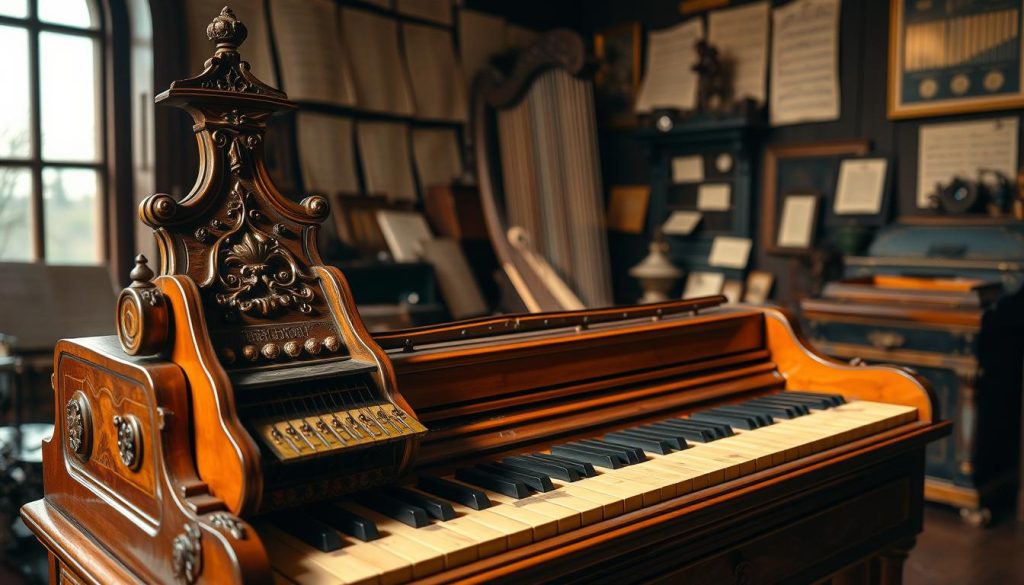
- Arrangement: determines the number and configuration of stops.
- 8-foot and 4-foot stops: fundamental to harmonic richness.
- Movable registers: manual changes that vary the texture.
The Influence of Baroque Music on Playing Technique
The treatises and practices of the period established performance conventions that are still taught today.
The Art of François Couperin
François Couperin published The Art of Playing the Harpsichord in 1713, a guide intended to make the instrument expressive despite the lack of variation in the force of the attack.
His approach explains how to ornament, articulate and shape phrases. Ornamented playing thus becomes a tool of expression.
French Baroque music emphasizes precise phrasing. Every note gains clarity through the mechanism and technique.
“The delicacy and precision of ornaments take the place of force here.”
Contemporary harpsichordists consult these treatises to guide their interpretations and respect the spirit of the period.
- Understanding ornamented playing is necessary for Baroque music.
- Articulation and the choice of registers lie at the heart of interpretation.
- To explore the subject further, see the historical method.
The Particular Features of the Keyboard and Its Range
The keyboard’s range often determines the choice of repertoire and the color of the pieces performed.
On most historical instruments, the range extends across 4.5 to 5 octaves. This compass determines which works from the period can be performed without transposition.
Construction varies according to national schools. Each workshop has its own practices and distinctive features. These influence how performers shape musical lines and play the instrument.
The strings are arranged perpendicular to the keyboard. This layout imposes structural constraints and affects the overall sound.
The number of notes was never fully standardized. Unlike the modern piano, instruments from each region offered their own solution.
The 8-foot and 4-foot stops are operated by means of the keyboard. Combining stops alters the power without changing finger pressure.
Mastering the keyboard remains the essential step in approaching complex Baroque pieces.
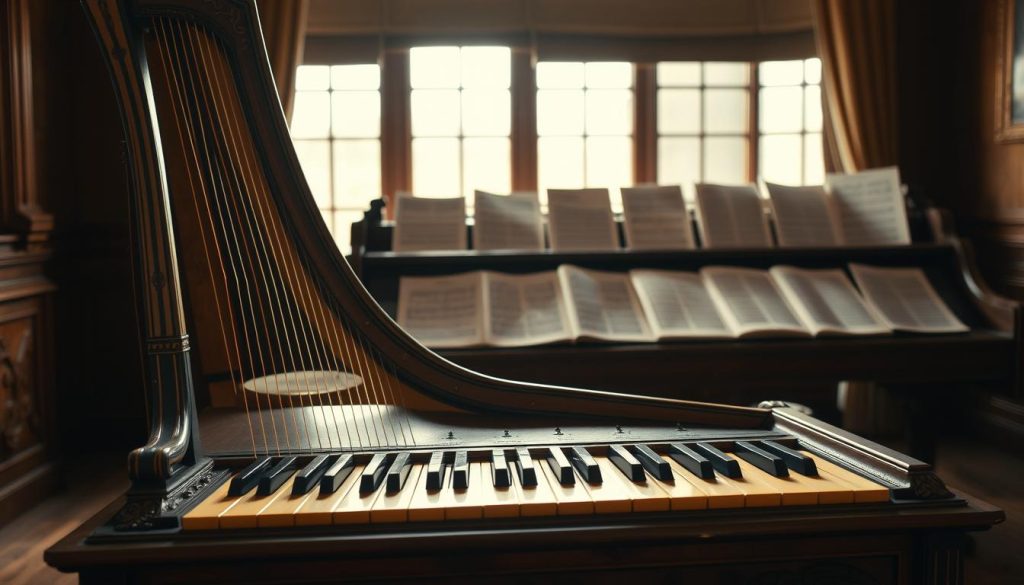
| Characteristic | Typical Value | Impact |
|---|---|---|
| Range | 4.5 to 5 octaves | Determines the accessible repertoire |
| String arrangement | Perpendicular to the keyboard | Structural constraints and tone |
| Stops | 8-foot and 4-foot | Variation in sound and power |
| Number of notes | Varies according to origin | No historical standardization |
The Question of Musical Expressiveness
Contrapuntal clarity and ornamentation become the principal tools of expression. On this keyboard, the emphasis is on articulation and phrasing rather than the force of the attack. The music gains precision when every voice remains audible.
Performers use techniques such as slightly staggering the notes and varying the stops to create accents. Derived from historical practice, these methods replace the gradation of volume offered by the modern piano.
Compared with other instruments, this one requires a different approach to teaching sound. Playing demands discipline: every mistake is immediately perceptible. In some cases, a piano performance can obscure the complexity of the counterpoint. The harpsichord, by contrast, favors clarity.
The debate remains lively: supporters of the modern piano and defenders of historical keyboards often discuss the best options for Bach. To continue exploring the issue, see the harpsichord/piano debate and its arguments.
The Revival of Historical Instruments
Over the past forty years, a movement has brought historical instruments and their distinctive sound back to life.
Pioneers such as Gustav Leonhardt revived interest in historical harpsichords and period practices.
Specialist makers reconstructed harpsichords according to eighteenth-century practices. They rejected certain modernized models in order to recover the original tone colors.
Early music thus regained a place in conservatories. Learning this instrument is now common among many students.
This revival made it possible to restore forgotten instruments and bring a rich repertoire back into the spotlight. Audiences show genuine enthusiasm for these historically informed performances.
A rare skill: makers must cut the plectra and adjust the mechanism with exacting expertise. This craftsmanship ensures the tactile response and harmonic richness of historical instruments.
“Returning to the sources offers a listening experience more faithful to the period.”
- Restoration and reconstruction faithful to historical practices.
- A greater presence for harpsichords in music education.
- Growing public interest in period music and historical performance.
Care and Maintenance Challenges
Caring for a historical instrument requires patience, precise movements and technical knowledge.
The strings are particularly fragile. A broken or poorly tuned string immediately alters the sound and requires prompt attention.
The construction requires regular monitoring of the stops and registers. Poor adjustments disrupt the alignment of the jacks and the keyboard’s response.
Today, approximately 165 classes in France teach this instrument. This number demonstrates how essential maintenance training is for harpsichordists.
Experienced makers—including Émile Jobin—provide maintenance and training. These professionals teach students to cut plectra, adjust the mechanism and tune the instrument frequently.
Unlike other instruments, this type of instrument requires daily involvement from the musician. Its longevity depends as much on its construction as on the player’s discipline.
- Frequent tuning according to humidity.
- Adjustment of stops to preserve tone color and power.
- Training students under makers to ensure longevity.
The Harpsichord’s Place in Contemporary Creation
On contemporary stages, the Baroque tone now enters into unprecedented dialogue with electronics and experimental instrument design.
Many twenty-first-century composers are reassessing this instrument and incorporating it into contemporary-music projects. They write works that exploit its harmonic richness and its ability to blend with other textures.
Some pieces add pedals or electronic sensors to extend notes or color the spectrum. For example, harpsichordist Laure Morabito regularly collaborates with composers to create works suited to copies of historical instruments.
This reassessment subsequently made it possible to distinguish its historical voice clearly from that of the piano and affirm an identity of its own. Its inclusion in modern ensembles demonstrates the instrument’s relevance far beyond the strictly historical repertoire.
- Innovation: combinations of acoustic and electronic sound.
- Collaboration: composers and performers create new works.
- Relevance: a growing presence in contemporary music and modern ensembles.
Conclusion
In summary, each instrument offers its own unique tactile and sonic experience. The mechanism defines its tone, articulation and expressive possibilities.
Baroque music, championed by François Couperin, finds in this instrument an expressive vitality that is difficult to reproduce on the piano. Ornamentation and phrasing remain central to playing.
The revival that began early in the last century rekindled performers’ interest. Mastering the technique and adjusting the stops with finesse takes time.
Conclusion: there is no need to set these instruments and aesthetics against each other. Each has its own historical and contemporary legitimacy. Appreciating their differences enriches both listening and musical practice.