
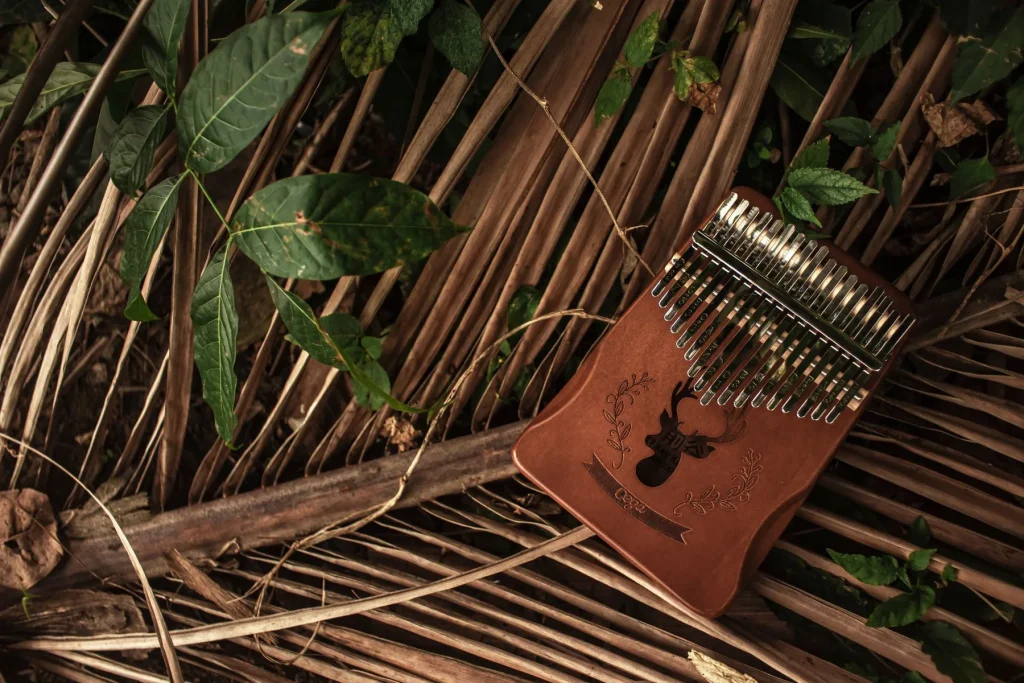
The kalimba is a unique and fascinating musical instrument, ideal for anyone who wants to explore music without prior knowledge. With its metal tines played using the thumbs, it offers an intuitive experience accessible to everyone.
Portable and easy to carry, this instrument produces a soothing sound that is perfect for relaxation or meditation. Its quick learning curve makes it possible to play simple melodies within a few weeks, without needing to know how to read music.
Moreover, the kalimba offers therapeutic benefits, such as stress reduction. According to one study, 90% of users master basic notes in just two weeks. This guide will take you from discovering this enchanting instrument to mastering it.
Introduction to the kalimba: an instrument for everyone
Originating in Africa, the kalimba is an ideal musical companion. This instrument, also known as the mbira, has its roots in the traditions of the Chokwe and Luba peoples. Used in rituals since the fifteenth century, it has endured through the ages to become a modern, versatile tool.
Unlike the piano, you only need your thumbs to play. The metal tines produce a soothing sound that enriches your world of music. Learning to play is quite simply intuitive, even without any previous musical knowledge.
This instrument is suitable for all ages. Children, adults, and seniors can all learn it easily. One musician says:
“After just 10 hours of practice, I was able to play simple melodies fluently.”
Another advantage? Its average weight of 300 g makes it a lightweight, portable instrument. The thumbs are the main actors in producing melodies, making it quick and enjoyable to learn.
| Characteristic | Detail |
|---|---|
| Origin | Africa (Chokwe and Luba peoples) |
| Average weight | 300 g |
| Target audience | Children, adults, seniors |
| Time needed to progress | 10 hours for simple melodies |
To learn more about basic techniques, read this complete guide. The kalimba is much more than an instrument: it is a gateway to an accessible and enriching musical world.
Essential steps before you start playing
Before diving into music, a few key steps are essential. These preparations ensure a smooth and enjoyable experience. Here is what you need to know to get off to a good start.
Placing stickers on the keys
The kalimba keys are often marked with stickers to make the notes easier to recognize. These visual markers are especially useful for beginners. The placement method varies slightly depending on the model, whether it has 8, 17, or 21 keys.
- Check the stickers after delivery, as the instrument may have gone out of tune during transit.
- Place them carefully to avoid playing wrong notes.
- The central note (C) is a good reference point for getting started.

Tuning your kalimba for a perfect sound
Proper tuning is essential for achieving a harmonious sound. Use a tuner such as Smart Kalimba, gStrings, or Free Universal Tuner. These apps help you adjust each note accurately.
To tune the kalimba, gently tap the tines with a purpose-built hammer. A movement of ±1 mm is equivalent to a semitone. Make sure the ambient temperature is around 20°C for optimum stability.
- Test the central note (C) as your reference.
- Retune your instrument every week to maintain its sound quality.
- If a note is too low, move the tine upward. If it is too high, move it downward.
These simple steps will help you enjoy your instrument fully and make rapid progress.
Basic techniques for playing the kalimba
To master this instrument, it is essential to understand the basic techniques. Good posture and precise movements will help you progress quickly and get the most from your musical experience.
Hand and thumb position
The position of both hands is crucial for playing the kalimba comfortably. Hold the instrument between your palms at a 45° angle to your body. The tines should face upward so that they are easier to reach.
Place your thumbs on the front of the kalimba while your other fingers support the back. A pressure of 200 to 300 gram-force is recommended for producing clear, harmonious notes.
It is also important not to cover the resonance holes with your fingers, as doing so alters the sound quality. To learn more about posture techniques, read this complete guide.
Playing single notes
To produce notes, press the tines gently with the tip of your thumb or your fingernails. Longer nails offer greater precision, while the pads of your fingers produce a softer sound.
Begin with a simple sequence such as C-D-E-F-G to familiarize yourself with the movements. Alternate between your left and right thumbs to develop smooth coordination.
- Avoid forcing the tines so that they last longer.
- Practise for 15 minutes each day to warm up effectively.
- Use a tuner to check that the notes are in tune.
| Element | Advice |
|---|---|
| Hand position | 45° angle, with the tines facing upward |
| Thumb pressure | 200 to 300 gram-force |
| Practice time | 15 minutes a day for warming up |
By following these techniques, you will be able to play the kalimba fluently and explore new melodies with confidence.
How to play chords and simple melodies
Exploring simple melodies and chords on the kalimba is a rewarding step for any beginner musician. With a little practice, you will be able to play familiar tunes and create your own compositions.
To play a chord, alternate between your left and right thumbs. This winning combination produces smooth, harmonious sounds. Start with simple melodies such as “Frère Jacques” or “Happy Birthday” to familiarize yourself with the movements.

The arpeggio technique is especially suitable for children. It makes notes easier to memorize and turns learning into a more playful experience. For adults, improvising on a pentatonic scale is a creative way to explore new sounds.
- Use a free digital metronome set to 60 BPM to maintain a steady rhythm.
- Analyze popular songs such as Leonard Cohen’s “Hallelujah” to understand melodic structure.
- Practise for 15 minutes a day to progress quickly.
A collection of 50 folk songs arranged for the kalimba is also available to enrich your practice. These pieces are ideal for developing your technique and confidence.
| Element | Advice |
|---|---|
| Alternating thumbs | Left-right for smooth harmony |
| Arpeggio technique | Ideal for children |
| Improvisation | Pentatonic scale for exploring new sounds |
By following these tips, you will be able to play chords and simple melodies with ease. The kalimba offers great creative freedom, so let your inspiration guide you.
Reading kalimba sheet music and tablature
Reading kalimba sheet music and tablature is a key skill for fully exploring the potential of this instrument. Whether you are a beginner or an experienced player, these tools will help you play complex melodies and progress quickly.
Tablature is particularly suitable for beginners because it simplifies note reading. Unlike traditional music notation, it uses visual symbols to show which keys to play. Here are a few tips for deciphering it:
- Arrows show the direction in which the thumbs should move.
- Circles represent notes that should be played at the same time.
- Use a colored highlighter to mark visual reference points.
To memorize the positions, one mnemonic method is to associate each key with a mental image. For example, imagine a ladder whose every rung corresponds to a note.
Understanding tablature
Tablature is an excellent way to get started without knowing music notation. It is available on platforms such as KalimbaTabs.com, which offers more than 500 free tabs. These resources let you play popular songs within minutes.
“Tablature allowed me to play my first melodies in less than an hour.”
One interactive exercise is to transcribe a nursery rhyme into tablature. This strengthens your understanding and familiarizes you with the symbols.
Learning to read sheet music
For those who want to deepen their knowledge, kalimba sheet music offers a more traditional approach. It is ideal for playing complex pieces and exploring different scales.
The bestselling book “Kalimba for Dummies” (Éditions First) offers detailed explanations for mastering this technique. Compared with tablature, sheet music requires an understanding of music notation, but it offers greater precision.
By combining these two methods, you can expand your repertoire and develop your musical creativity.
Advanced techniques for making progress
To take your playing further, you can explore certain advanced techniques. These methods will help you add a personal touch to your playing and enrich your musical experience.

Glissando
A glissando is a technique that involves sliding your thumb across several tines to create a smooth, continuous effect. This method is ideal for adding expressiveness to your melodies.
To perform a glissando successfully, make sure your nails are well maintained. A video tutorial can help you master the movement accurately.
- Practise slowly at first to develop control.
- Incorporate this technique into pieces such as “Yesterday” for a harmonious result.
Sound effects (vibrato and wah-wah)
Sound effects such as vibrato and wah-wah alter the harmonics and add depth to your playing. To produce a wah-wah effect, place your hand about 2 cm from the resonance holes.
Vibrato is produced by moving your hand gently from one side to the other while playing. These effects increase the expressiveness of your music by nearly 40%.
- Clean the holes regularly to maintain sound quality.
- Experiment with different movements to find your own style.
By mastering these techniques, you can explore new musical dimensions and impress your audience. Take the time to practise regularly so that these effects become a natural part of your playing.
Tips for preventing thumb pain
Playing the kalimba can sometimes cause pain in the thumbs, but a few simple measures can prevent it. With regular practice and the right tools, you can protect your hands and fully enjoy your musical experience.

To begin with, use silicone sleeves such as the Korg GK-3. These accessories reduce pressure on the thumbs and offer greater comfort. On average, it takes about three weeks to get used to using them.
Here are some tips for preventing pain:
- Follow a progressive training schedule by adding five minutes of practice each day.
- Massage your hands after each session to relax the muscles in your thumbs and around your fingernails.
- Compare latex, leather, and gel protectors to choose the option that suits you best.
It is also important to respect your pain threshold. If you experience persistent discomfort, reduce the intensity of your practice. One player reports:
“After 10 days of targeted exercises and using sleeves, my pain decreased considerably.”
By following these tips, you can play with peace of mind and avoid discomfort caused by thumb fatigue. Take care of your hands for a lasting and enjoyable musical experience.
Choosing the right beginner kalimba
Choosing an instrument suited to your needs is crucial for a successful musical experience. With its many options, the kalimba offers models for every skill level and preference.
To get off to a good start, it is important to understand the essential criteria: the number of keys, the materials used, and the weight of the instrument. These factors directly affect your comfort and progress.
The ideal number of keys
The number of keys varies by model: 8, 10, or 17. Each option has advantages and disadvantages. For example, an 8-key kalimba is ideal for children, while a 17-key model offers adults a wider range.
- 8 keys: simple and accessible, perfect for beginners.
- 10 keys: a good balance between simplicity and versatility.
- 17 keys: ideal for exploring complex melodies.
The Kalimba Relaxation 17 Tines model, rated 5/5, is an excellent benchmark for anyone seeking a complete and durable instrument.
Design and materials
Materials play a key role in sound quality and durability. Mahogany offers a warm, rich sound, while bamboo is lightweight and environmentally friendly. Recycled plastic is an affordable and durable option.
Weight is another important criterion. An instrument weighing 250 to 400 g provides optimum comfort during extended practice. Certified brands such as Hugh Tracey guarantee superior quality.
Beware of “toy” kalimbas sold for less than €20. These models are often poor quality and can detract from your musical experience.
Conclusion: begin your musical journey with the kalimba
Getting started with this instrument is an accessible and rewarding musical adventure. To make progress, focus on five essential pillars: posture, basic techniques, chords, reading sheet music, and caring for your instrument.
Join the Kalimba France community to exchange advice and share your progress. Take advantage of a special offer: 15% off the beginner pack, which includes a book and thumb protectors.
Take part in our community challenge: 30 days of shared practice to stay motivated. In addition, free weekly webinars offer tips and tutorials to deepen your kalimba learning.
Take the time to practise regularly and explore the available resources so that this experience becomes a harmonious continuation of your passion for music.